
Nigeria Press Freedom Index Score 2025: 46.81 points
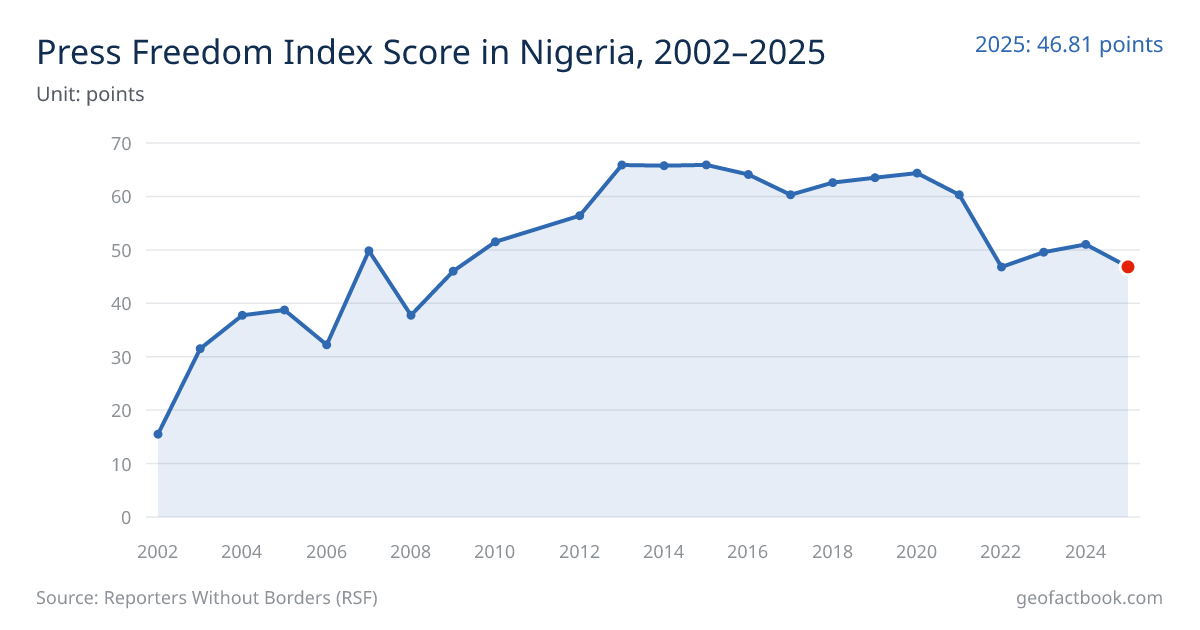
Nigeria's press freedom index score in 2025 is 46.81 points, down 8.3% from 2024. It ranks #120 of 178 countries.
The Press Freedom Index Score measures the level of media freedom in countries worldwide. A higher score indicates stronger press independence, essential for democracy and transparency. Understanding these scores helps highlight the importance of free expression in society.
Where Nigeria ranks (2025)
#120 of 178- #118
 Morocco48.04 points
- #119
 Togo48.03 points
- #120
 Nigeria46.81 points
- #121
 Singapore45.78 points
- #122
 Mexico45.55 points
Press Freedom Index Score over time
| Year | Value | Change | % Change | Actions |
|---|---|---|---|---|
| 2025 | 46.81 points | 4.22 points | -8.27% | |
| 2024 | 51.03 points | +1.47 points | +2.97% | |
| 2023 | 49.56 points | +2.77 points | +5.92% | |
| 2022 | 46.79 points | 13.52 points | -22.42% | |
| 2021 | 60.31 points | 4.06 points | -6.31% | |
| 2020 | 64.37 points | +0.87 points | +1.37% | |
| 2019 | 63.5 points | +0.91 points | +1.45% | |
| 2018 | 62.59 points | +2.28 points | +3.78% | |
| 2017 | 60.31 points | 3.79 points | -5.91% | |
| 2016 | 64.1 points | 1.81 points | -2.75% | |
| 2015 | 65.91 points | +0.15 points | +0.23% | |
| 2014 | 65.76 points | 0.13 points | -0.20% | |
| 2013 | 65.89 points | +9.49 points | +16.83% | |
| 2012 | 56.4 points | +4.9 points | +9.51% | |
| 2010 | 51.5 points | +5.5 points | +11.96% | |
| 2009 | 46 points | +8.25 points | +21.85% | |
| 2008 | 37.75 points | 12.08 points | -24.24% | |
| 2007 | 49.83 points | +17.6 points | +54.61% | |
| 2006 | 32.23 points | 6.52 points | -16.83% | |
| 2005 | 38.75 points | +1 points | +2.65% | |
| 2004 | 37.75 points | +6.25 points | +19.84% | |
| 2003 | 31.5 points | +16 points | +103.23% | |
| 2002 | 15.5 points | — | — |
Press Freedom Index Score in Nigeria, 2002–2025: chart
Cite this page
Geo Factbook. (n.d.). Nigeria: Press Freedom Index Score. Retrieved November 27, 2026, from https://geofactbook.com/countries/nigeria/press-freedom-index-score
The figures on this page come from Reporters Without Borders (RSF). For academic work, cite the original source as well.
Frequently Asked Questions About Nigeria Press Freedom Index Score
What is Nigeria's press freedom index score in 2025?▾
Nigeria's press freedom index score is 46.81 points in 2025, according to Reporters Without Borders (RSF).
Is Nigeria's press freedom index score increasing or decreasing?▾
Nigeria's press freedom index score fell by 8.3% from 2024 (51.03 points) to 2025 (46.81 points). Over the past decade (2015–2025) it fell by 29.0%.
How does Nigeria rank for press freedom index score?▾
In 2025, Nigeria has the 120th highest press freedom index score out of 178 countries with data.
What was Nigeria's press freedom index score in 2002?▾
In 2002, Nigeria's press freedom index score was 15.50 points. By 2025 it rose by 202.0%.
Explore additional statistical insights
Internet Penetration Rate (%) in Nigeria
The Internet Penetration Rate indicates the percentage of the population with internet access, crucial for digital public service access.
Internet Users (% of Population) in Nigeria
Explore Internet Users worldwide, compare usage rates by country, and visualize trends with interactive maps and rankings.
Fixed Broadband Penetration in Nigeria
Fixed broadband penetration indicates the availability and use of high-speed internet connections in households.
Broadband Internet Penetration in Nigeria
Broadband internet penetration measures the percentage of the population with access to high-speed internet.
AI Preparedness Index in Nigeria
The IMF's AI Preparedness Index scores how ready a country is to adopt artificial intelligence, on a scale from 0 to 1 (higher is better prepared). It combines four areas: digital infrastructure, human capital and labour market policies, innovation and economic integration, and regulation and ethics. It measures readiness, not how many jobs AI has replaced or could affect.
R&D Expenditure (% of GDP) in Nigeria
R&D expenditure as a percentage of GDP indicates investment in innovation and technology development across countries.