
Myanmar Beer Consumption per Capita 2022: 0.45 liters
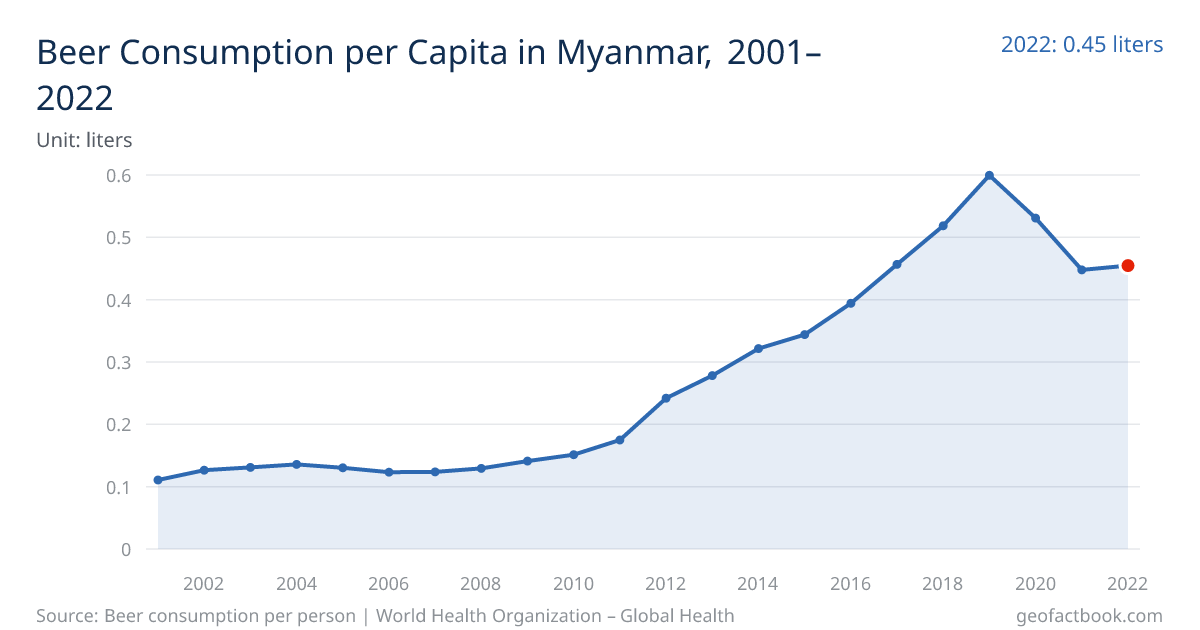
Myanmar's beer consumption per capita in 2022 is 0.45 liters, up 1.6% from 2021. It ranks #139 of 186 countries.
Beer consumption per capita measures the average liters of beer consumed by each person in a country annually.
Source (2022): Beer consumption per person | Our World in Data
Where Myanmar ranks (2022)
#139 of 186- #137
 Lebanon0.47 liters
- #138
 Congo, Democratic Republic of the0.46 liters
- #139
 Myanmar0.45 liters
- #140
 Papua New Guinea0.41 liters
- #141
 Madagascar0.4 liters
Beer Consumption per Capita over time
| Year | Value | Change | % Change | Actions |
|---|---|---|---|---|
| 2022 | 0.45 liters | +0.01 liters | +1.55% | |
| 2021 | 0.45 liters | 0.08 liters | -15.67% | |
| 2020 | 0.53 liters | 0.07 liters | -11.44% | |
| 2019 | 0.6 liters | +0.08 liters | +15.63% | |
| 2018 | 0.52 liters | +0.06 liters | +13.56% | |
| 2017 | 0.46 liters | +0.06 liters | +15.83% | |
| 2016 | 0.39 liters | +0.05 liters | +14.58% | |
| 2015 | 0.34 liters | +0.02 liters | +7.02% | |
| 2014 | 0.32 liters | +0.04 liters | +15.58% | |
| 2013 | 0.28 liters | +0.04 liters | +14.93% | |
| 2012 | 0.24 liters | +0.07 liters | +38.36% | |
| 2011 | 0.17 liters | +0.02 liters | +15.65% | |
| 2010 | 0.15 liters | +0.01 liters | +7.27% | |
| 2009 | 0.14 liters | +0.01 liters | +9.08% | |
| 2008 | 0.13 liters | +0.01 liters | +4.52% | |
| 2007 | 0.12 liters | +0 liters | +0.32% | |
| 2006 | 0.12 liters | 0.01 liters | -5.44% | |
| 2005 | 0.13 liters | 0.01 liters | -3.93% | |
| 2004 | 0.14 liters | +0 liters | +3.67% | |
| 2003 | 0.13 liters | +0 liters | +3.48% | |
| 2002 | 0.13 liters | +0.02 liters | +14.27% | |
| 2001 | 0.11 liters | — | — |
Beer Consumption per Capita in Myanmar, 2001–2022: chart
Cite this page
Geo Factbook. (n.d.). Myanmar: Beer Consumption per Capita. Retrieved November 28, 2026, from https://geofactbook.com/countries/myanmar/beer-consumption-per-capita
The figures on this page come from Beer consumption per person | World Health Organization – Global Health Observatory via Our World in Data. For academic work, cite the original source as well.
Frequently Asked Questions About Myanmar Beer Consumption per Capita
What is Myanmar's beer consumption per capita in 2022?▾
Myanmar's beer consumption per capita is 0.45 liters in 2022, according to Beer consumption per person | World Health Organization – Global Health Observatory via Our World in Data.
Is Myanmar's beer consumption per capita increasing or decreasing?▾
Myanmar's beer consumption per capita rose by 1.6% from 2021 (0.45 liters) to 2022 (0.45 liters). Over the past decade (2012–2022) it rose by 87.9%.
How does Myanmar rank for beer consumption per capita?▾
In 2022, Myanmar has the 139th highest beer consumption per capita out of 186 countries with data.
What was Myanmar's beer consumption per capita in 2001?▾
In 2001, Myanmar's beer consumption per capita was 0.11 liters. By 2022 it rose by 310.7%.
Explore additional statistical insights
Total fertility rate in Myanmar
The total fertility rate measures the average number of children a woman is expected to have during her lifetime, reflecting population growth and demographic trends. Understanding this statistic is crucial for analyzing economic development, healthcare needs, and societal changes across countries.
Female population of reproductive age in Myanmar
The female population of reproductive age is a crucial demographic statistic that influences healthcare, economic growth, and social policies in countries. Understanding this population helps address reproductive health needs and support family planning initiatives.
Physician Density in Myanmar
Physician density measures healthcare access, showing the number of doctors per square kilometer. Compare countries and explore interactive maps.
Old-Age Dependency Ratio in Myanmar
Old-age dependency ratio compares the number of elderly dependents to working-age people, affecting economic sustainability.
Primary School Pupil-Teacher Ratio in Myanmar
Pupil-teacher ratio in primary schools reflects educational quality; lower ratios indicate more personalized attention.
Total demand for family planning (Percent) in Myanmar
Total demand for family planning measures the percentage of individuals seeking access to reproductive health services. Understanding this statistic is crucial for addressing global population growth and improving health outcomes.