
Montenegro Percentage of population by degree of urbanization 2026: 81.97 %
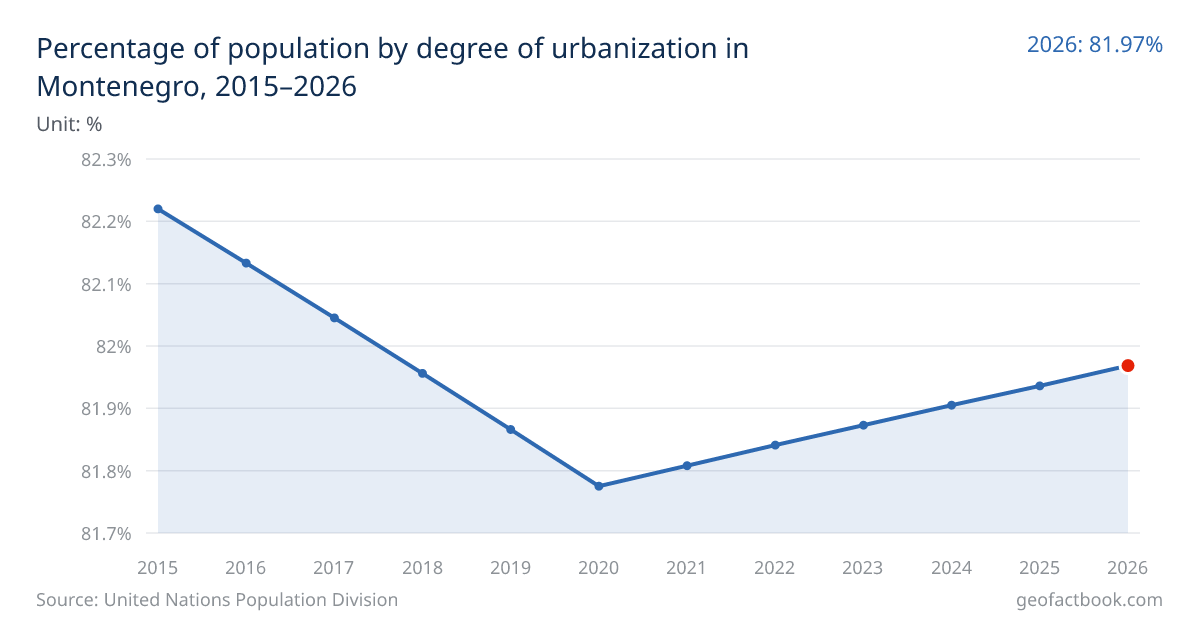
Montenegro's percentage of population by degree of urbanization in 2026 is 81.97 % (estimate), unchanged from 2025. It ranks #79 of 237 countries.
Explore the percentage of population by degree of urbanization across countries, highlighting the shift towards urban living and its impact on economic growth and development. Understanding these trends is crucial for addressing urban planning and resource allocation.
Estimated value for 2026 (interpolated, no direct source).
Where Montenegro ranks (2026)
#79 of 237- #77
 Chile82.37%
- #78
 Nigeria82.04%
- #79
 Montenegro81.97%
- #80
 Australia81.69%
- #81
 Algeria81.25%
Percentage of population by degree of urbanization over timeSome values are estimated based on historical trends
| Year | Value | Change | % Change | Actions |
|---|---|---|---|---|
| 2026 | 81.97 % | +0.03 % | +0.04% | |
| 2025 | 81.94 % | +0.03 % | +0.04% | |
| 2024 | 81.91 % | +0.03 % | +0.04% | |
| 2023 | 81.87 % | +0.03 % | +0.04% | |
| 2022 | 81.84 % | +0.03 % | +0.04% | |
| 2021 | 81.81 % | +0.03 % | +0.04% | |
| 2020 | 81.78 % | 0.09 % | -0.11% | |
| 2019 | 81.87 % | 0.09 % | -0.11% | |
| 2018 | 81.96 % | 0.09 % | -0.11% | |
| 2017 | 82.05 % | 0.09 % | -0.11% | |
| 2016 | 82.13 % | 0.09 % | -0.11% | |
| 2015 | 82.22 % | — | — |
Percentage of population by degree of urbanization in Montenegro, 2015–2026: chart
Cite this page
Geo Factbook. (n.d.). Montenegro: Percentage of population by degree of urbanization. Retrieved November 29, 2026, from https://geofactbook.com/countries/montenegro/percentage-of-population-by-degree-of-urbanization
The figures on this page come from United Nations Population Division. For academic work, cite the original source as well.
Frequently Asked Questions About Montenegro Percentage of population by degree of urbanization
What is Montenegro's percentage of population by degree of urbanization in 2026?▾
Montenegro's percentage of population by degree of urbanization is 81.97 % in 2026 (estimate), according to United Nations Population Division.
Is Montenegro's percentage of population by degree of urbanization increasing or decreasing?▾
Montenegro's percentage of population by degree of urbanization was essentially unchanged from 2025 (81.94 %) to 2026 (81.97 %). Over the past decade (2016–2026) it fell by 0.2%.
How does Montenegro rank for percentage of population by degree of urbanization?▾
In 2026, Montenegro has the 79th highest percentage of population by degree of urbanization out of 237 countries with data.
What was Montenegro's percentage of population by degree of urbanization in 2015?▾
In 2015, Montenegro's percentage of population by degree of urbanization was 82.22 %. By 2026 it fell by 0.3%.
Explore additional statistical insights
Length of paid parental leave for mother in Montenegro
Discover how the length of paid parental leave for mothers varies by country, impacting family well-being and workforce participation. Explore the statistics that highlight this critical social issue.
Major Urban Areas Population in Montenegro
Explore population figures for major urban areas worldwide. Compare cities, view rankings, and interact with detailed maps.
Total demand for family planning (Percent) in Montenegro
Total demand for family planning measures the percentage of individuals seeking access to reproductive health services. Understanding this statistic is crucial for addressing global population growth and improving health outcomes.
Percentage of One-Person Households in Montenegro
Discover which countries have the highest percentage of one-person households, highlighting trends in living arrangements.
Human Development Index in Montenegro
The Human Development Index combines indicators of health, education, and income to assess development levels.
Population living in slums in Montenegro
This statistic measures the percentage of a country's population living in slums, highlighting urban poverty and living conditions. Understanding slum populations is crucial for addressing housing challenges and improving the quality of life.