
Montenegro Labor Force 2025: 296,618
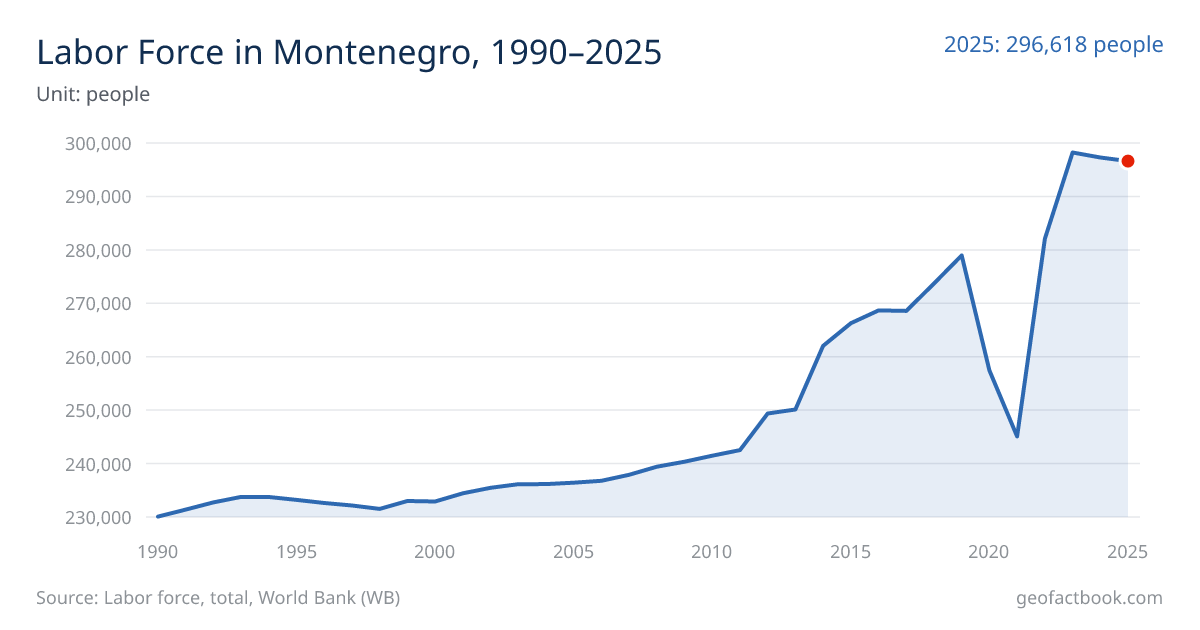
Montenegro's labor force in 2025 is 296,618, down 0.2% from 2024. It ranks #162 of 181 countries.
Labor force participation rate measures the active workforce in each country. Explore rankings, compare nations, and view historical trends.
Source (2025): Labor force, total, World Bank (WB)
Where Montenegro ranks (2025)
#162 of 181- #160
 Malta323,052 people
- #161
 Comoros310,841 people
- #162
 Montenegro296,618 people
- #163
 Maldives272,320 people
- #164
 Djibouti267,610 people
Labor Force over time
| Year | Value | Change | % Change | Actions |
|---|---|---|---|---|
| 2025 | 296.62K people | 666 people | -0.22% | |
| 2024 | 297.28K people | 935 people | -0.31% | |
| 2023 | 298.22K people | +16.14K people | +5.72% | |
| 2022 | 282.08K people | +37.00K people | +15.10% | |
| 2021 | 245.08K people | 12.36K people | -4.80% | |
| 2020 | 257.44K people | 21.53K people | -7.72% | |
| 2019 | 278.97K people | +5.27K people | +1.93% | |
| 2018 | 273.70K people | +5.11K people | +1.90% | |
| 2017 | 268.58K people | 79 people | -0.03% | |
| 2016 | 268.66K people | +2.38K people | +0.90% | |
| 2015 | 266.28K people | +4.26K people | +1.62% | |
| 2014 | 262.02K people | +11.91K people | +4.76% | |
| 2013 | 250.11K people | +747 people | +0.30% | |
| 2012 | 249.37K people | +6.84K people | +2.82% | |
| 2011 | 242.52K people | +1.06K people | +0.44% | |
| 2010 | 241.47K people | +1.11K people | +0.46% | |
| 2009 | 240.35K people | +942 people | +0.39% | |
| 2008 | 239.41K people | +1.51K people | +0.63% | |
| 2007 | 237.90K people | +1.12K people | +0.47% | |
| 2006 | 236.78K people | +371 people | +0.16% | |
| 2005 | 236.41K people | +262 people | +0.11% | |
| 2004 | 236.15K people | +12 people | +0.01% | |
| 2003 | 236.14K people | +680 people | +0.29% | |
| 2002 | 235.46K people | +1.03K people | +0.44% | |
| 2001 | 234.43K people | +1.54K people | +0.66% | |
| 2000 | 232.89K people | 100 people | -0.04% | |
| 1999 | 232.99K people | +1.48K people | +0.64% | |
| 1998 | 231.51K people | 646 people | -0.28% | |
| 1997 | 232.16K people | 466 people | -0.20% | |
| 1996 | 232.62K people | 575 people | -0.25% | |
| 1995 | 233.20K people | 542 people | -0.23% | |
| 1994 | 233.74K people | 29 people | -0.01% | |
| 1993 | 233.77K people | +1.03K people | +0.44% | |
| 1992 | 232.74K people | +1.36K people | +0.59% | |
| 1991 | 231.38K people | +1.31K people | +0.57% | |
| 1990 | 230.07K people | — | — |
Labor Force in Montenegro, 1990–2025: chart
Cite this page
Geo Factbook. (n.d.). Montenegro: Labor Force. Retrieved November 27, 2026, from https://geofactbook.com/countries/montenegro/labor-force
The figures on this page come from Labor force, total, World Bank (WB). For academic work, cite the original source as well.
Frequently Asked Questions About Montenegro Labor Force
What is Montenegro's labor force in 2025?▾
Montenegro's labor force is 296,618 in 2025, according to Labor force, total, World Bank (WB).
Is Montenegro's labor force increasing or decreasing?▾
Montenegro's labor force fell by 0.2% from 2024 (297,284) to 2025 (296,618). Over the past decade (2015–2025) it rose by 11.4%.
How does Montenegro rank for labor force?▾
In 2025, Montenegro has the 162nd highest labor force out of 181 countries with data.
What was Montenegro's labor force in 1990?▾
In 1990, Montenegro's labor force was 230,072. By 2025 it rose by 28.9%.
Explore additional statistical insights
Academic Freedom Index in Montenegro
Explore the Academic Freedom Index measuring educational liberties globally. Compare countries' scores, view rankings, and analyze historical trends.
Length of paid parental leave for mother in Montenegro
Discover how the length of paid parental leave for mothers varies by country, impacting family well-being and workforce participation. Explore the statistics that highlight this critical social issue.
Mean Years of Schooling in Montenegro
Mean Years of Schooling indicates the average number of years of education received by people aged 25 and older.
Female Tertiary Enrollment Rate (%) in Montenegro
This measures the percentage of female students enrolling in tertiary education, reflecting gender parity in higher education globally.
Total demand for family planning (Percent) in Montenegro
Total demand for family planning measures the percentage of individuals seeking access to reproductive health services. Understanding this statistic is crucial for addressing global population growth and improving health outcomes.
Population density in Montenegro
Population density measures how many people live per square kilometer in a country, highlighting urbanization and resource distribution. Understanding this statistic is crucial for assessing living conditions, infrastructure needs, and environmental impact.