
Montenegro Gini Index Coefficient 2025: 34.30
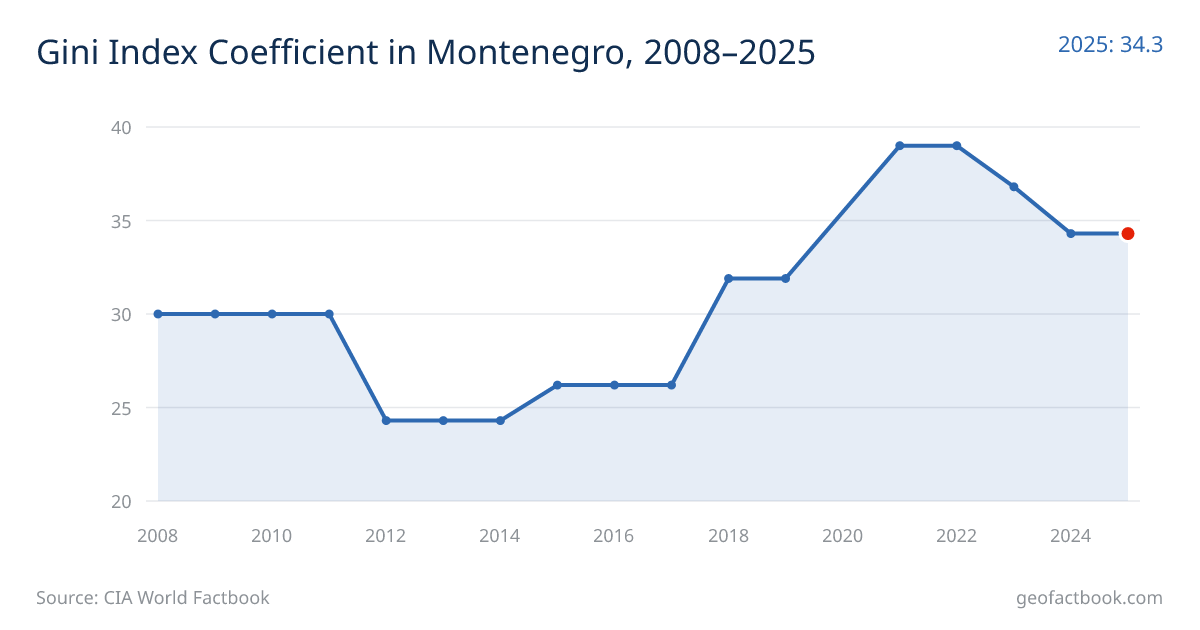
Montenegro's gini index coefficient in 2025 is 34.30, unchanged from 2024. It ranks #78 of 144 countries.
Gini Index measures income inequality within a country. Compare rankings, explore trends, and visualize data on our interactive map.
Where Montenegro ranks (2025)
#78 of 144- #77
 Benin34.4
- #78
 Australia34.3
- #78
 Montenegro34.3
- #80
 Barbados34.1
- #80
 Luxembourg34.1
Gini Index Coefficient over time
| Year | Value | Change | % Change | Actions |
|---|---|---|---|---|
| 2025 | 34.3 | 0 | 0.00% | |
| 2024 | 34.3 | 2.5 | -6.79% | |
| 2023 | 36.8 | 2.2 | -5.64% | |
| 2022 | 39 | 0 | 0.00% | |
| 2021 | 39 | +7.1 | +22.26% | |
| 2019 | 31.9 | 0 | 0.00% | |
| 2018 | 31.9 | +5.7 | +21.76% | |
| 2017 | 26.2 | 0 | 0.00% | |
| 2016 | 26.2 | 0 | 0.00% | |
| 2015 | 26.2 | +1.9 | +7.82% | |
| 2014 | 24.3 | 0 | 0.00% | |
| 2013 | 24.3 | 0 | 0.00% | |
| 2012 | 24.3 | 5.7 | -19.00% | |
| 2011 | 30 | 0 | 0.00% | |
| 2010 | 30 | 0 | 0.00% | |
| 2009 | 30 | 0 | 0.00% | |
| 2008 | 30 | — | — |
Gini Index Coefficient in Montenegro, 2008–2025: chart
Cite this page
Geo Factbook. (n.d.). Montenegro: Gini Index Coefficient. Retrieved November 29, 2026, from https://geofactbook.com/countries/montenegro/gini-index-coefficient-distribution-of-family-income
The figures on this page come from CIA World Factbook. For academic work, cite the original source as well.
Frequently Asked Questions About Montenegro Gini Index Coefficient
What is Montenegro's gini index coefficient in 2025?▾
Montenegro's gini index coefficient is 34.30 in 2025, according to CIA World Factbook.
Is Montenegro's gini index coefficient increasing or decreasing?▾
Montenegro's gini index coefficient was essentially unchanged from 2024 (34.30) to 2025 (34.30). Over the past decade (2015–2025) it rose by 30.9%.
How does Montenegro rank for gini index coefficient?▾
In 2025, Montenegro has the 78th highest gini index coefficient out of 144 countries with data.
What was Montenegro's gini index coefficient in 2008?▾
In 2008, Montenegro's gini index coefficient was 30. By 2025 it rose by 14.3%.
Explore additional statistical insights
ATMs per 100,000 Adults in Montenegro
ATMs per 100,000 adults measures access to banking services; higher values indicate better financial inclusion.
Youth Labor Force Participation Rate in Montenegro
Youth labor force participation measures the percentage of young people actively engaged in the labor market, employed or seeking work.
Population living in slums in Montenegro
This statistic measures the percentage of a country's population living in slums, highlighting urban poverty and living conditions. Understanding slum populations is crucial for addressing housing challenges and improving the quality of life.
Barley Production Volume in Montenegro
Barley production volume measures the total barley output of a country, indicating agricultural capacity and efficiency.
Top FDI Inflows (% of GDP) in Montenegro
Top FDI inflows as a percentage of GDP highlight countries attracting significant foreign investments relative to their economy size.
GNI Per Capita (PPP) in Montenegro
GNI per capita (PPP) shows the average income earned per person, adjusted for purchasing power.