
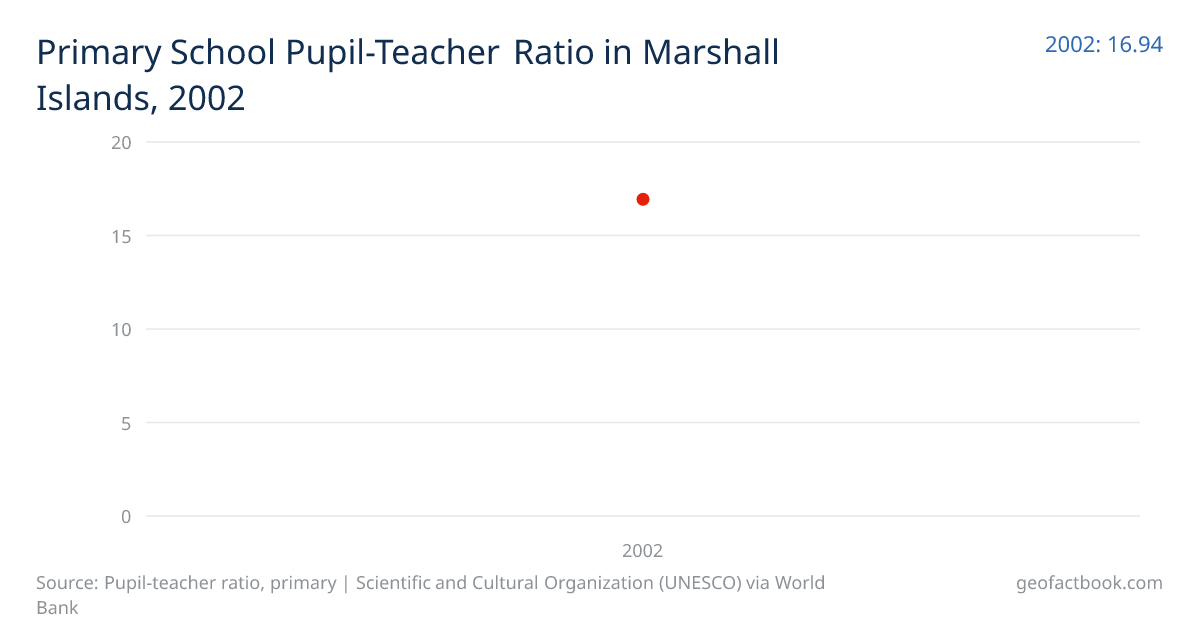
Marshall Islands Primary School Pupil-Teacher Ratio 2002: 16.94
Marshall Islands's primary school pupil-teacher ratio in 2002 is 16.94. It ranks #111 of 142 countries.
Pupil-teacher ratio in primary schools reflects educational quality; lower ratios indicate more personalized attention.
Source (2002): Pupil-teacher ratio, primary
Where Marshall Islands ranks (2002)
#111 of 142- #109
 United Kingdom17.18
- #110
 Russia16.96
- #111
 Marshall Islands16.94
- #112
 Bahamas16.83
- #113
 Bulgaria16.82
Primary School Pupil-Teacher Ratio over time
| Year | Value | Change | % Change | Actions |
|---|---|---|---|---|
| 2002 | 16.94 | — | — |
Primary School Pupil-Teacher Ratio in Marshall Islands, 2002: chart
Cite this page
Geo Factbook. (n.d.). Marshall Islands: Primary School Pupil-Teacher Ratio. Retrieved November 28, 2026, from https://geofactbook.com/countries/marshall-islands/primary-school-pupil-teacher-ratio
The figures on this page come from Pupil-teacher ratio, primary | Scientific and Cultural Organization (UNESCO) via World Bank. For academic work, cite the original source as well.
Frequently Asked Questions About Marshall Islands Primary School Pupil-Teacher Ratio
What is Marshall Islands's primary school pupil-teacher ratio in 2002?▾
Marshall Islands's primary school pupil-teacher ratio is 16.94 in 2002, according to Pupil-teacher ratio, primary | Scientific and Cultural Organization (UNESCO) via World Bank.
How does Marshall Islands rank for primary school pupil-teacher ratio?▾
In 2002, Marshall Islands has the 111th highest primary school pupil-teacher ratio out of 142 countries with data.
Explore additional statistical insights
Egg Consumption per Capita in Marshall Islands
Egg consumption per capita measures the average number of eggs consumed annually by individuals in a country.
Total fertility rate in Marshall Islands
The total fertility rate measures the average number of children a woman is expected to have during her lifetime, reflecting population growth and demographic trends. Understanding this statistic is crucial for analyzing economic development, healthcare needs, and societal changes across countries.
Global Average Sex Ratio at Birth in Marshall Islands
Explore the global average sex ratio at birth, highlighting the natural baseline in different countries.
Fixed Broadband Penetration Rate in Marshall Islands
Fixed broadband penetration rate indicates the proportion of households with broadband access, reflecting connectivity.
Median age of population in Marshall Islands
The median age of a population is a key demographic indicator, reflecting the age distribution within a country. Understanding median age helps assess economic development, healthcare needs, and social dynamics. Countries with a higher median age may face challenges related to aging populations, while younger populations often indicate growth potential.
Population living in slums in Marshall Islands
This statistic measures the percentage of a country's population living in slums, highlighting urban poverty and living conditions. Understanding slum populations is crucial for addressing housing challenges and improving the quality of life.