
Marshall Islands Internet Usage Rate by Country (% of Population) 2023: 65.72 %
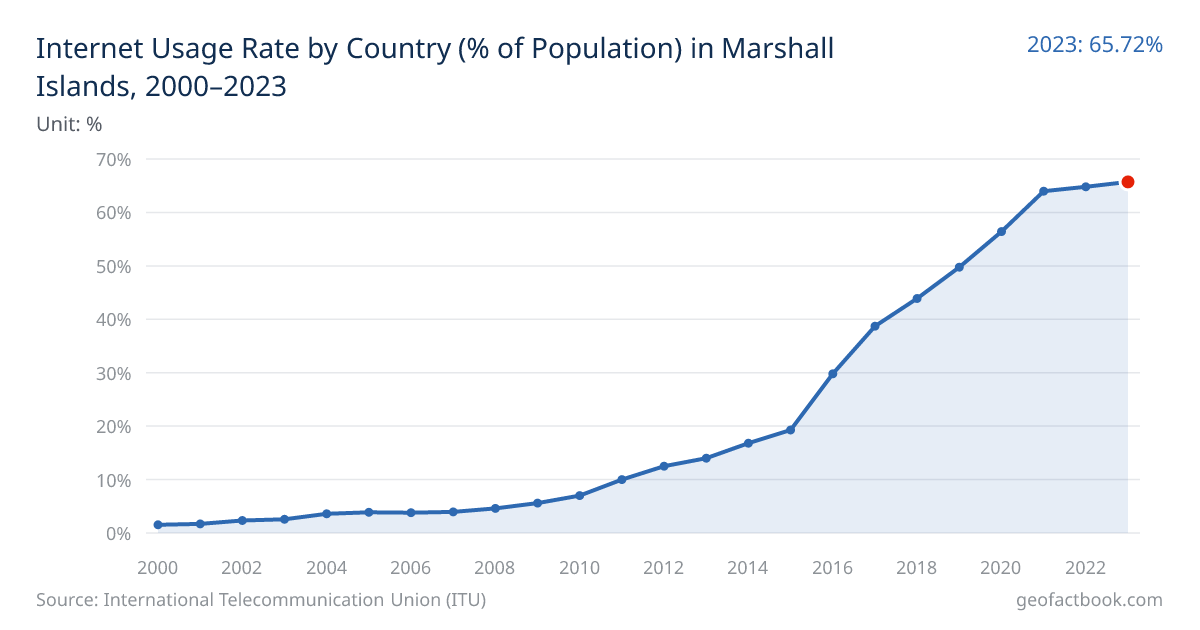
Marshall Islands's internet usage rate by country (% of population) in 2023 is 65.72 %, up 1.4% from 2022.
Discover the internet usage rate by country, showcasing the percentage of the population online. This statistic highlights digital accessibility and connectivity trends globally, emphasizing the importance of internet access in today's world.
More about Marshall Islands
- Annual Scholarly AI Publications#137 of 1581
- Internet Penetration Rate (%)#127 of 18265.92%
- Fixed Broadband Penetration#151 of 2052.35 subscriptions per 100 inhabitants
Internet Usage Rate by Country (% of Population) over time
| Year | Value | Change | % Change | Actions |
|---|---|---|---|---|
| 2024 | — | — | — | |
| 2023 | 65.72 % | +0.92 % | +1.41% | |
| 2022 | 64.8 % | +0.83 % | +1.30% | |
| 2021 | 63.97 % | +7.55 % | +13.39% | |
| 2020 | 56.42 % | +6.66 % | +13.39% | |
| 2019 | 49.76 % | +5.88 % | +13.39% | |
| 2018 | 43.88 % | +5.18 % | +13.39% | |
| 2017 | 38.7 % | +8.91 % | +29.92% | |
| 2016 | 29.79 % | +10.51 % | +54.48% | |
| 2015 | 19.28 % | +2.48 % | +14.78% | |
| 2014 | 16.8 % | +2.8 % | +20.00% | |
| 2013 | 14 % | +1.5 % | +12.00% | |
| 2012 | 12.5 % | +2.5 % | +25.00% | |
| 2011 | 10 % | +3 % | +42.86% | |
| 2010 | 7 % | +1.4 % | +25.00% | |
| 2009 | 5.6 % | +1 % | +21.74% | |
| 2008 | 4.6 % | +0.65 % | +16.46% | |
| 2007 | 3.95 % | +0.15 % | +4.07% | |
| 2006 | 3.8 % | 0.08 % | -2.14% | |
| 2005 | 3.88 % | +0.28 % | +7.75% | |
| 2004 | 3.6 % | +1.03 % | +40.08% | |
| 2003 | 2.57 % | +0.23 % | +10.03% | |
| 2002 | 2.34 % | +0.63 % | +36.85% | |
| 2001 | 1.71 % | +0.17 % | +11.23% | |
| 2000 | 1.53 % | — | — |
Internet Usage Rate by Country (% of Population) in Marshall Islands, 2000–2023: chart
Cite this page
Geo Factbook. (n.d.). Marshall Islands: Internet Usage Rate by Country (% of Population). Retrieved November 29, 2026, from https://geofactbook.com/countries/marshall-islands/internet-usage-rate-by-country-percentage-of-population
The figures on this page come from International Telecommunication Union (ITU). For academic work, cite the original source as well.
Frequently Asked Questions About Marshall Islands Internet Usage Rate by Country (% of Population)
What is Marshall Islands's internet usage rate by country (% of population) in 2023?▾
Marshall Islands's internet usage rate by country (% of population) is 65.72 % in 2023, according to International Telecommunication Union (ITU).
Is Marshall Islands's internet usage rate by country (% of population) increasing or decreasing?▾
Marshall Islands's internet usage rate by country (% of population) rose by 1.4% from 2022 (64.80 %) to 2023 (65.72 %). Over the past decade (2013–2023) it rose by 369.4%.
What was Marshall Islands's internet usage rate by country (% of population) in 2000?▾
In 2000, Marshall Islands's internet usage rate by country (% of population) was 1.53 %. By 2023 it rose by 4183.3%.
Explore additional statistical insights
Broadband Internet Penetration in Marshall Islands
Broadband internet penetration measures the percentage of the population with access to high-speed internet.
Internet Users (% of Population) in Marshall Islands
Explore Internet Users worldwide, compare usage rates by country, and visualize trends with interactive maps and rankings.
Fixed Broadband Penetration Rate in Marshall Islands
Fixed broadband penetration rate indicates the proportion of households with broadband access, reflecting connectivity.
Population Change in Marshall Islands
This statistic measures population change across countries, highlighting shifts in demographics. Understanding these changes is crucial for planning resources, economic growth, and social services.
Protected Land Area for Adaptation in Marshall Islands
Protected land as a climate adaptation strategy ensures biodiversity and resilience against climate impacts.
Female Tertiary Enrollment Rate (%) in Marshall Islands
This measures the percentage of female students enrolling in tertiary education, reflecting gender parity in higher education globally.