
Malaysia Urban Population Share 2050 2025: 77.39 %
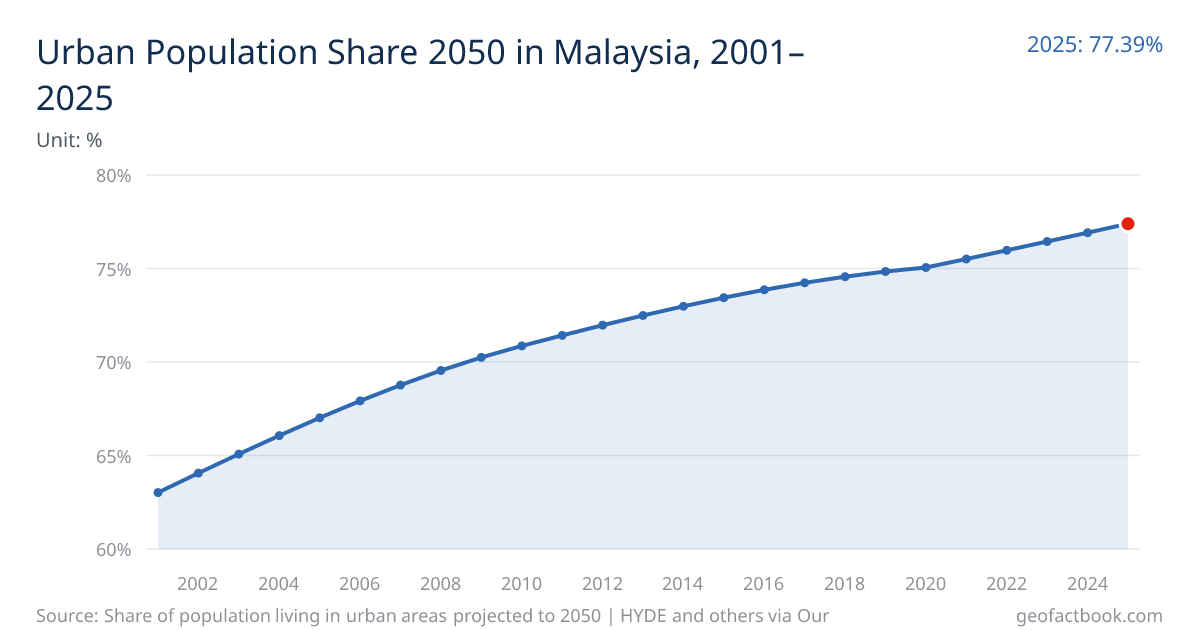
Malaysia's urban population share 2050 in 2025 is 77.39 %, up 0.6% from 2024. It ranks #81 of 236 countries.
Urban population share by 2050 shows urbanization trends. Discover which countries will be most urbanized.
Source (2025): Share of population living in urban areas projected to 2050 | Our World in Data
Where Malaysia ranks (2025)
#81 of 236- #79
 Colombia78.78%
- #80
 Cabo Verde77.63%
- #81
 Malaysia77.39%
- #82
 Iran77.38%
- #83
 Cuba77.23%
Urban Population Share 2050 over time
| Year | Value | Change | % Change | Actions |
|---|---|---|---|---|
| 2025 | 77.39 % | +0.48 % | +0.62% | |
| 2024 | 76.92 % | +0.47 % | +0.62% | |
| 2023 | 76.44 % | +0.47 % | +0.62% | |
| 2022 | 75.97 % | +0.47 % | +0.62% | |
| 2021 | 75.51 % | +0.46 % | +0.61% | |
| 2020 | 75.05 % | +0.21 % | +0.29% | |
| 2019 | 74.84 % | +0.27 % | +0.37% | |
| 2018 | 74.56 % | +0.33 % | +0.44% | |
| 2017 | 74.24 % | +0.38 % | +0.51% | |
| 2016 | 73.86 % | +0.42 % | +0.57% | |
| 2015 | 73.44 % | +0.46 % | +0.63% | |
| 2014 | 72.98 % | +0.49 % | +0.68% | |
| 2013 | 72.49 % | +0.52 % | +0.72% | |
| 2012 | 71.97 % | +0.54 % | +0.76% | |
| 2011 | 71.42 % | +0.56 % | +0.79% | |
| 2010 | 70.86 % | +0.62 % | +0.88% | |
| 2009 | 70.25 % | +0.7 % | +1.01% | |
| 2008 | 69.54 % | +0.78 % | +1.13% | |
| 2007 | 68.76 % | +0.85 % | +1.25% | |
| 2006 | 67.92 % | +0.9 % | +1.35% | |
| 2005 | 67.02 % | +0.95 % | +1.44% | |
| 2004 | 66.06 % | +0.99 % | +1.52% | |
| 2003 | 65.08 % | +1.02 % | +1.59% | |
| 2002 | 64.06 % | +1.04 % | +1.65% | |
| 2001 | 63.02 % | — | — |
Urban Population Share 2050 in Malaysia, 2001–2025: chart
Cite this page
Geo Factbook. (n.d.). Malaysia: Urban Population Share 2050. Retrieved November 29, 2026, from https://geofactbook.com/countries/malaysia/urban-population-share-2050
The figures on this page come from Share of population living in urban areas projected to 2050 | HYDE and others via Our World in Data. For academic work, cite the original source as well.
Frequently Asked Questions About Malaysia Urban Population Share 2050
What is Malaysia's urban population share 2050 in 2025?▾
Malaysia's urban population share 2050 is 77.39 % in 2025, according to Share of population living in urban areas projected to 2050 | HYDE and others via Our World in Data.
Is Malaysia's urban population share 2050 increasing or decreasing?▾
Malaysia's urban population share 2050 rose by 0.6% from 2024 (76.92 %) to 2025 (77.39 %). Over the past decade (2015–2025) it rose by 5.4%.
How does Malaysia rank for urban population share 2050?▾
In 2025, Malaysia has the 81st highest urban population share 2050 out of 236 countries with data.
What was Malaysia's urban population share 2050 in 2001?▾
In 2001, Malaysia's urban population share 2050 was 63.02 %. By 2025 it rose by 22.8%.
Explore additional statistical insights
Total population in Malaysia
Discover the latest total population statistics for every country and region worldwide. Explore accurate, up-to-date data on global population growth, density, and demographic trends — sourced from trusted international databases like the UN and World Bank. Perfect for researchers, students, and data enthusiasts looking to understand how the world’s population is changing.
Population Growth Rate in Malaysia
Explore the Population Growth Rate across 266+ countries. Compare trends, view rankings, and interact with detailed maps.
Under-five mortality rate in Malaysia
The under-five mortality rate measures the number of deaths per 1,000 live births for children under five. This critical statistic highlights child health and development, reflecting a country's healthcare quality and socioeconomic conditions. Understanding these rates is vital for improving global health initiatives.
Primary School Pupil-Teacher Ratio in Malaysia
Pupil-teacher ratio in primary schools reflects educational quality; lower ratios indicate more personalized attention.
Learning-adjusted years of school in Malaysia
Learning-adjusted years of school measures educational quality by accounting for both enrollment and learning outcomes. This statistic highlights the effectiveness of education systems across countries, emphasizing the need for improved learning environments.
Education Expenditure (% of GDP) in Malaysia
Education expenditure measures the percentage of GDP spent on education. Compare countries and explore interactive rankings and trends.