
Malawi Mean Years of Schooling 2023: 5.24 years
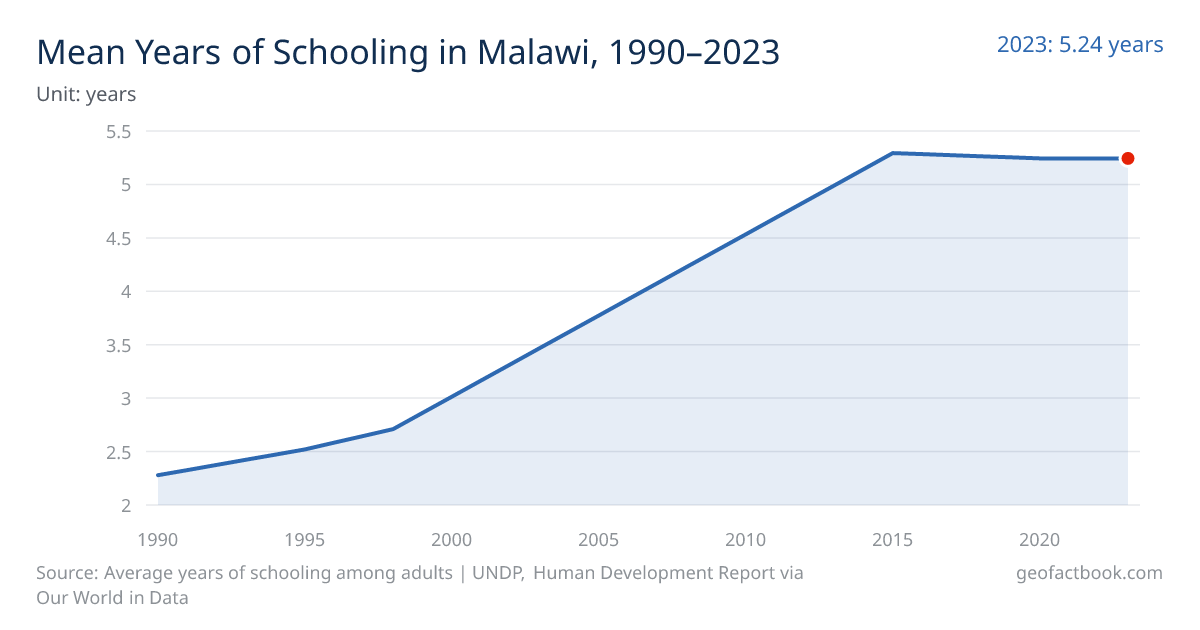
Malawi's mean years of schooling in 2023 is 5.24 years, unchanged from 2022. It ranks #166 of 193 countries.
Mean Years of Schooling indicates the average number of years of education received by people aged 25 and older.
Source (2023): Average years of schooling (UNDP) | Our World in Data
Where Malawi ranks (2023)
#166 of 193- #164
 Yemen5.48 years
- #165
 Haiti5.38 years
- #166
 Malawi5.24 years
- #167
 Cambodia5.2 years
- #168
 Eritrea5.09 years
Mean Years of Schooling over time
| Year | Value | Change | % Change | Actions |
|---|---|---|---|---|
| 2023 | 5.24 years | 0 years | 0.00% | |
| 2022 | 5.24 years | 0 years | 0.00% | |
| 2021 | 5.24 years | 0 years | 0.00% | |
| 2020 | 5.24 years | 0.01 years | -0.19% | |
| 2019 | 5.25 years | 0.01 years | -0.19% | |
| 2018 | 5.26 years | 0.01 years | -0.19% | |
| 2017 | 5.27 years | 0.01 years | -0.19% | |
| 2016 | 5.28 years | 0.01 years | -0.19% | |
| 2015 | 5.29 years | +0.15 years | +2.96% | |
| 2014 | 5.14 years | +0.15 years | +3.05% | |
| 2013 | 4.99 years | +0.15 years | +3.14% | |
| 2012 | 4.84 years | +0.15 years | +3.24% | |
| 2011 | 4.69 years | +0.15 years | +3.35% | |
| 2010 | 4.53 years | +0.15 years | +3.47% | |
| 2009 | 4.38 years | +0.15 years | +3.59% | |
| 2008 | 4.23 years | +0.15 years | +3.73% | |
| 2007 | 4.08 years | +0.15 years | +3.87% | |
| 2006 | 3.93 years | +0.15 years | +4.03% | |
| 2005 | 3.77 years | +0.15 years | +4.20% | |
| 2004 | 3.62 years | +0.15 years | +4.38% | |
| 2003 | 3.47 years | +0.15 years | +4.58% | |
| 2002 | 3.32 years | +0.15 years | +4.80% | |
| 2001 | 3.17 years | +0.15 years | +5.04% | |
| 2000 | 3.01 years | +0.15 years | +5.31% | |
| 1999 | 2.86 years | +0.15 years | +5.61% | |
| 1998 | 2.71 years | +0.06 years | +2.39% | |
| 1997 | 2.65 years | +0.06 years | +2.45% | |
| 1996 | 2.58 years | +0.06 years | +2.51% | |
| 1995 | 2.52 years | +0.05 years | +1.96% | |
| 1994 | 2.47 years | +0.05 years | +2.00% | |
| 1993 | 2.42 years | +0.05 years | +2.04% | |
| 1992 | 2.38 years | +0.05 years | +2.08% | |
| 1991 | 2.33 years | +0.05 years | +2.12% | |
| 1990 | 2.28 years | — | — |
Mean Years of Schooling in Malawi, 1990–2023: chart
Cite this page
Geo Factbook. (n.d.). Malawi: Mean Years of Schooling. Retrieved November 27, 2026, from https://geofactbook.com/countries/malawi/mean-years-of-schooling
The figures on this page come from Average years of schooling among adults | UNDP, Human Development Report via Our World in Data. For academic work, cite the original source as well.
Frequently Asked Questions About Malawi Mean Years of Schooling
What is Malawi's mean years of schooling in 2023?▾
Malawi's mean years of schooling is 5.24 years in 2023, according to Average years of schooling among adults | UNDP, Human Development Report via Our World in Data.
Is Malawi's mean years of schooling increasing or decreasing?▾
Malawi's mean years of schooling was essentially unchanged from 2022 (5.24 years) to 2023 (5.24 years). Over the past decade (2013–2023) it rose by 5.1%.
How does Malawi rank for mean years of schooling?▾
In 2023, Malawi has the 166th highest mean years of schooling out of 193 countries with data.
What was Malawi's mean years of schooling in 1990?▾
In 1990, Malawi's mean years of schooling was 2.28 years. By 2023 it rose by 130.1%.
Explore additional statistical insights
Egg Consumption per Capita in Malawi
Egg consumption per capita measures the average number of eggs consumed annually by individuals in a country.
Percentage of One-Person Households in Malawi
Discover which countries have the highest percentage of one-person households, highlighting trends in living arrangements.
Crude Birth Rate in Malawi
Crude birth rate measures births per 1,000 people. Identify regions with high or low birth rates globally.
Milk Consumption per Capita in Malawi
Milk consumption per capita indicates dietary habits and dairy dependence across countries.
Population living in slums in Malawi
This statistic measures the percentage of a country's population living in slums, highlighting urban poverty and living conditions. Understanding slum populations is crucial for addressing housing challenges and improving the quality of life.
Human Capital Index in Malawi
The Human Capital Index measures a country's investment in education and health, reflecting its potential for economic growth and productivity. This vital statistic highlights the importance of nurturing human resources for sustainable development.