
Malawi Fertilizer Use Per Hectare 2024: 36.56 kg/ha
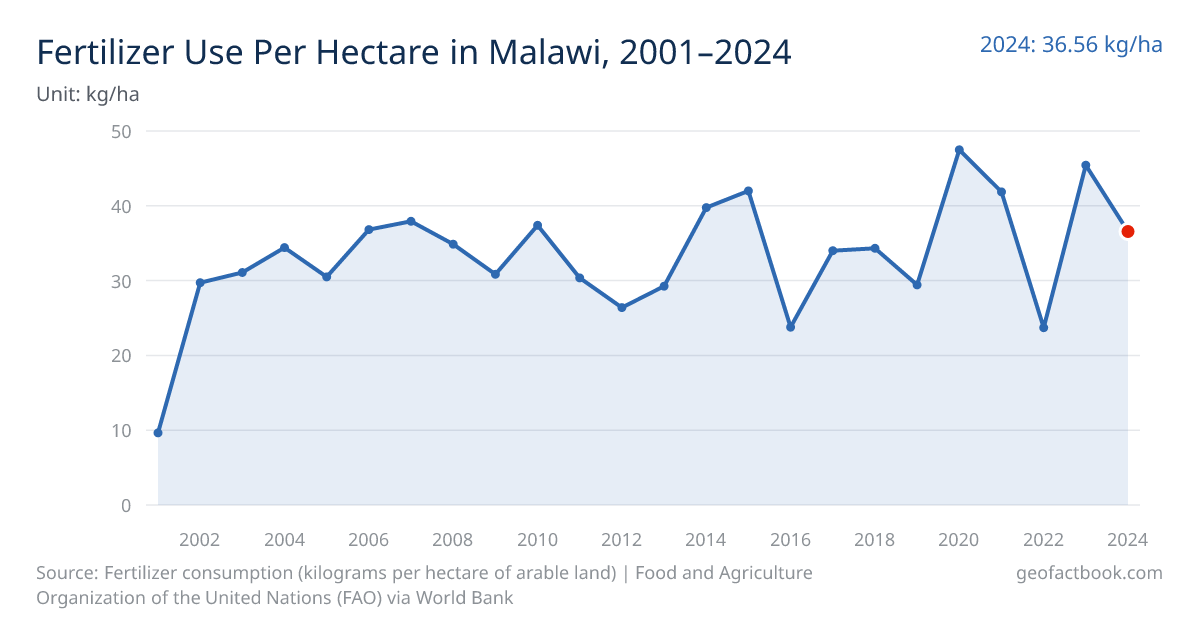
Malawi's fertilizer use per hectare in 2024 is 36.56 kg/ha, down 19.5% from 2023. It ranks #128 of 189 countries.
Fertilizer use per hectare shows how much fertilizer is applied to agricultural land in different countries, impacting crop yield.
Source (2024): Fertilizer use per hectare
Where Malawi ranks (2024)
#128 of 189- #126
 Ukraine41.74 kg/ha
- #127
 Armenia41.2 kg/ha
- #128
 Malawi36.56 kg/ha
- #129
 Libya34.55 kg/ha
- #130
 Barbados32.29 kg/ha
Fertilizer Use Per Hectare over time
| Year | Value | Change | % Change | Actions |
|---|---|---|---|---|
| 2024 | 36.56 kg/ha | 8.87 kg/ha | -19.52% | |
| 2023 | 45.43 kg/ha | +21.72 kg/ha | +91.62% | |
| 2022 | 23.71 kg/ha | 18.15 kg/ha | -43.36% | |
| 2021 | 41.86 kg/ha | 5.63 kg/ha | -11.85% | |
| 2020 | 47.49 kg/ha | +18.06 kg/ha | +61.38% | |
| 2019 | 29.43 kg/ha | 4.89 kg/ha | -14.25% | |
| 2018 | 34.32 kg/ha | +0.32 kg/ha | +0.95% | |
| 2017 | 33.99 kg/ha | +10.22 kg/ha | +43.02% | |
| 2016 | 23.77 kg/ha | 18.23 kg/ha | -43.41% | |
| 2015 | 42 kg/ha | +2.23 kg/ha | +5.62% | |
| 2014 | 39.76 kg/ha | +10.51 kg/ha | +35.91% | |
| 2013 | 29.26 kg/ha | +2.86 kg/ha | +10.84% | |
| 2012 | 26.4 kg/ha | 3.97 kg/ha | -13.07% | |
| 2011 | 30.37 kg/ha | 7.03 kg/ha | -18.80% | |
| 2010 | 37.4 kg/ha | +6.55 kg/ha | +21.24% | |
| 2009 | 30.85 kg/ha | 4.02 kg/ha | -11.54% | |
| 2008 | 34.87 kg/ha | 3.06 kg/ha | -8.06% | |
| 2007 | 37.93 kg/ha | +1.1 kg/ha | +2.99% | |
| 2006 | 36.82 kg/ha | +6.33 kg/ha | +20.77% | |
| 2005 | 30.49 kg/ha | 3.91 kg/ha | -11.38% | |
| 2004 | 34.41 kg/ha | +3.33 kg/ha | +10.71% | |
| 2003 | 31.08 kg/ha | +1.36 kg/ha | +4.59% | |
| 2002 | 29.71 kg/ha | +20.07 kg/ha | +208.14% | |
| 2001 | 9.64 kg/ha | — | — |
Fertilizer Use Per Hectare in Malawi, 2001–2024: chart
Cite this page
Geo Factbook. (n.d.). Malawi: Fertilizer Use Per Hectare. Retrieved November 27, 2026, from https://geofactbook.com/countries/malawi/fertilizer-use-per-hectare
The figures on this page come from Fertilizer consumption (kilograms per hectare of arable land) | Food and Agriculture Organization of the United Nations (FAO) via World Bank. For academic work, cite the original source as well.
Frequently Asked Questions About Malawi Fertilizer Use Per Hectare
What is Malawi's fertilizer use per hectare in 2024?▾
Malawi's fertilizer use per hectare is 36.56 kg/ha in 2024, according to Fertilizer consumption (kilograms per hectare of arable land) | Food and Agriculture Organization of the United Nations (FAO) via World Bank.
Is Malawi's fertilizer use per hectare increasing or decreasing?▾
Malawi's fertilizer use per hectare fell by 19.5% from 2023 (45.43 kg/ha) to 2024 (36.56 kg/ha). Over the past decade (2014–2024) it fell by 8.1%.
How does Malawi rank for fertilizer use per hectare?▾
In 2024, Malawi has the 128th highest fertilizer use per hectare out of 189 countries with data.
What was Malawi's fertilizer use per hectare in 2001?▾
In 2001, Malawi's fertilizer use per hectare was 9.64 kg/ha. By 2024 it rose by 279.2%.
Explore additional statistical insights
Electricity from Hydroelectric Plants in Malawi
Electricity from hydroelectric plants shows renewable energy production. Explore country rankings, compare data, and view interactive maps.
Refined Petroleum Products Imports in Malawi
Refined petroleum products imports indicate a country's energy demand. Explore rankings, compare nations, and view interactive maps.
Threatened Bird Species Count in Malawi
Threatened bird species count measures the number of bird species at risk of extinction in each country.
Access to Clean Cooking Fuels in Malawi
Explore the percentage of households with access to clean cooking fuels and technologies in various countries worldwide.
Total Renewable Groundwater Resources by Country in Malawi
Total renewable groundwater represents the combined volume of internally generated and externally sourced groundwater that is naturally replenished and available for use.
Protected Land Area for Adaptation in Malawi
Protected land as a climate adaptation strategy ensures biodiversity and resilience against climate impacts.