
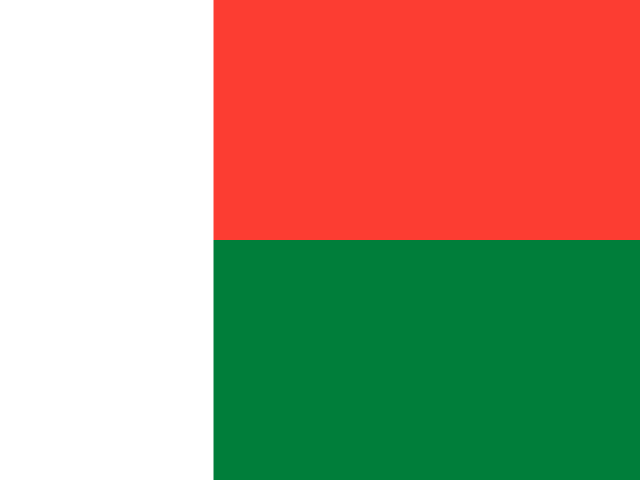
Location
Madagascar is in Southern Africa, island in the Indian Ocean, east of Mozambique. It has no land borders and has 4,828 km of coastline. The capital is Antananarivo.
Madagascar population 2026: 33.52 Million — growth, rank & history →Key Statistics for 2026
Total population
Population Change
Median age of population
Population density
Life expectancy at birth
Agricultural land
Apple Import Volume
Average Female Breast Size by Country: Worldwide Data & Rankings
Dam capacity per capita
Female population of reproductive age
Health Care Spending per Capita
History
Madagascar's history is marked by a unique blend of influences from Africa, Asia, and Europe, beginning with its early settlement around 200 BC. The island was first inhabited by Austronesian peoples, who are believed to have arrived from Southeast Asia and brought with them agricultural practices and the domestication of animals. This early population laid the foundation for the diverse ethnic groups that would later emerge, including the Merina, Betsimisaraka, and Sakalava. The indigenous Malagasy culture developed distinct languages, social structures, and traditions, setting Madagascar apart from mainland Africa.
During the medieval period, specifically from the 15th to the 19th centuries, Madagascar witnessed significant political and economic developments. The rise of powerful kingdoms, particularly the Merina Kingdom in the central highlands, transformed the political landscape. The Merina, under leaders such as King Andrianampoinimerina, expanded their territory through military conquests and alliances, establishing a centralized state. This era also saw the establishment of trade networks with Arab, Indian, and European merchants, facilitating the exchange of goods like spices, textiles, and slaves, which greatly influenced the island's economy.
The modern history of Madagascar was significantly shaped by European colonization. In 1896, Madagascar became a French colony, leading to profound social and economic changes. The colonial period was marked by resistance and uprisings, most notably the *Menalamba Rebellion* in the early 1900s, which sought to reclaim sovereignty. Following World War II, nationalist movements gained momentum, culminating in Madagascar's independence from France in 1960. The post-independence era was characterized by political instability, including a series of coups and changes in government, as well as social unrest.
In recent decades, Madagascar has continued to grapple with political challenges, including a coup in 2009 that led to international isolation and economic difficulties. Nevertheless, the island has also garnered attention for its rich biodiversity and unique ecosystems, which are under threat from deforestation and climate change. The country’s historical significance lies not only in its distinct cultural heritage but also in its ongoing struggle for political stability and environmental conservation, making it a focal point for both regional and global discussions in the 21st century.
Geography
Madagascar is an island nation located off the southeastern coast of Africa in the Indian Ocean. It is the fourth largest island in the world, covering approximately 587,041 square kilometers (226,658 square miles). The country is separated from the African mainland by the Mozambique Channel, which is about 400 kilometers (250 miles) wide at its narrowest point. Madagascar shares maritime borders with several island nations, including Comoros to the northwest and Mauritius to the east. Its unique geographical position contributes to its rich biodiversity and distinct ecosystems.
The island's topography is characterized by a central highland region that rises to an altitude of over 2,800 meters (9,186 feet) at Maromokotro, the highest peak in the Tsaratanana Massif. Surrounding these highlands are coastal lowlands, which are generally hot and humid. The terrain includes a variety of landscapes, from rainforests in the east, where the majority of the country’s rivers such as the Onive and the Mangoky originate, to dry deciduous forests in the west. The diverse geography of Madagascar supports a range of climates, influenced by its elevation and proximity to the ocean.
Madagascar experiences a tropical climate, with a distinct wet and dry season. The rainy season typically runs from November to April, bringing heavy rainfall to the eastern rainforests, while the western regions experience a drier climate. Average temperatures vary considerably depending on the region and altitude, with coastal areas averaging around 25°C (77°F) and the highlands being cooler, especially during the winter months. Tropical cyclones frequently impact the island, particularly during the rainy season, resulting in significant weather variability.
The island is rich in natural resources, including precious minerals, gemstones, and timber. Madagascar is known for its unique flora and fauna, with approximately 90% of its wildlife being endemic, meaning they are found nowhere else on Earth. However, the country faces numerous environmental challenges, including deforestation, habitat destruction, and biodiversity loss. Conservation efforts are ongoing to protect Madagascar's unique ecosystems, which play a crucial role in the global environment and contribute to the livelihoods of local communities.
Government
Madagascar operates under a semi-presidential republic framework, combining elements of both presidential and parliamentary systems. The President of Madagascar serves as both the head of state and the commander-in-chief of the armed forces, while the Prime Minister, appointed by the President, acts as the head of government. This dual executive structure allows for a division of responsibilities, with the President primarily focusing on national issues and the Prime Minister managing the day-to-day affairs of the government.
The governmental structure is composed of three main branches: the executive, legislative, and judicial. The executive branch is led by the President and the Prime Minister, supported by a Council of Ministers. The legislative branch, known as the National Assembly, consists of 151 members elected for five-year terms, alongside a Senate comprising 50 members, of which 34 are elected and 16 appointed. This bicameral legislature is responsible for enacting laws and approving the national budget. The judicial branch is independent and includes a Supreme Court and various lower courts, tasked with interpreting laws and ensuring justice.
Key institutions within the government of Madagascar include the Presidency, the Prime Minister's Office, and the National Assembly, each playing a crucial role in maintaining the balance of power. The current political landscape has been shaped by a history of instability and multiple transitions between democratic and authoritarian rule. Since the end of a political crisis in 2014, Madagascar has seen a gradual restoration of democratic governance, though challenges remain in terms of political cohesion and public trust in institutions.
The electoral system in Madagascar is characterized by a mixed approach, employing both direct and indirect voting methods. Presidential elections are held every five years, with the last election occurring in November 2018, leading to the re-election of President Andry Rajoelina. Legislative elections also take place every five years, and the political landscape is marked by a multitude of parties, with coalitions often forming to gain a majority in the National Assembly. This dynamic political environment reflects the diverse interests of Madagascar's population while emphasizing the ongoing need for political reform and stability.
Economy
Madagascar operates under a mixed economic system that blends elements of both market and command economies. As of 2023, the country has a Gross Domestic Product (GDP) of approximately $14.5 billion, with a GDP per capita of around $500. The economy is largely informal, with a significant portion of the workforce engaged in subsistence farming and small-scale trading. Additionally, Madagascar's economic growth has been hampered by political instability and challenges in governance, yet it has shown resilience with an average growth rate of about 4% per year over the last decade.
The major industries in Madagascar include agriculture, mining, and tourism. Agriculture is the backbone of the economy, employing over 70% of the population and contributing significantly to the GDP. Key agricultural products include rice, vanilla, cloves, and coffee, with Madagascar being one of the world's leading producers of high-quality vanilla. The mining sector, particularly in minerals like nickel, cobalt, and ilmenite, presents substantial opportunities for export and foreign investment. Tourism, characterized by the country's unique biodiversity and cultural heritage, has also become a vital economic driver, attracting visitors to its national parks and nature reserves.
In terms of trade relationships, Madagascar has established connections with various countries and regions. Its primary trading partners include France, China, and the United States. The country's exports are largely dominated by agricultural products, textiles, and minerals, while imports consist mainly of consumer goods, machinery, and fuel. The trade balance has been historically negative, contributing to a reliance on foreign aid and external financing to support economic growth and development initiatives.
Despite its potential, Madagascar faces numerous economic challenges, including infrastructure deficits, political instability, and vulnerability to climate change. The country is prone to natural disasters such as cyclones and droughts, which can adversely impact agriculture and food security. However, opportunities exist in sustainable tourism development, eco-friendly agricultural practices, and the enhancement of the mining sector. With strategic investment and effective governance, Madagascar could harness its rich natural resources and improve its economic standing in the global market.
Culture
Madagascar is a nation rich in cultural diversity, with its population primarily composed of various ethnic groups, including the Merina, Betsimisaraka, and Betsileo, among others. The island's official languages are Malagasy and French, reflecting its colonial history and indigenous roots. Malagasy, a member of the Austronesian language family, varies significantly in dialects across regions. In religious practices, the majority of the population adheres to traditional beliefs, often intertwined with Christianity, leading to a unique spiritual landscape where ancestral veneration plays a significant role.
In Madagascar, cultural traditions and customs are deeply rooted in the Malagasy way of life. One notable custom is the famadihana, or the "turning of the bones," which involves exhuming and rewrapping the remains of ancestors to celebrate their memory. This ritual illustrates the strong connection between the living and their ancestors, showcasing the importance of family and heritage in Malagasy culture. Other customs include intricate ceremonies for birth, marriage, and death, often accompanied by music, dance, and storytelling that pass down history and values through generations.
The arts in Madagascar manifest through vibrant music, dance, and literature, reflecting its cultural heritage. Traditional music includes the use of instruments such as the valiha (a bamboo tube zither) and the marovany (a box zither), which are often featured in celebratory events and ceremonies. Additionally, the country's literature, both oral and written, encompasses a rich tapestry of folktales, proverbs, and contemporary works that explore themes of identity and social issues. The annual Hira Gasy festival showcases traditional performances, combining storytelling, music, and dance, which are integral to the island's cultural expression.
Madagascar's cuisine is as diverse as its culture, with a focus on rice, which is a staple in daily meals. The Malagasy diet includes a range of ingredients such as zebu (a type of cattle), seafood, and a variety of fruits and vegetables. Signature dishes like romazava (a meat and vegetable stew) and ravitoto (pork with cassava leaves) highlight local flavors and culinary techniques. Daily life in Madagascar often revolves around communal activities such as farming, fishing, and engaging in local markets, where vibrant colors and aromas reflect the island's agricultural bounty. The blend of tradition and modernity in Madagascar creates a unique cultural landscape that continues to thrive amidst globalization.
About This Data
This page displays comprehensive statistical data for Madagascar for the year 2026. All data points are sourced from authoritative international organizations and are regularly updated to ensure accuracy and reliability.
Click on any statistic to explore more detailed information, see how Madagascar compares with other countries, and view historical trends.
Primary Data Sources
CIA World Factbook
Comprehensive country profiles and demographic statistics from the Central Intelligence Agency
Learn moreUnited Nations Statistics
Global demographic data and population projections from UN agencies and research divisions
Learn moreWorld Bank Open Data
Development indicators and comprehensive population metrics from the World Bank database
Learn moreCompare Madagascar with other countries
Side-by-side comparisons across population, GDP, geography, and more.
Frequently Asked Questions About Madagascar
Which continent is Madagascar in?▾
Madagascar is in Africa, in the Eastern Africa subregion according to the UN geoscheme.
What is the population of Madagascar in 2026?▾
The population of Madagascar in 2026 is approximately 33,516,400 persons.
What is the GDP of Madagascar?▾
The GDP of Madagascar is 19,305,778,316.12 US dollars.
What is the life expectancy in Madagascar?▾
The life expectancy at birth in Madagascar is 66.35 years.
What is the total fertility rate in Madagascar?▾
The total fertility rate in Madagascar is 3.78 children per woman.
What percentage of Madagascar's population lives in urban areas?▾
Approximately 45.35% of Madagascar's population lives in urban areas.
What is the capital of Madagascar?▾
The capital of Madagascar is Antananarivo.