
Lower-middle-income countries Internet Usage Rate by Country (% of Population) 2023: 57.92 %
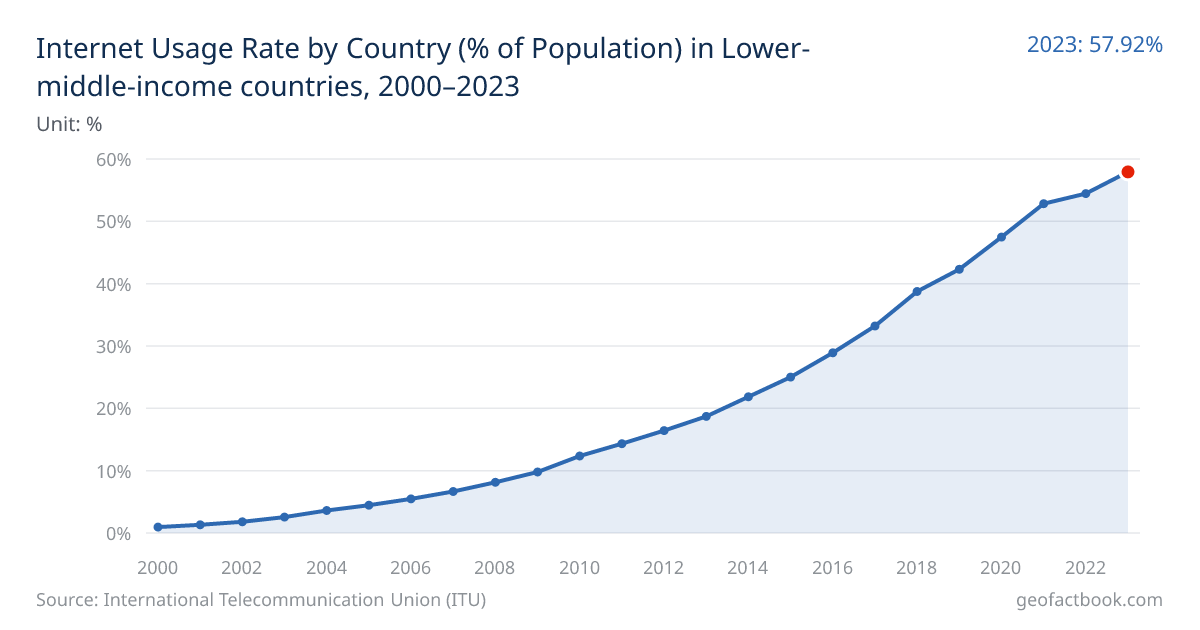
Lower-middle-income countries's internet usage rate by country (% of population) in 2023 is 57.92 %, up 6.4% from 2022.
Discover the internet usage rate by country, showcasing the percentage of the population online. This statistic highlights digital accessibility and connectivity trends globally, emphasizing the importance of internet access in today's world.
Internet Usage Rate by Country (% of Population) over time
| Year | Value | Change | % Change | Actions |
|---|---|---|---|---|
| 2024 | — | — | — | |
| 2023 | 57.92 % | +3.47 % | +6.38% | |
| 2022 | 54.45 % | +1.62 % | +3.07% | |
| 2021 | 52.83 % | +5.36 % | +11.28% | |
| 2020 | 47.47 % | +5.16 % | +12.19% | |
| 2019 | 42.31 % | +3.56 % | +9.19% | |
| 2018 | 38.75 % | +5.54 % | +16.68% | |
| 2017 | 33.21 % | +4.31 % | +14.90% | |
| 2016 | 28.9 % | +3.89 % | +15.56% | |
| 2015 | 25.01 % | +3.17 % | +14.50% | |
| 2014 | 21.84 % | +3.13 % | +16.74% | |
| 2013 | 18.71 % | +2.28 % | +13.85% | |
| 2012 | 16.44 % | +2.1 % | +14.67% | |
| 2011 | 14.33 % | +1.98 % | +16.06% | |
| 2010 | 12.35 % | +2.57 % | +26.23% | |
| 2009 | 9.78 % | +1.65 % | +20.32% | |
| 2008 | 8.13 % | +1.48 % | +22.27% | |
| 2007 | 6.65 % | +1.19 % | +21.71% | |
| 2006 | 5.46 % | +1 % | +22.31% | |
| 2005 | 4.47 % | +0.86 % | +23.91% | |
| 2004 | 3.61 % | +1.05 % | +41.20% | |
| 2003 | 2.55 % | +0.76 % | +42.30% | |
| 2002 | 1.79 % | +0.48 % | +36.31% | |
| 2001 | 1.32 % | +0.36 % | +37.95% | |
| 2000 | 0.95 % | — | — |
Internet Usage Rate by Country (% of Population) in Lower-middle-income countries, 2000–2023: chart
Cite this page
Geo Factbook. (n.d.). Lower-middle-income countries: Internet Usage Rate by Country (% of Population). Retrieved November 29, 2026, from https://geofactbook.com/countries/lower-middle-income-countries/internet-usage-rate-by-country-percentage-of-population
The figures on this page come from International Telecommunication Union (ITU). For academic work, cite the original source as well.
Frequently Asked Questions About Lower-middle-income countries Internet Usage Rate by Country (% of Population)
What is Lower-middle-income countries's internet usage rate by country (% of population) in 2023?▾
Lower-middle-income countries's internet usage rate by country (% of population) is 57.92 % in 2023, according to International Telecommunication Union (ITU).
Is Lower-middle-income countries's internet usage rate by country (% of population) increasing or decreasing?▾
Lower-middle-income countries's internet usage rate by country (% of population) rose by 6.4% from 2022 (54.45 %) to 2023 (57.92 %). Over the past decade (2013–2023) it rose by 209.5%.
What was Lower-middle-income countries's internet usage rate by country (% of population) in 2000?▾
In 2000, Lower-middle-income countries's internet usage rate by country (% of population) was 0.95 %. By 2023 it rose by 5969.9%.
Explore additional statistical insights
Percentage of land area by degree of urbanization in Lower-middle-income countries
Explore the percentage of land area by degree of urbanization, highlighting how urban development shapes countries' landscapes and influences economic growth. Understanding this statistic reveals the balance between urban and rural spaces, essential for sustainable planning.
Total fertility rate in Lower-middle-income countries
The total fertility rate measures the average number of children a woman is expected to have during her lifetime, reflecting population growth and demographic trends. Understanding this statistic is crucial for analyzing economic development, healthcare needs, and societal changes across countries.
Total deaths in Lower-middle-income countries
Total deaths in countries measure the number of individuals who have passed away within a specific timeframe. This statistic is crucial for understanding health trends, mortality rates, and the impact of various factors on population dynamics.
Currently married (Percent) in Lower-middle-income countries
The percentage of currently married individuals by country highlights societal trends in family structure and relationships. Understanding these statistics can provide insights into cultural norms and demographic shifts, influencing policies and social programs.
Under-five mortality rate in Lower-middle-income countries
The under-five mortality rate measures the number of deaths per 1,000 live births for children under five. This critical statistic highlights child health and development, reflecting a country's healthcare quality and socioeconomic conditions. Understanding these rates is vital for improving global health initiatives.
Total demand for family planning (Percent) in Lower-middle-income countries
Total demand for family planning measures the percentage of individuals seeking access to reproductive health services. Understanding this statistic is crucial for addressing global population growth and improving health outcomes.