
Lower-middle-income countries Human Capital Index 2026: 0.50
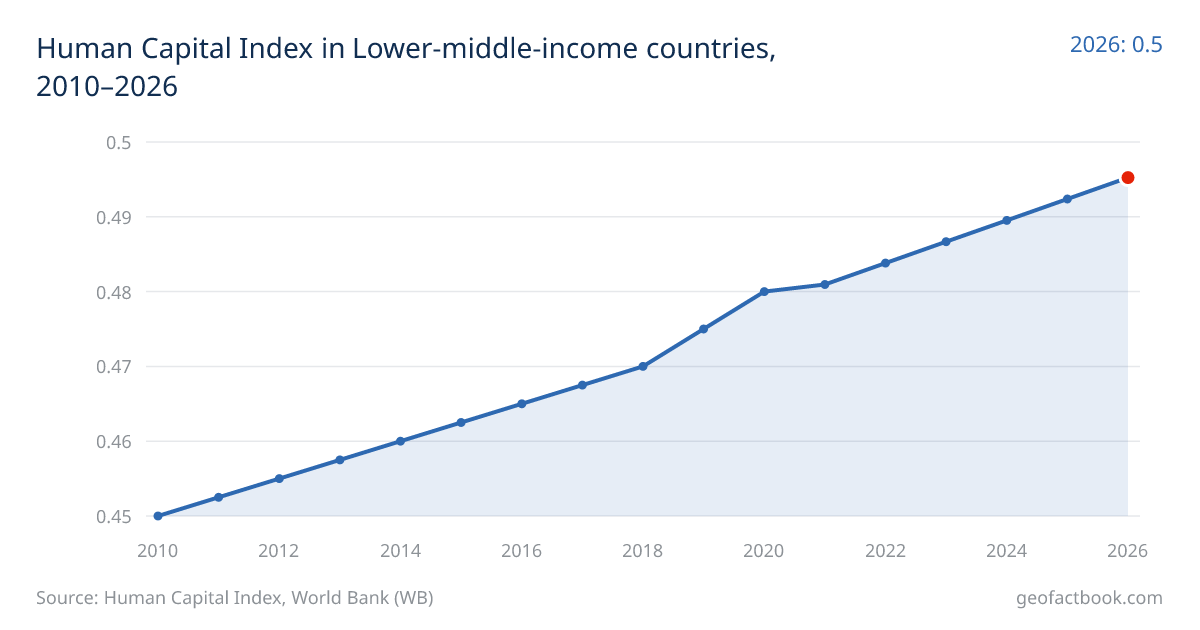
Lower-middle-income countries's human capital index in 2026 is 0.50 (estimate), up 0.6% from 2025.
The Human Capital Index measures a country's investment in education and health, reflecting its potential for economic growth and productivity. This vital statistic highlights the importance of nurturing human resources for sustainable development.
Estimated value for 2026 (interpolated, no direct source).
Human Capital Index over timeSome values are estimated based on historical trends
| Year | Value | Change | % Change | Actions |
|---|---|---|---|---|
| 2026 | 0.5 | +0 | +0.58% | |
| 2025 | 0.49 | +0 | +0.58% | |
| 2024 | 0.49 | +0 | +0.59% | |
| 2023 | 0.49 | +0 | +0.59% | |
| 2022 | 0.48 | +0 | +0.59% | |
| 2021 | 0.48 | +0 | +0.20% | |
| 2020 | 0.48 | +0.01 | +1.05% | |
| 2019 | 0.48 | +0.01 | +1.06% | |
| 2018 | 0.47 | +0 | +0.53% | |
| 2017 | 0.47 | +0 | +0.54% | |
| 2016 | 0.46 | +0 | +0.54% | |
| 2015 | 0.46 | +0 | +0.54% | |
| 2014 | 0.46 | +0 | +0.55% | |
| 2013 | 0.46 | +0 | +0.55% | |
| 2012 | 0.46 | +0 | +0.55% | |
| 2011 | 0.45 | +0 | +0.56% | |
| 2010 | 0.45 | — | — |
Human Capital Index in Lower-middle-income countries, 2010–2026: chart
Cite this page
Geo Factbook. (n.d.). Lower-middle-income countries: Human Capital Index. Retrieved November 29, 2026, from https://geofactbook.com/countries/lower-middle-income-countries/human-capital-index
The figures on this page come from Human Capital Index, World Bank (WB). For academic work, cite the original source as well.
Frequently Asked Questions About Lower-middle-income countries Human Capital Index
What is Lower-middle-income countries's human capital index in 2026?▾
Lower-middle-income countries's human capital index is 0.50 in 2026 (estimate), according to Human Capital Index, World Bank (WB).
Is Lower-middle-income countries's human capital index increasing or decreasing?▾
Lower-middle-income countries's human capital index rose by 0.6% from 2025 (0.49) to 2026 (0.50). Over the past decade (2016–2026) it rose by 6.5%.
What was Lower-middle-income countries's human capital index in 2010?▾
In 2010, Lower-middle-income countries's human capital index was 0.45. By 2026 it rose by 10.1%.
Explore additional statistical insights
Percentage of population by degree of urbanization in Lower-middle-income countries
Explore the percentage of population by degree of urbanization across countries, highlighting the shift towards urban living and its impact on economic growth and development. Understanding these trends is crucial for addressing urban planning and resource allocation.
Female population of reproductive age in Lower-middle-income countries
The female population of reproductive age is a crucial demographic statistic that influences healthcare, economic growth, and social policies in countries. Understanding this population helps address reproductive health needs and support family planning initiatives.
Total fertility rate in Lower-middle-income countries
The total fertility rate measures the average number of children a woman is expected to have during her lifetime, reflecting population growth and demographic trends. Understanding this statistic is crucial for analyzing economic development, healthcare needs, and societal changes across countries.
Median age of population in Lower-middle-income countries
The median age of a population is a key demographic indicator, reflecting the age distribution within a country. Understanding median age helps assess economic development, healthcare needs, and social dynamics. Countries with a higher median age may face challenges related to aging populations, while younger populations often indicate growth potential.
Population density in Lower-middle-income countries
Population density measures how many people live per square kilometer in a country, highlighting urbanization and resource distribution. Understanding this statistic is crucial for assessing living conditions, infrastructure needs, and environmental impact.
Currently married (Percent) in Lower-middle-income countries
The percentage of currently married individuals by country highlights societal trends in family structure and relationships. Understanding these statistics can provide insights into cultural norms and demographic shifts, influencing policies and social programs.