
Liberia Beer Consumption per Capita 2022: 0.30 liters
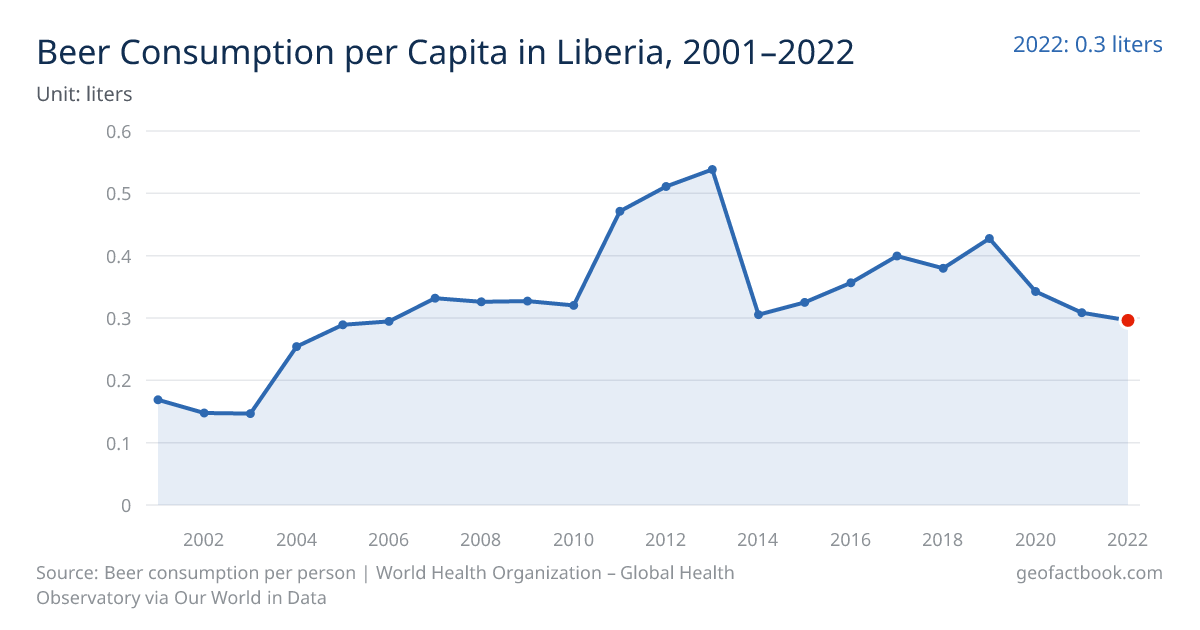
Liberia's beer consumption per capita in 2022 is 0.30 liters, down 4.0% from 2021. It ranks #152 of 186 countries.
Beer consumption per capita measures the average liters of beer consumed by each person in a country annually.
Source (2022): Beer consumption per person | Our World in Data
Where Liberia ranks (2022)
#152 of 186- #150
 Maldives0.3 liters
- #151
 Guinea0.3 liters
- #152
 Liberia0.3 liters
- #153
 Sierra Leone0.27 liters
- #154
 Algeria0.26 liters
Beer Consumption per Capita over time
| Year | Value | Change | % Change | Actions |
|---|---|---|---|---|
| 2022 | 0.3 liters | 0.01 liters | -4.00% | |
| 2021 | 0.31 liters | 0.03 liters | -9.92% | |
| 2020 | 0.34 liters | 0.09 liters | -19.91% | |
| 2019 | 0.43 liters | +0.05 liters | +12.59% | |
| 2018 | 0.38 liters | 0.02 liters | -4.91% | |
| 2017 | 0.4 liters | +0.04 liters | +12.04% | |
| 2016 | 0.36 liters | +0.03 liters | +9.68% | |
| 2015 | 0.33 liters | +0.02 liters | +6.49% | |
| 2014 | 0.31 liters | 0.23 liters | -43.29% | |
| 2013 | 0.54 liters | +0.03 liters | +5.34% | |
| 2012 | 0.51 liters | +0.04 liters | +8.44% | |
| 2011 | 0.47 liters | +0.15 liters | +47.17% | |
| 2010 | 0.32 liters | 0.01 liters | -2.15% | |
| 2009 | 0.33 liters | +0 liters | +0.39% | |
| 2008 | 0.33 liters | 0.01 liters | -1.77% | |
| 2007 | 0.33 liters | +0.04 liters | +12.68% | |
| 2006 | 0.29 liters | +0.01 liters | +1.84% | |
| 2005 | 0.29 liters | +0.03 liters | +13.77% | |
| 2004 | 0.25 liters | +0.11 liters | +73.31% | |
| 2003 | 0.15 liters | 0 liters | -0.62% | |
| 2002 | 0.15 liters | 0.02 liters | -12.55% | |
| 2001 | 0.17 liters | — | — |
Beer Consumption per Capita in Liberia, 2001–2022: chart
Cite this page
Geo Factbook. (n.d.). Liberia: Beer Consumption per Capita. Retrieved November 27, 2026, from https://geofactbook.com/countries/liberia/beer-consumption-per-capita
The figures on this page come from Beer consumption per person | World Health Organization – Global Health Observatory via Our World in Data. For academic work, cite the original source as well.
Frequently Asked Questions About Liberia Beer Consumption per Capita
What is Liberia's beer consumption per capita in 2022?▾
Liberia's beer consumption per capita is 0.30 liters in 2022, according to Beer consumption per person | World Health Organization – Global Health Observatory via Our World in Data.
Is Liberia's beer consumption per capita increasing or decreasing?▾
Liberia's beer consumption per capita fell by 4.0% from 2021 (0.31 liters) to 2022 (0.30 liters). Over the past decade (2012–2022) it fell by 42.0%.
How does Liberia rank for beer consumption per capita?▾
In 2022, Liberia has the 152nd highest beer consumption per capita out of 186 countries with data.
What was Liberia's beer consumption per capita in 2001?▾
In 2001, Liberia's beer consumption per capita was 0.17 liters. By 2022 it rose by 75.5%.
Explore additional statistical insights
Female Tertiary Enrollment Rate (%) in Liberia
This measures the percentage of female students enrolling in tertiary education, reflecting gender parity in higher education globally.
Human Development Index in Liberia
The Human Development Index combines indicators of health, education, and income to assess development levels.
Female population of reproductive age in Liberia
The female population of reproductive age is a crucial demographic statistic that influences healthcare, economic growth, and social policies in countries. Understanding this population helps address reproductive health needs and support family planning initiatives.
Total net-migration in Liberia
Total net-migration measures the difference between the number of immigrants and emigrants in a country, reflecting population shifts and economic opportunities. Understanding this statistic is crucial for analyzing demographic trends and policy impacts in nations worldwide.
Crude Birth Rate in Liberia
Crude birth rate measures births per 1,000 people. Identify regions with high or low birth rates globally.
Human Capital Index in Liberia
The Human Capital Index measures a country's investment in education and health, reflecting its potential for economic growth and productivity. This vital statistic highlights the importance of nurturing human resources for sustainable development.