
Lebanon Remittances 2025: 33.30
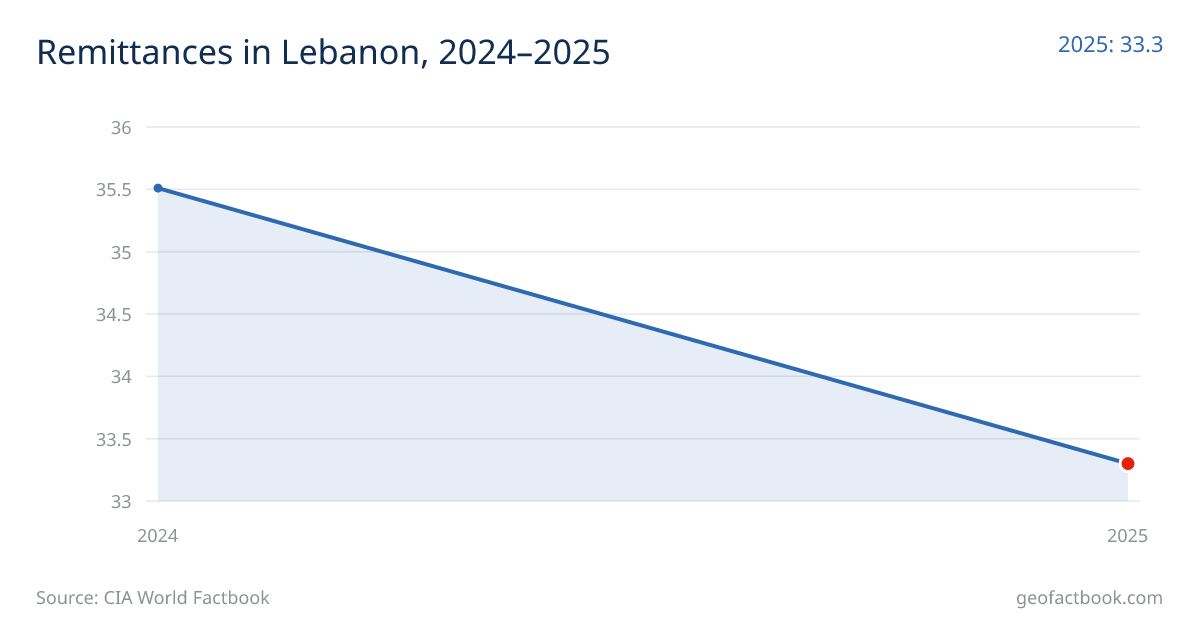
Lebanon's remittances in 2025 is 33.30, down 6.2% from 2024. It ranks #3 of 190 countries.
Remittances measure money sent home by migrants, highlighting economic support. Explore country comparisons and historical trends with interactive maps.
Where Lebanon ranks (2025)
#3 of 190- #1
 Tonga50
- #2
 Tajikistan47.9
- #3
 Lebanon33.3
- #4
 Nepal33.1
- #5
 Nicaragua26.6
Remittances over time
| Year | Value | Change | % Change | Actions |
|---|---|---|---|---|
| 2025 | 33.3 | 2.21 | -6.22% | |
| 2024 | 35.51 | — | — |
Remittances in Lebanon, 2024–2025: chart
Cite this page
Geo Factbook. (n.d.). Lebanon: Remittances. Retrieved November 27, 2026, from https://geofactbook.com/countries/lebanon/remittances
The figures on this page come from CIA World Factbook. For academic work, cite the original source as well.
Frequently Asked Questions About Lebanon Remittances
What is Lebanon's remittances in 2025?▾
Lebanon's remittances is 33.30 in 2025, according to CIA World Factbook.
Is Lebanon's remittances increasing or decreasing?▾
Lebanon's remittances fell by 6.2% from 2024 (35.51) to 2025 (33.30).
How does Lebanon rank for remittances?▾
In 2025, Lebanon has the 3rd highest remittances out of 190 countries with data.
What was Lebanon's remittances in 2024?▾
In 2024, Lebanon's remittances was 35.51. By 2025 it fell by 6.2%.
Explore additional statistical insights
Tax Burden (% of GDP) in Lebanon
Tax Burden measures the proportion of GDP collected by governments as taxes, influencing economic freedom.
Wheat Production Volume in Lebanon
Wheat production volume measures total tonnes produced annually. Key for understanding agricultural output.
Inflation Rate (CPI) in Lebanon
Inflation rate measures the annual percentage increase in consumer prices, reflecting the cost of living.
Youth Labor Force Participation Rate in Lebanon
Youth labor force participation measures the percentage of young people actively engaged in the labor market, employed or seeking work.
Population living in slums in Lebanon
This statistic measures the percentage of a country's population living in slums, highlighting urban poverty and living conditions. Understanding slum populations is crucial for addressing housing challenges and improving the quality of life.
Apple Import Volume in Lebanon
Apple import volume tracks the total weight of apples imported by a country, reflecting demand and local production capacity.