
Latvia Under-five mortality rate 2026: 3.24 per live births
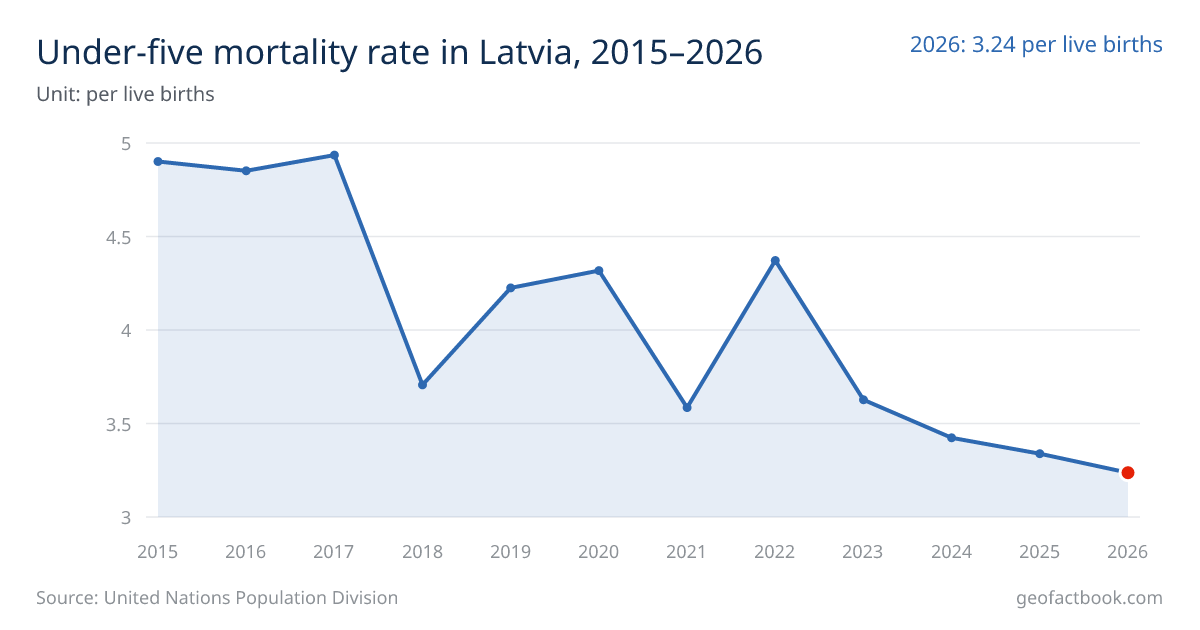
Latvia's under-five mortality rate in 2026 is 3.24 per live births (estimate), down 3.0% from 2025. It ranks #210 of 236 countries.
The under-five mortality rate measures the number of deaths per 1,000 live births for children under five. This critical statistic highlights child health and development, reflecting a country's healthcare quality and socioeconomic conditions. Understanding these rates is vital for improving global health initiatives.
Estimated value for 2026 (interpolated, no direct source).
Where Latvia ranks (2026)
#210 of 236- #208
 Hungary3.34 per live births
- #209
 Austria3.32 per live births
- #210
 Latvia3.24 per live births
- #211
 Belgium3.23 per live births
- #212
 Germany3.21 per live births
Under-five mortality rate over timeSome values are estimated based on historical trends
| Year | Value | Change | % Change | Actions |
|---|---|---|---|---|
| 2026 | 3.24 per live births | 0.1 per live births | -3.04% | |
| 2025 | 3.34 per live births | 0.09 per live births | -2.48% | |
| 2024 | 3.42 per live births | 0.2 per live births | -5.60% | |
| 2023 | 3.63 per live births | 0.74 per live births | -17.04% | |
| 2022 | 4.37 per live births | +0.79 per live births | +21.95% | |
| 2021 | 3.58 per live births | 0.73 per live births | -16.98% | |
| 2020 | 4.32 per live births | +0.09 per live births | +2.19% | |
| 2019 | 4.23 per live births | +0.52 per live births | +14.00% | |
| 2018 | 3.71 per live births | 1.23 per live births | -24.90% | |
| 2017 | 4.94 per live births | +0.08 per live births | +1.73% | |
| 2016 | 4.85 per live births | 0.05 per live births | -1.01% | |
| 2015 | 4.9 per live births | — | — |
Under-five mortality rate in Latvia, 2015–2026: chart
Cite this page
Geo Factbook. (n.d.). Latvia: Under-five mortality rate. Retrieved November 27, 2026, from https://geofactbook.com/countries/latvia/under-five-mortality-rate
The figures on this page come from United Nations Population Division. For academic work, cite the original source as well.
Frequently Asked Questions About Latvia Under-five mortality rate
What is Latvia's under-five mortality rate in 2026?▾
Latvia's under-five mortality rate is 3.24 per live births in 2026 (estimate), according to United Nations Population Division.
Is Latvia's under-five mortality rate increasing or decreasing?▾
Latvia's under-five mortality rate fell by 3.0% from 2025 (3.34 per live births) to 2026 (3.24 per live births). Over the past decade (2016–2026) it fell by 33.3%.
How does Latvia rank for under-five mortality rate?▾
In 2026, Latvia has the 210th highest under-five mortality rate out of 236 countries with data.
What was Latvia's under-five mortality rate in 2015?▾
In 2015, Latvia's under-five mortality rate was 4.90 per live births. By 2026 it fell by 33.9%.
Explore additional statistical insights
Contraceptive Prevalence Rate in Latvia
Contraceptive Prevalence Rate indicates the percentage of women using contraception. Explore global rankings, compare countries, and view trends.
Education Expenditure (% of GDP) in Latvia
Education expenditure measures the percentage of GDP spent on education. Compare countries and explore interactive rankings and trends.
Total deaths in Latvia
Total deaths in countries measure the number of individuals who have passed away within a specific timeframe. This statistic is crucial for understanding health trends, mortality rates, and the impact of various factors on population dynamics.
Milk Consumption per Capita in Latvia
Milk consumption per capita indicates dietary habits and dairy dependence across countries.
Population living in slums in Latvia
This statistic measures the percentage of a country's population living in slums, highlighting urban poverty and living conditions. Understanding slum populations is crucial for addressing housing challenges and improving the quality of life.
Total demand for family planning (Percent) in Latvia
Total demand for family planning measures the percentage of individuals seeking access to reproductive health services. Understanding this statistic is crucial for addressing global population growth and improving health outcomes.