
Latin America and the Caribbean Human Capital Index 2026: 0.56
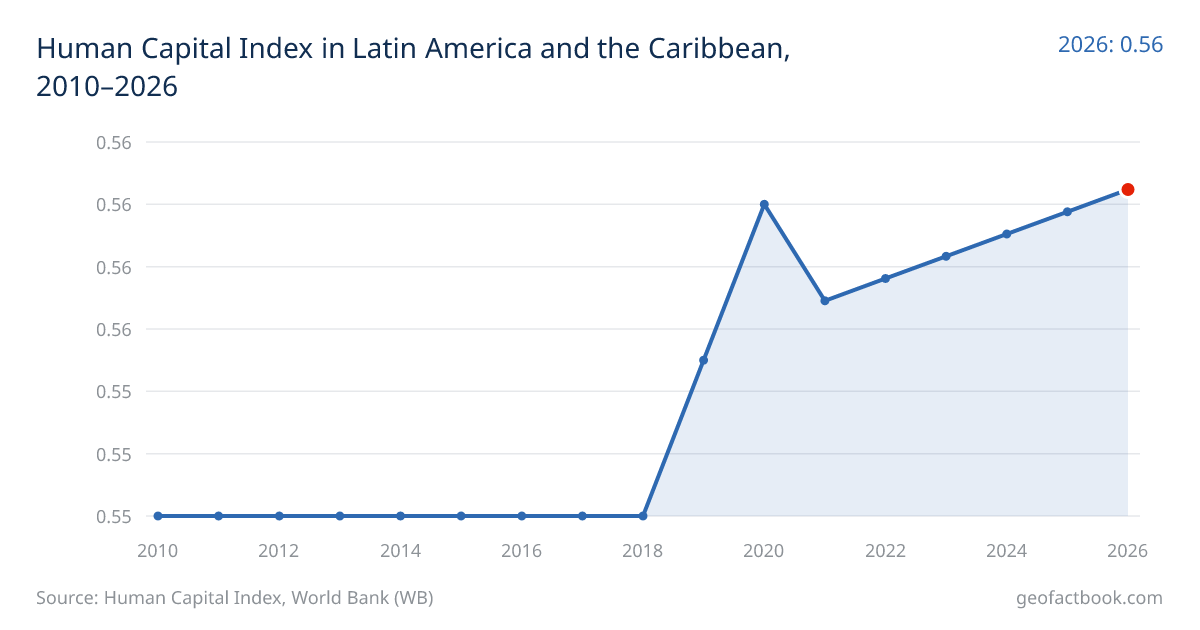
Latin America and the Caribbean's human capital index in 2026 is 0.56 (estimate), up 0.1% from 2025.
The Human Capital Index measures a country's investment in education and health, reflecting its potential for economic growth and productivity. This vital statistic highlights the importance of nurturing human resources for sustainable development.
Estimated value for 2026 (interpolated, no direct source).
Human Capital Index over timeSome values are estimated based on historical trends
| Year | Value | Change | % Change | Actions |
|---|---|---|---|---|
| 2026 | 0.56 | +0 | +0.13% | |
| 2025 | 0.56 | +0 | +0.13% | |
| 2024 | 0.56 | +0 | +0.13% | |
| 2023 | 0.56 | +0 | +0.13% | |
| 2022 | 0.56 | +0 | +0.13% | |
| 2021 | 0.56 | 0 | -0.55% | |
| 2020 | 0.56 | +0.01 | +0.90% | |
| 2019 | 0.56 | +0.01 | +0.91% | |
| 2018 | 0.55 | 0 | 0.00% | |
| 2017 | 0.55 | 0 | 0.00% | |
| 2016 | 0.55 | 0 | 0.00% | |
| 2015 | 0.55 | 0 | 0.00% | |
| 2014 | 0.55 | 0 | 0.00% | |
| 2013 | 0.55 | 0 | 0.00% | |
| 2012 | 0.55 | 0 | 0.00% | |
| 2011 | 0.55 | 0 | 0.00% | |
| 2010 | 0.55 | — | — |
Human Capital Index in Latin America and the Caribbean, 2010–2026: chart
Cite this page
Geo Factbook. (n.d.). Latin America and the Caribbean: Human Capital Index. Retrieved November 29, 2026, from https://geofactbook.com/countries/latin-america-and-the-caribbean/human-capital-index
The figures on this page come from Human Capital Index, World Bank (WB). For academic work, cite the original source as well.
Frequently Asked Questions About Latin America and the Caribbean Human Capital Index
What is Latin America and the Caribbean's human capital index in 2026?▾
Latin America and the Caribbean's human capital index is 0.56 in 2026 (estimate), according to Human Capital Index, World Bank (WB).
Is Latin America and the Caribbean's human capital index increasing or decreasing?▾
Latin America and the Caribbean's human capital index rose by 0.1% from 2025 (0.56) to 2026 (0.56). Over the past decade (2016–2026) it rose by 1.9%.
What was Latin America and the Caribbean's human capital index in 2010?▾
In 2010, Latin America and the Caribbean's human capital index was 0.55. By 2026 it rose by 1.9%.
Explore additional statistical insights
Total deaths in Latin America and the Caribbean
Total deaths in countries measure the number of individuals who have passed away within a specific timeframe. This statistic is crucial for understanding health trends, mortality rates, and the impact of various factors on population dynamics.
Percentage of population by degree of urbanization in Latin America and the Caribbean
Explore the percentage of population by degree of urbanization across countries, highlighting the shift towards urban living and its impact on economic growth and development. Understanding these trends is crucial for addressing urban planning and resource allocation.
Population density in Latin America and the Caribbean
Population density measures how many people live per square kilometer in a country, highlighting urbanization and resource distribution. Understanding this statistic is crucial for assessing living conditions, infrastructure needs, and environmental impact.
Currently married (Percent) in Latin America and the Caribbean
The percentage of currently married individuals by country highlights societal trends in family structure and relationships. Understanding these statistics can provide insights into cultural norms and demographic shifts, influencing policies and social programs.
Total net-migration in Latin America and the Caribbean
Total net-migration measures the difference between the number of immigrants and emigrants in a country, reflecting population shifts and economic opportunities. Understanding this statistic is crucial for analyzing demographic trends and policy impacts in nations worldwide.
Life expectancy at birth in Latin America and the Caribbean
Life expectancy at birth measures the average years a newborn is expected to live, reflecting a country's health standards and quality of life. This vital statistic highlights disparities in healthcare and living conditions across nations, making it essential for global health assessments.