
Kuwait Mean Years of Schooling 2023: 7.57 years
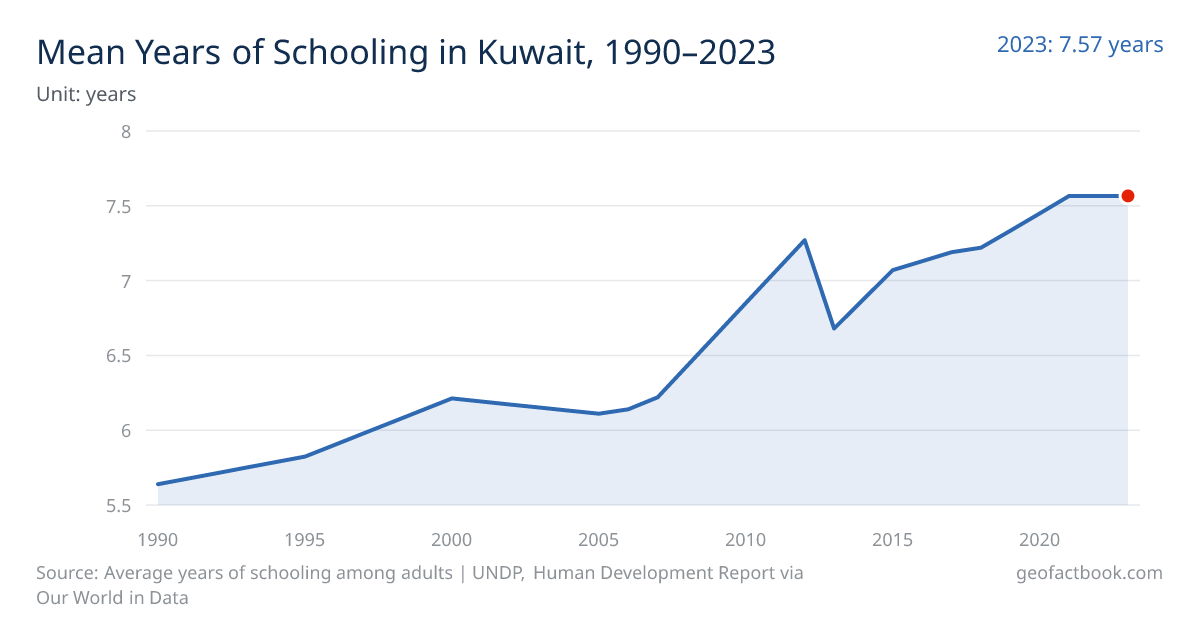
Kuwait's mean years of schooling in 2023 is 7.57 years, unchanged from 2022. It ranks #132 of 193 countries.
Mean Years of Schooling indicates the average number of years of education received by people aged 25 and older.
Source (2023): Average years of schooling (UNDP) | Our World in Data
Where Kuwait ranks (2023)
#132 of 193- #130
 Tunisia7.59 years
- #131
 Nigeria7.59 years
- #132
 Kuwait7.57 years
- #133
 Honduras7.51 years
- #134
 Algeria7.42 years
Mean Years of Schooling over time
| Year | Value | Change | % Change | Actions |
|---|---|---|---|---|
| 2023 | 7.57 years | 0 years | 0.00% | |
| 2022 | 7.57 years | 0 years | 0.00% | |
| 2021 | 7.57 years | +0.12 years | +1.57% | |
| 2020 | 7.45 years | +0.12 years | +1.57% | |
| 2019 | 7.33 years | +0.11 years | +1.57% | |
| 2018 | 7.22 years | +0.03 years | +0.42% | |
| 2017 | 7.19 years | +0.06 years | +0.84% | |
| 2016 | 7.13 years | +0.06 years | +0.85% | |
| 2015 | 7.07 years | +0.2 years | +2.84% | |
| 2014 | 6.88 years | +0.2 years | +2.92% | |
| 2013 | 6.68 years | 0.59 years | -8.12% | |
| 2012 | 7.27 years | +0.21 years | +2.97% | |
| 2011 | 7.06 years | +0.21 years | +3.07% | |
| 2010 | 6.85 years | +0.21 years | +3.16% | |
| 2009 | 6.64 years | +0.21 years | +3.27% | |
| 2008 | 6.43 years | +0.21 years | +3.38% | |
| 2007 | 6.22 years | +0.08 years | +1.30% | |
| 2006 | 6.14 years | +0.03 years | +0.49% | |
| 2005 | 6.11 years | 0.02 years | -0.33% | |
| 2004 | 6.13 years | 0.02 years | -0.33% | |
| 2003 | 6.15 years | 0.02 years | -0.33% | |
| 2002 | 6.17 years | 0.02 years | -0.33% | |
| 2001 | 6.19 years | 0.02 years | -0.33% | |
| 2000 | 6.21 years | +0.08 years | +1.27% | |
| 1999 | 6.13 years | +0.08 years | +1.28% | |
| 1998 | 6.06 years | +0.08 years | +1.30% | |
| 1997 | 5.98 years | +0.08 years | +1.32% | |
| 1996 | 5.9 years | +0.08 years | +1.34% | |
| 1995 | 5.82 years | +0.04 years | +0.64% | |
| 1994 | 5.79 years | +0.04 years | +0.64% | |
| 1993 | 5.75 years | +0.04 years | +0.64% | |
| 1992 | 5.71 years | +0.04 years | +0.65% | |
| 1991 | 5.68 years | +0.04 years | +0.65% | |
| 1990 | 5.64 years | — | — |
Mean Years of Schooling in Kuwait, 1990–2023: chart
Cite this page
Geo Factbook. (n.d.). Kuwait: Mean Years of Schooling. Retrieved November 27, 2026, from https://geofactbook.com/countries/kuwait/mean-years-of-schooling
The figures on this page come from Average years of schooling among adults | UNDP, Human Development Report via Our World in Data. For academic work, cite the original source as well.
Frequently Asked Questions About Kuwait Mean Years of Schooling
What is Kuwait's mean years of schooling in 2023?▾
Kuwait's mean years of schooling is 7.57 years in 2023, according to Average years of schooling among adults | UNDP, Human Development Report via Our World in Data.
Is Kuwait's mean years of schooling increasing or decreasing?▾
Kuwait's mean years of schooling was essentially unchanged from 2022 (7.57 years) to 2023 (7.57 years). Over the past decade (2013–2023) it rose by 13.3%.
How does Kuwait rank for mean years of schooling?▾
In 2023, Kuwait has the 132nd highest mean years of schooling out of 193 countries with data.
What was Kuwait's mean years of schooling in 1990?▾
In 1990, Kuwait's mean years of schooling was 5.64 years. By 2023 it rose by 34.2%.
Explore additional statistical insights
Milk Consumption per Capita in Kuwait
Milk consumption per capita indicates dietary habits and dairy dependence across countries.
Mathematics Proficiency Scores in Kuwait
Mathematics proficiency scores assess students' ability to understand and apply mathematical concepts across countries.
Old-Age Dependency Ratio in Kuwait
Old-age dependency ratio compares the number of elderly dependents to working-age people, affecting economic sustainability.
Total demand for family planning (Percent) in Kuwait
Total demand for family planning measures the percentage of individuals seeking access to reproductive health services. Understanding this statistic is crucial for addressing global population growth and improving health outcomes.
Primary School Pupil-Teacher Ratio in Kuwait
Pupil-teacher ratio in primary schools reflects educational quality; lower ratios indicate more personalized attention.
Human Development Index in Kuwait
The Human Development Index combines indicators of health, education, and income to assess development levels.