
India Population living in slums 2018: 5.41 %
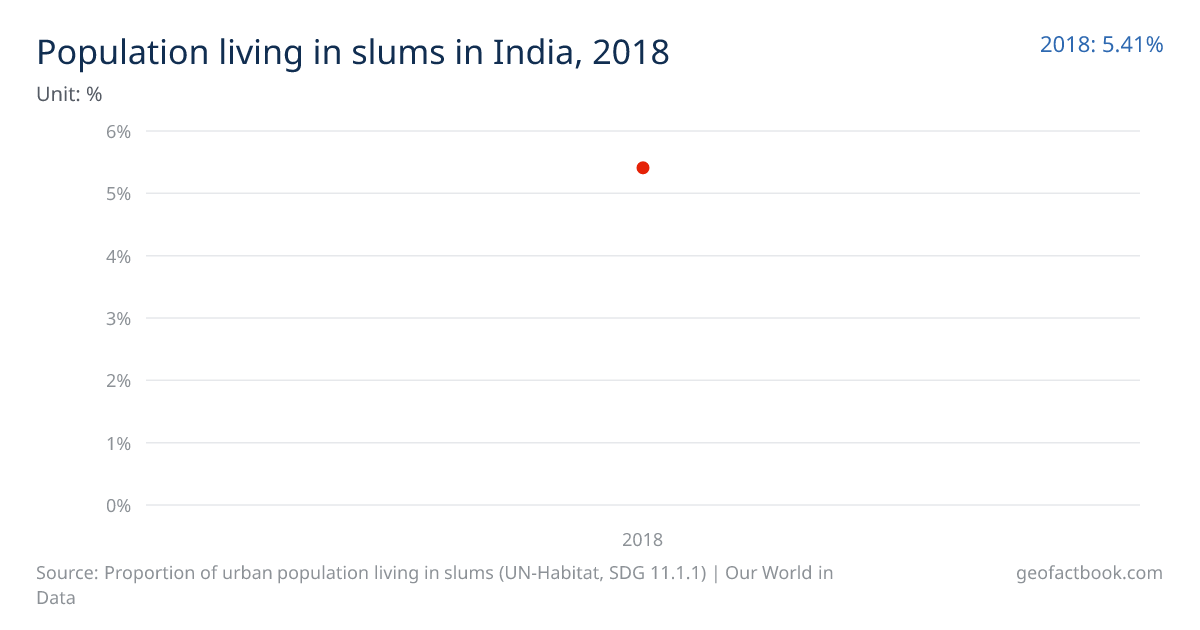
India's population living in slums in 2018 is 5.41 %. It ranks #107 of 197 countries.
This statistic measures the percentage of a country's population living in slums, highlighting urban poverty and living conditions. Understanding slum populations is crucial for addressing housing challenges and improving the quality of life.
Source (2018): Proportion of urban population living in slums (UN-Habitat, SDG 11.1.1) | Our World in Data
Where India ranks (2018)
#107 of 197- #105
 China, Hong Kong SAR6.64%
- #106
 Republic of Moldova6.5%
- #107
 India5.41%
- #108
 Cayman Islands5.1%
- #109
 Lebanon4.53%
Population living in slums over time
| Year | Value | Change | % Change | Actions |
|---|---|---|---|---|
| 2018 | 5.41 % | — | — |
Population living in slums in India, 2018: chart
Cite this page
Geo Factbook. (n.d.). India: Population living in slums. Retrieved November 28, 2026, from https://geofactbook.com/countries/india/population-living-in-slums
The figures on this page come from Proportion of urban population living in slums (UN-Habitat, SDG 11.1.1) | Our World in Data. For academic work, cite the original source as well.
Frequently Asked Questions About India Population living in slums
What is India's population living in slums in 2018?▾
India's population living in slums is 5.41 % in 2018, according to Proportion of urban population living in slums (UN-Habitat, SDG 11.1.1) | Our World in Data.
How does India rank for population living in slums?▾
In 2018, India has the 107th highest population living in slums out of 197 countries with data.
Explore additional statistical insights
Gross Domestic Product (GDP) by Country in Current US Dollars in India
Discover the Gross Domestic Product (GDP) by country in current US dollars, a key indicator of economic performance. This statistic reveals the financial health and growth potential of nations, making it essential for investors and policymakers.
Agricultural land in India
Agricultural land measures the area dedicated to farming and cultivation in countries, impacting food production and sustainability. Understanding this statistic is crucial for assessing agricultural capacity and economic development.
Population Change in India
This statistic measures population change across countries, highlighting shifts in demographics. Understanding these changes is crucial for planning resources, economic growth, and social services.
Gender Wage Gap in India
Gender wage gap measures income disparity between men and women. Discover which countries have the highest and lowest gaps.
Red List Index Score in India
The Red List Index Score indicates the overall extinction risk of species within a country based on the IUCN Red List categories.
Remittances in India
Remittances measure money sent home by migrants, highlighting economic support. Explore country comparisons and historical trends with interactive maps.