
Iceland Population living in slums 2018: 14.10 %
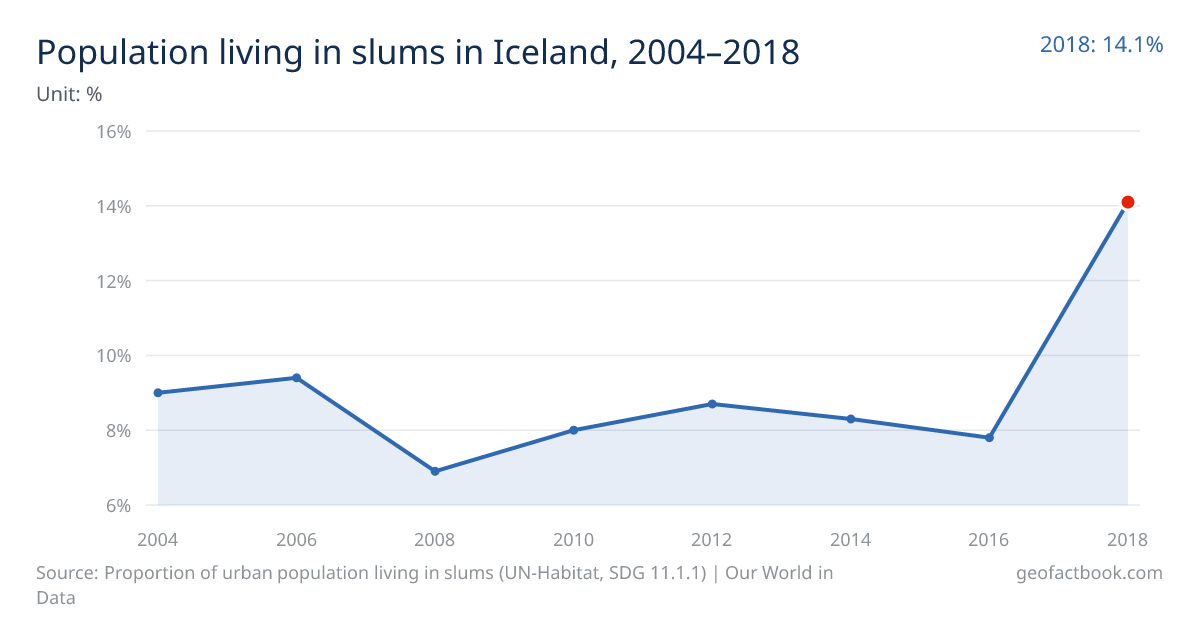
Iceland's population living in slums in 2018 is 14.10 %, up 80.8% from 2016. It ranks #91 of 197 countries.
This statistic measures the percentage of a country's population living in slums, highlighting urban poverty and living conditions. Understanding slum populations is crucial for addressing housing challenges and improving the quality of life.
Source (2018): Proportion of urban population living in slums (UN-Habitat, SDG 11.1.1) | Our World in Data
Where Iceland ranks (2018)
#91 of 197




Population living in slums over time
| Year | Value | Change | % Change | Actions |
|---|---|---|---|---|
| 2018 | 14.1 % | +6.3 % | +80.77% | |
| 2016 | 7.8 % | 0.5 % | -6.02% | |
| 2014 | 8.3 % | 0.4 % | -4.60% | |
| 2012 | 8.7 % | +0.7 % | +8.75% | |
| 2010 | 8 % | +1.1 % | +15.94% | |
| 2008 | 6.9 % | 2.5 % | -26.60% | |
| 2006 | 9.4 % | +0.4 % | +4.44% | |
| 2004 | 9 % | — | — |
Population living in slums in Iceland, 2004–2018: chart
Cite this page
Geo Factbook. (n.d.). Iceland: Population living in slums. Retrieved November 28, 2026, from https://geofactbook.com/countries/iceland/population-living-in-slums
The figures on this page come from Proportion of urban population living in slums (UN-Habitat, SDG 11.1.1) | Our World in Data. For academic work, cite the original source as well.
Frequently Asked Questions About Iceland Population living in slums
What is Iceland's population living in slums in 2018?▾
Iceland's population living in slums is 14.10 % in 2018, according to Proportion of urban population living in slums (UN-Habitat, SDG 11.1.1) | Our World in Data.
Is Iceland's population living in slums increasing or decreasing?▾
Iceland's population living in slums rose by 80.8% from 2016 (7.80 %) to 2018 (14.10 %). Over the past decade (2008–2018) it rose by 104.3%.
How does Iceland rank for population living in slums?▾
In 2018, Iceland has the 91st highest population living in slums out of 197 countries with data.
What was Iceland's population living in slums in 2004?▾
In 2004, Iceland's population living in slums was 9 %. By 2018 it rose by 56.7%.
Explore additional statistical insights
Red List Index Score in Iceland
The Red List Index Score indicates the overall extinction risk of species within a country based on the IUCN Red List categories.
Life expectancy at birth in Iceland
Life expectancy at birth measures the average years a newborn is expected to live, reflecting a country's health standards and quality of life. This vital statistic highlights disparities in healthcare and living conditions across nations, making it essential for global health assessments.
Total Threatened Mammal Species in Iceland
Total threatened mammal species highlight biodiversity risks. Track conservation efforts worldwide.
Cereal Yield in Iceland
Cereal yield measures the amount of cereal produced per hectare of land, highlighting agricultural efficiency.
ATMs per 100,000 Adults in Iceland
ATMs per 100,000 adults measures access to banking services; higher values indicate better financial inclusion.
Researchers in R&D per Million in Iceland
Researchers in R&D per million people measures a country's investment in innovation and scientific progress.