
Hungary Old-Age Dependency Ratio 2023: 32.16 %
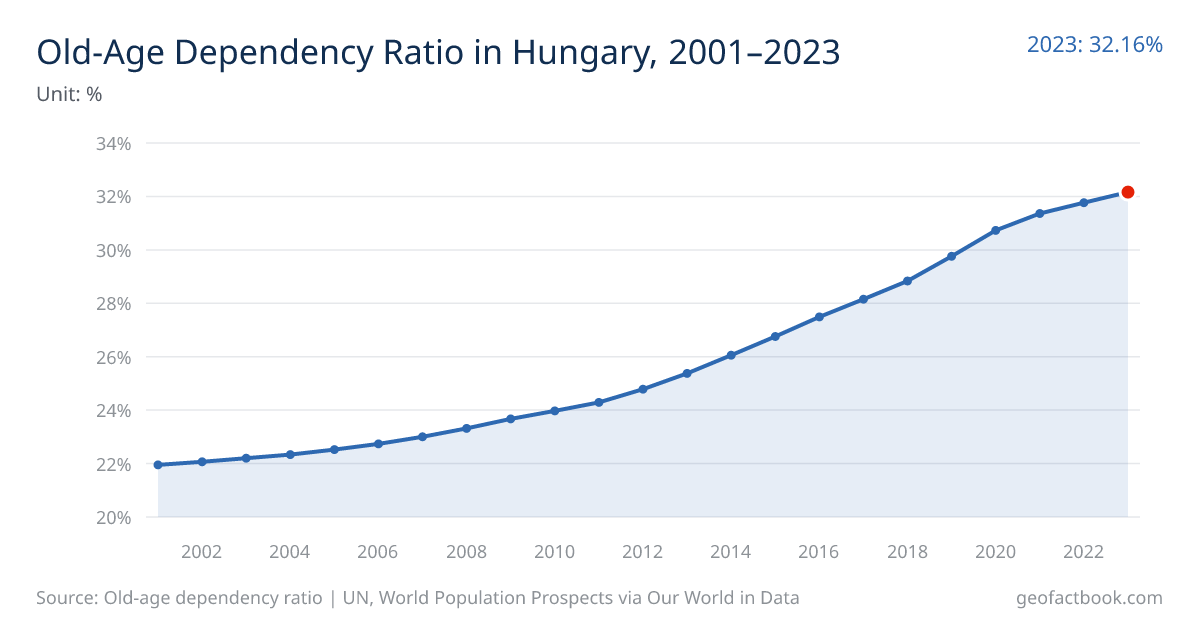
Hungary's old-age dependency ratio in 2023 is 32.16 %, up 1.2% from 2022. It ranks #28 of 236 countries.
Old-age dependency ratio compares the number of elderly dependents to working-age people, affecting economic sustainability.
Source (2023): Old-age dependency ratio | Our World in Data
Where Hungary ranks (2023)
#28 of 236




Old-Age Dependency Ratio over time
| Year | Value | Change | % Change | Actions |
|---|---|---|---|---|
| 2023 | 32.16 % | +0.4 % | +1.25% | |
| 2022 | 31.76 % | +0.4 % | +1.28% | |
| 2021 | 31.36 % | +0.63 % | +2.06% | |
| 2020 | 30.73 % | +0.97 % | +3.26% | |
| 2019 | 29.76 % | +0.93 % | +3.21% | |
| 2018 | 28.83 % | +0.68 % | +2.42% | |
| 2017 | 28.15 % | +0.66 % | +2.41% | |
| 2016 | 27.49 % | +0.73 % | +2.73% | |
| 2015 | 26.76 % | +0.7 % | +2.70% | |
| 2014 | 26.06 % | +0.68 % | +2.69% | |
| 2013 | 25.37 % | +0.59 % | +2.38% | |
| 2012 | 24.78 % | +0.49 % | +2.03% | |
| 2011 | 24.29 % | +0.32 % | +1.34% | |
| 2010 | 23.97 % | +0.3 % | +1.27% | |
| 2009 | 23.67 % | +0.36 % | +1.53% | |
| 2008 | 23.32 % | +0.31 % | +1.36% | |
| 2007 | 23 % | +0.27 % | +1.18% | |
| 2006 | 22.74 % | +0.21 % | +0.94% | |
| 2005 | 22.52 % | +0.19 % | +0.84% | |
| 2004 | 22.34 % | +0.14 % | +0.61% | |
| 2003 | 22.2 % | +0.13 % | +0.60% | |
| 2002 | 22.07 % | +0.12 % | +0.54% | |
| 2001 | 21.95 % | — | — |
Old-Age Dependency Ratio in Hungary, 2001–2023: chart
Cite this page
Geo Factbook. (n.d.). Hungary: Old-Age Dependency Ratio. Retrieved November 26, 2026, from https://geofactbook.com/countries/hungary/old-age-dependency-ratio
The figures on this page come from Old-age dependency ratio | UN, World Population Prospects via Our World in Data. For academic work, cite the original source as well.
Frequently Asked Questions About Hungary Old-Age Dependency Ratio
What is Hungary's old-age dependency ratio in 2023?▾
Hungary's old-age dependency ratio is 32.16 % in 2023, according to Old-age dependency ratio | UN, World Population Prospects via Our World in Data.
Is Hungary's old-age dependency ratio increasing or decreasing?▾
Hungary's old-age dependency ratio rose by 1.2% from 2022 (31.76 %) to 2023 (32.16 %). Over the past decade (2013–2023) it rose by 26.7%.
How does Hungary rank for old-age dependency ratio?▾
In 2023, Hungary has the 28th highest old-age dependency ratio out of 236 countries with data.
What was Hungary's old-age dependency ratio in 2001?▾
In 2001, Hungary's old-age dependency ratio was 21.95 %. By 2023 it rose by 46.5%.
Explore additional statistical insights
Median age of population in Hungary
The median age of a population is a key demographic indicator, reflecting the age distribution within a country. Understanding median age helps assess economic development, healthcare needs, and social dynamics. Countries with a higher median age may face challenges related to aging populations, while younger populations often indicate growth potential.
Female Tertiary Enrollment Rate (%) in Hungary
This measures the percentage of female students enrolling in tertiary education, reflecting gender parity in higher education globally.
Urban Population Share 2050 in Hungary
Urban population share by 2050 shows urbanization trends. Discover which countries will be most urbanized.
Currently married (Percent) in Hungary
The percentage of currently married individuals by country highlights societal trends in family structure and relationships. Understanding these statistics can provide insights into cultural norms and demographic shifts, influencing policies and social programs.
Crude Birth Rate in Hungary
Crude birth rate measures births per 1,000 people. Identify regions with high or low birth rates globally.
Fixed Broadband Penetration Rate in Hungary
Fixed broadband penetration rate indicates the proportion of households with broadband access, reflecting connectivity.