
Guadeloupe Electricity Production 2023: 1.67 TWh
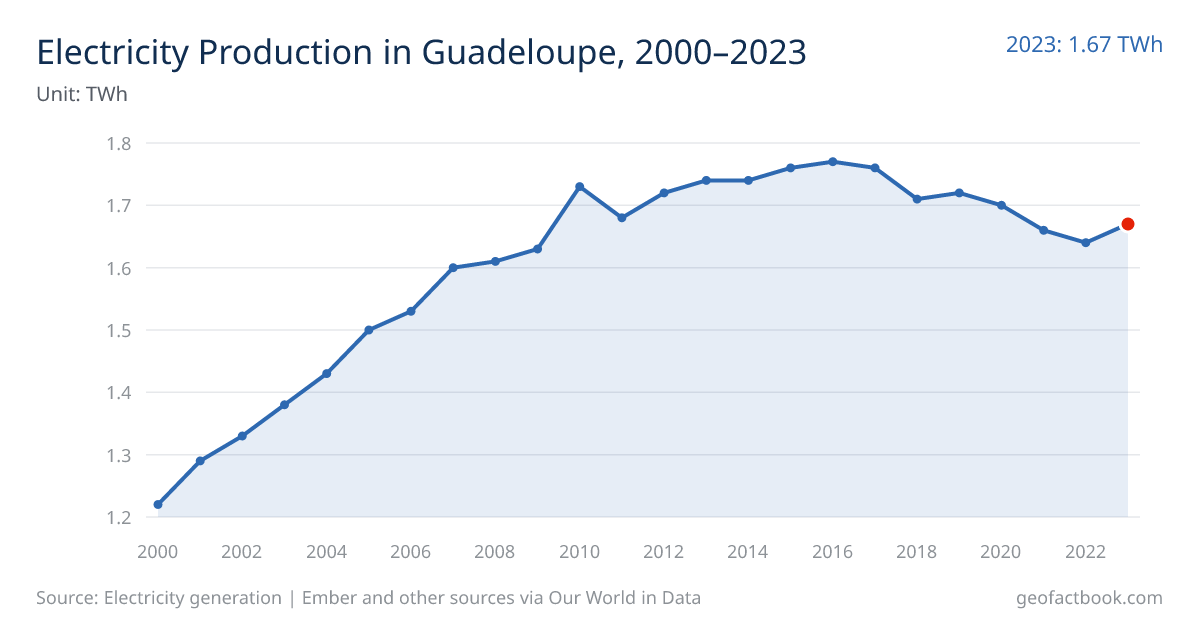
Guadeloupe's electricity production in 2023 is 1.67 TWh, up 1.8% from 2022. It ranks #148 of 212 countries.
Electricity production data reveals output levels for countries worldwide. Compare rankings, explore trends, and visualize data on interactive maps.
Source (2023): Electricity generation | Our World in Data
Where Guadeloupe ranks (2023)
#148 of 212- #146
 Suriname1.73 TWh
- #147
 Burkina Faso1.69 TWh
- #148
 Guadeloupe1.67 TWh
- #149
 Martinique1.51 TWh
- #150
 Equatorial Guinea1.43 TWh
Electricity Production over time
| Year | Value | Change | % Change | Actions |
|---|---|---|---|---|
| 2023 | 1.67 TWh | +0.03 TWh | +1.83% | |
| 2022 | 1.64 TWh | 0.02 TWh | -1.20% | |
| 2021 | 1.66 TWh | 0.04 TWh | -2.35% | |
| 2020 | 1.7 TWh | 0.02 TWh | -1.16% | |
| 2019 | 1.72 TWh | +0.01 TWh | +0.58% | |
| 2018 | 1.71 TWh | 0.05 TWh | -2.84% | |
| 2017 | 1.76 TWh | 0.01 TWh | -0.56% | |
| 2016 | 1.77 TWh | +0.01 TWh | +0.57% | |
| 2015 | 1.76 TWh | +0.02 TWh | +1.15% | |
| 2014 | 1.74 TWh | 0 TWh | 0.00% | |
| 2013 | 1.74 TWh | +0.02 TWh | +1.16% | |
| 2012 | 1.72 TWh | +0.04 TWh | +2.38% | |
| 2011 | 1.68 TWh | 0.05 TWh | -2.89% | |
| 2010 | 1.73 TWh | +0.1 TWh | +6.13% | |
| 2009 | 1.63 TWh | +0.02 TWh | +1.24% | |
| 2008 | 1.61 TWh | +0.01 TWh | +0.63% | |
| 2007 | 1.6 TWh | +0.07 TWh | +4.58% | |
| 2006 | 1.53 TWh | +0.03 TWh | +2.00% | |
| 2005 | 1.5 TWh | +0.07 TWh | +4.90% | |
| 2004 | 1.43 TWh | +0.05 TWh | +3.62% | |
| 2003 | 1.38 TWh | +0.05 TWh | +3.76% | |
| 2002 | 1.33 TWh | +0.04 TWh | +3.10% | |
| 2001 | 1.29 TWh | +0.07 TWh | +5.74% | |
| 2000 | 1.22 TWh | — | — |
Electricity Production in Guadeloupe, 2000–2023: chart
Cite this page
Geo Factbook. (n.d.). Guadeloupe: Electricity Production. Retrieved November 28, 2026, from https://geofactbook.com/countries/guadeloupe/electricity-production
The figures on this page come from Electricity generation | Ember and other sources via Our World in Data. For academic work, cite the original source as well.
Frequently Asked Questions About Guadeloupe Electricity Production
What is Guadeloupe's electricity production in 2023?▾
Guadeloupe's electricity production is 1.67 TWh in 2023, according to Electricity generation | Ember and other sources via Our World in Data.
Is Guadeloupe's electricity production increasing or decreasing?▾
Guadeloupe's electricity production rose by 1.8% from 2022 (1.64 TWh) to 2023 (1.67 TWh). Over the past decade (2013–2023) it fell by 4.0%.
How does Guadeloupe rank for electricity production?▾
In 2023, Guadeloupe has the 148th highest electricity production out of 212 countries with data.
What was Guadeloupe's electricity production in 2000?▾
In 2000, Guadeloupe's electricity production was 1.22 TWh. By 2023 it rose by 36.9%.
Explore additional statistical insights
Oil Production in Guadeloupe
Oil Production data reveals output levels across countries. Compare rankings, explore trends, and view interactive maps.
Natural Gas Consumption in Guadeloupe
Natural gas consumption data reveals energy usage trends across countries. Compare figures, explore rankings, and visualize with interactive maps.
Electricity from Fossil Fuels in Guadeloupe
Electricity from fossil fuels measures energy generation trends. Compare countries, explore rankings, and analyze historical data with interactive maps.
Electricity from Hydroelectric Plants in Guadeloupe
Electricity from hydroelectric plants shows renewable energy production. Explore country rankings, compare data, and view interactive maps.
Electricity Consumption in Guadeloupe
Electricity consumption data reveals energy usage trends across countries. Explore rankings and interactive maps for deeper insights.
Total population in Guadeloupe
Discover the latest total population statistics for every country and region worldwide. Explore accurate, up-to-date data on global population growth, density, and demographic trends — sourced from trusted international databases like the UN and World Bank. Perfect for researchers, students, and data enthusiasts looking to understand how the world’s population is changing.