
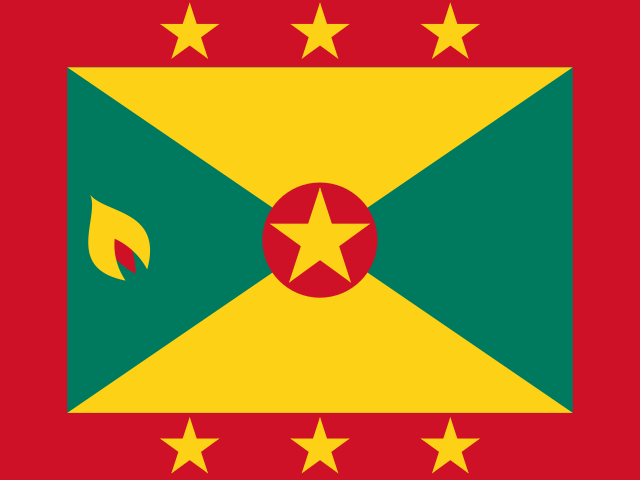
Location
Grenada is in the Caribbean, island between the Caribbean Sea and Atlantic Ocean, north of Trinidad and Tobago. It has no land borders and has 121 km of coastline. The capital is Saint George's.
Grenada population 2026: 117,400 — growth, rank & history →Key Statistics for 2026
Total population
Population Change
Median age of population
Population density
Life expectancy at birth
Agricultural land
Apple Import Volume
Dam capacity per capita
Female population of reproductive age
Health Care Spending per Capita
Learning-adjusted years of school
History
The history of Grenada is rich and complex, beginning with its early inhabitants, the Carib and Arawak peoples. These indigenous groups arrived on the island around the 1st millennium AD, establishing a society that thrived on fishing, agriculture, and trade. The Caribs, known for their warrior culture, displaced the Arawaks and became the dominant force until the arrival of European explorers in the late 15th century. In 1498, Christopher Columbus sighted Grenada during his third voyage to the New World, though it remained uncolonized for over a century due to its challenging geography and the resistance of its indigenous inhabitants.
The medieval period in Grenada saw the island remain largely untouched by European powers until the French began to assert their influence in the early 17th century. In 1650, the French officially settled Grenada, establishing sugar plantations that relied heavily on enslaved African labor. The island changed hands between the British and the French several times, culminating in the British formally taking control in 1763 after the Treaty of Paris, which ended the Seven Years' War. This colonial era was marked by the growth of the plantation economy, which became a cornerstone of Grenada's development and shaped its social structure.
The modern history of Grenada has been significantly influenced by its colonial past and the quest for independence. After a series of political changes and social unrest, Grenada attained independence from Britain on February 7, 1974. However, the island's stability was short-lived; a coup d'état in 1979 led by Maurice Bishop established a Marxist government that caused international concern. In response, the United States led an invasion of Grenada in 1983, known as Operation Urgent Fury, which aimed to restore order and protect American citizens on the island. This military intervention marked a pivotal moment in Grenada's history, as it led to a return to democratic governance.
In recent decades, Grenada has focused on rebuilding and developing its economy, which relies heavily on tourism, agriculture, and the spice trade. The island has also made strides in political stability, with regular democratic elections and a commitment to regional cooperation within organizations such as the Caribbean Community (CARICOM). Grenada's recent historical significance is underscored by its response to global challenges, including climate change and economic vulnerabilities, which have prompted the nation to advocate for sustainable development practices while preserving its cultural heritage and natural beauty.
Geography
Grenada is a small island nation located in the Caribbean Sea, specifically in the Lesser Antilles archipelago. It lies approximately 160 kilometers (100 miles) north of Venezuela and is bordered by the Caribbean Sea to the west and the Atlantic Ocean to the east. The country comprises the main island of Grenada and several smaller islands, including Carriacou and Petit Martinique. Grenada's geographical coordinates are 12.1165° N latitude and 61.6790° W longitude, making it one of the southernmost islands in the Caribbean chain.
The physical features of Grenada are characterized by a rugged terrain, with approximately two-thirds of the island covered by mountains. The central mountain range, known as the Grand Etang, includes the highest peak, Mount Saint Catherine, which rises to an elevation of 841 meters (2,762 feet). The island is also dotted with numerous rivers, including the River Antoine and the Balthazar River, which flow through lush rainforests and contribute to Grenada's rich biodiversity. The coastline features beautiful beaches, rocky cliffs, and sheltered bays, providing a stunning contrast to the island's mountainous interior.
Grenada experiences a tropical climate, with a wet season from June to December and a dry season from January to May. Average temperatures range from 24°C (75°F) to 30°C (86°F) throughout the year, with humidity levels remaining consistently high. The island is susceptible to hurricanes, particularly during the Atlantic hurricane season, which peaks between August and October. However, the surrounding waters help moderate temperatures, contributing to Grenada's lush vegetation and vibrant ecosystems.
The natural resources of Grenada include nutmeg, cocoa, and various tropical fruits, which play a significant role in the island's economy. Grenada is often referred to as the "Island of Spice" due to its prominence in nutmeg production, which accounts for a considerable portion of its agricultural output. Additionally, the island's rich marine environment supports fishing and tourism, with coral reefs and marine parks attracting visitors. Environmental characteristics include diverse ecosystems, such as mangroves, rainforests, and coastal wetlands, which are vital for maintaining biodiversity and supporting local wildlife.
Government
Grenada operates as a parliamentary democracy within the framework of a constitutional monarchy. The head of state is the monarch of the United Kingdom, represented locally by a Governor-General, while the head of government is the Prime Minister. This political system allows for a separation of powers among the executive, legislative, and judicial branches, ensuring a balance of governance and accountability. The country gained independence from British colonial rule in 1974, and its political landscape has since evolved, characterized by a multiparty system.
The structure of Grenada's government is composed of three distinct branches: the executive, legislative, and judicial. The executive branch is led by the Prime Minister, who is appointed from the majority party in the House of Representatives and is responsible for the administration of government policies. The legislative branch consists of a bicameral parliament, which includes the House of Representatives and the Senate. The House of Representatives has 15 members elected by the public, while the Senate comprises 13 appointed members, with seven appointed by the Prime Minister and six by the Leader of the Opposition. The judicial branch is independent of the other two branches and includes the Supreme Court and the Court of Appeal, which oversee the administration of justice in Grenada.
Key institutions that play a significant role in Grenada's governance include the Governor-General, the Prime Minister, and the Parliament. The Governor-General's role is largely ceremonial, but they have the authority to summon and dissolve Parliament and appoint judges. The Prime Minister leads the Cabinet, which is composed of ministers responsible for various government departments. Grenada's political landscape has been shaped by several parties, with the New National Party (NNP) and the National Democratic Congress (NDC) being the two dominant political entities. This dynamic has led to a competitive electoral atmosphere, where elections are held every five years, allowing citizens to participate actively in shaping their government.
The electoral system in Grenada is based on a first-past-the-post voting system. This method allows for direct election of members to the House of Representatives, making it essential for parties to mobilize significant grassroots support. Political campaigns are typically vibrant, engaging the electorate on issues such as economic development, education, and healthcare. The electoral process is overseen by the Electoral Office, ensuring transparency and fairness in the conduct of elections. Overall, Grenada's government reflects a commitment to democratic principles, with ongoing efforts to enhance political participation and governance for its citizens.
Economy
The economy of Grenada is characterized as a mixed economy, heavily dependent on tourism, agriculture, and services. As of the latest reports, Grenada's Gross Domestic Product (GDP) is estimated at approximately $1.1 billion, with a per capita GDP of around $10,000. The economy has shown resilience, rebounding from the impacts of natural disasters and global economic fluctuations. Tourism is the leading sector, contributing significantly to both employment and national income, with the island attracting visitors drawn to its picturesque beaches, vibrant culture, and rich history.
Major industries in Grenada include agriculture, with nutmeg and cocoa being the two most notable exports, alongside other crops such as bananas and spices. The agricultural sector, while declining in relative importance, still plays a vital role in the economy, employing a substantial portion of the workforce. The manufacturing sector is small but includes food processing and the production of rum. Additionally, financial services, particularly offshore banking, have emerged as a critical part of the economy, aided by policies that have attracted foreign investment.
Grenada's trade relationships are primarily with countries in the Caribbean region, the United States, and Europe. The country exports a variety of goods, with nutmeg being a significant part of its export profile, alongside other spices and agricultural products. Imports predominantly consist of fuel, machinery, and foodstuffs, with a trade deficit evident due to a higher volume of imports than exports. The government has been actively seeking to diversify trade partnerships and has engaged in various regional trade agreements to enhance economic stability and growth.
Despite its economic strengths, Grenada faces several challenges, including vulnerability to natural disasters such as hurricanes, which can severely impact infrastructure and tourism. Additionally, reliance on a narrow range of exports makes the economy sensitive to global market fluctuations. However, opportunities exist in expanding the tourism sector, particularly in eco-tourism and luxury travel, as well as in enhancing agricultural productivity through modern techniques. The government is also exploring renewable energy sources to reduce dependence on imported fuels and promote sustainable development.
Culture
The culture of Grenada is a vibrant tapestry woven from various influences, reflecting its rich history and diverse population. The official language is English, a remnant of British colonial rule, while Grenadian Creole, known as "Patwa," is commonly spoken in informal settings. The island's population is predominantly of African descent, with smaller communities of East Indian, European, and Indigenous ancestry. In terms of religion, the majority of Grenadians identify as Christian, particularly Roman Catholic and Protestant, although there is a notable presence of other faiths, including Rastafarianism and Hinduism, which contribute to the island's cultural diversity.
Grenada's cultural traditions are deeply rooted in its history and are celebrated through various festivals and customs. One of the most significant events is Carnival, held annually in August, where vibrant parades, elaborate costumes, and lively music fill the streets. This celebration is a fusion of African, European, and Caribbean influences, showcasing Grenada's rich heritage. Other important customs include the observance of traditional holidays, such as Independence Day and Emancipation Day, which commemorate the nation’s history and cultural resilience. The practice of "Jab Jab," a traditional masquerade featuring devil-like figures, is particularly notable during Carnival, symbolizing the island's unique folklore.
The arts in Grenada are a vital aspect of its cultural expression, with music playing a central role in the daily lives of its people. Calypso, soca, and reggae are popular music genres that resonate throughout the island, often accompanied by traditional dances. Grenadian musicians and bands frequently participate in regional competitions, showcasing their talents and enriching the local music scene. The literature of Grenada, while still developing, features works by prominent authors such as George Lamming and Merle Collins, who explore themes of identity, history, and social justice, reflecting the complexities of Grenadian life.
The cuisine of Grenada is another essential component of its culture, characterized by a blend of flavors and ingredients that reflect the island's agricultural bounty. With a strong emphasis on fresh produce, local dishes often feature spices such as nutmeg, which is a key export of the island. Signature dishes include "oil down," a hearty stew made with breadfruit, meat, and coconut milk, as well as "callaloo," a nutritious soup made from leafy greens. Daily life in Grenada is often centered around community gatherings, where food plays a crucial role in social interaction, celebrating family and friendship. Overall, Grenada's cultural landscape is a dynamic and evolving expression of its people, history, and the natural environment that surrounds them.
About This Data
This page displays comprehensive statistical data for Grenada for the year 2026. All data points are sourced from authoritative international organizations and are regularly updated to ensure accuracy and reliability.
Click on any statistic to explore more detailed information, see how Grenada compares with other countries, and view historical trends.
Primary Data Sources
CIA World Factbook
Comprehensive country profiles and demographic statistics from the Central Intelligence Agency
Learn moreUnited Nations Statistics
Global demographic data and population projections from UN agencies and research divisions
Learn moreWorld Bank Open Data
Development indicators and comprehensive population metrics from the World Bank database
Learn moreCompare Grenada with other countries
Side-by-side comparisons across population, GDP, geography, and more.
Frequently Asked Questions About Grenada
Which continent is Grenada in?▾
Grenada is in North America, in the Caribbean subregion according to the UN geoscheme.
What is the population of Grenada in 2026?▾
The population of Grenada in 2026 is approximately 117,399.5 persons.
What is the GDP of Grenada?▾
The GDP of Grenada is approximately 1,568,079,999.999 US dollars.
What is the total fertility rate in Grenada?▾
The total fertility rate in Grenada is approximately 1.44 children per woman.
What is the life expectancy in Grenada?▾
The life expectancy at birth in Grenada is approximately 79 years.
What is the official language of Grenada?▾
The official language of Grenada is English.
What is the capital of Grenada?▾
The capital of Grenada is St. George's.