
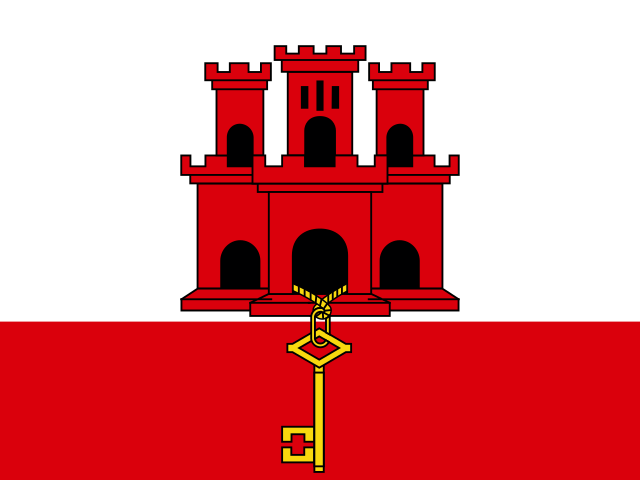
Location
Gibraltar is in Southwestern Europe, bordering the Strait of Gibraltar, which links the Mediterranean Sea and the North Atlantic Ocean, on the southern coast of Spain. It shares land borders with Spain (1 km) and has 12 km of coastline. The capital is Gibraltar.
Gibraltar population 2026: 40,923 — growth, rank & history →Key Statistics for 2026
Total population
Population Change
Median age of population
Population density
Life expectancy at birth
Female population of reproductive age
Percentage of population by degree of urbanization
Protected Land Area for Adaptation
Total deaths
Total fertility rate
Total net-migration
History
The history of Gibraltar is rich and diverse, with roots tracing back to ancient times. Originally inhabited by the Neanderthals, the Rock of Gibraltar has been a strategic location for various civilizations. The earliest known settlers were the Phoenicians, who established a trading post around 1000 BCE. Later, the region came under the influence of the Carthaginians and, subsequently, the Romans, who referred to it as "Mons Calpe." The Roman presence lasted until the decline of their empire in the 5th century CE, after which the area saw a series of invasions, including the Visigoths and later the Moors, who conquered Gibraltar in 711 CE, integrating it into the Umayyad Caliphate.
Geography
Gibraltar is a British Overseas Territory located at the southern tip of the Iberian Peninsula, bordered to the north by Spain. Its strategic position at the entrance to the Mediterranean Sea makes it a key shipping lane and a significant military outpost. The territory has a total area of approximately 6.7 square kilometers and is flanked by the Strait of Gibraltar, which separates Europe from Africa, making it a crucial point for maritime navigation. Gibraltar shares a land border with Spain that is about 1.2 kilometers long, while the rest of its perimeter is surrounded by the Mediterranean Sea.
The topography of Gibraltar is dominated by the famous Rock of Gibraltar, a limestone promontory rising to an elevation of 426 meters (1,398 feet). This prominent geological feature is flanked by a rugged coastline, characterized by cliffs and small beaches. The interior of Gibraltar consists of a series of limestone caves and tunnels, which were historically significant for both military defense and archaeological research. There are no major rivers within Gibraltar, but the terrain is interspersed with small streams and natural springs that contribute to its unique ecosystem.
Gibraltar experiences a Mediterranean climate, characterized by hot, dry summers and mild, wet winters. Average summer temperatures can reach highs of around 30°C (86°F), while winter temperatures typically range from 10°C to 17°C (50°F to 63°F). Rainfall is most common in the winter months, with an annual average of approximately 600 millimeters (23.6 inches). The region is also known for its strong winds, particularly the “Levanter,” which can bring moisture-laden air and fog, impacting visibility along the coast.
Natural resources in Gibraltar are limited due to its small size and geographical constraints, yet the territory benefits from its rich biodiversity, particularly within the Upper Rock Nature Reserve, which is home to various species of flora and fauna, including the Barbary macaques. The environmental characteristics of Gibraltar are influenced by its unique position at the crossroads of two continents, which has fostered a diverse ecosystem. Conservation efforts are ongoing to protect the natural habitats and maintain biodiversity, especially given the increasing pressures from urban development and tourism.
Government
Gibraltar is a British Overseas Territory located at the southern tip of the Iberian Peninsula. It operates under a parliamentary representative democratic system, where the Chief Minister serves as the head of government. The political structure is defined by the Gibraltar Constitution Order of 2006, which grants a high degree of self-governance to the residents while maintaining the United Kingdom's responsibility for defense and foreign affairs. The political system is characterized by a multi-party framework, with the Gibraltar Socialist Labour Party (GSLP) and the Gibraltar Conservative Party being the two primary political entities.
The government of Gibraltar is structured into three branches: the executive, legislative, and judicial. The executive branch is headed by the Chief Minister, who is supported by a Cabinet composed of ministers responsible for various portfolios. The legislative authority is vested in the Parliament of Gibraltar, which consists of 17 elected members. This unicameral body enacts laws, oversees government actions, and approves budgets. The judicial system operates independently, with the Supreme Court of Gibraltar serving as the highest court, and it is based on English common law.
Key institutions include the Office of the Chief Minister, the Parliament of Gibraltar, and the Governor of Gibraltar, who represents the British Monarch. The Governor has a ceremonial role and oversees matters related to defense and external affairs, while the Chief Minister and the Parliament handle local governance. The political landscape is dynamic, with regular elections held approximately every four years, allowing citizens to vote for their representatives. The electoral system operates on a proportional representation basis, ensuring that multiple voices and parties have a platform in the legislative process.
Gibraltar's political environment is influenced by its unique status, with discussions regarding sovereignty and self-determination being prominent themes. The territorial dispute with Spain adds a layer of complexity to its political dynamics, as both countries maintain claims over the territory. Despite these challenges, Gibraltar has developed a strong sense of identity and governance, marked by its commitment to democratic principles and the rule of law, which continue to shape its future.
Economy
Gibraltar's economy is characterized by a high degree of service-oriented activity, reflecting its strategic position at the entrance to the Mediterranean Sea. The economy operates within a mixed economic system, with a significant portion driven by tourism, financial services, and shipping. As of recent estimates, Gibraltar's Gross Domestic Product (GDP) stands at approximately $3.5 billion, with a GDP per capita of around $100,000, one of the highest in the world. This high GDP per capita underscores the affluence of its population and the effectiveness of its economic policies.
The major industries in Gibraltar include tourism, which attracts millions of visitors annually, primarily from neighboring Spain, and financial services, which benefit from a favorable regulatory environment. Other important sectors include online gaming, shipping, and logistics. The presence of numerous online gambling companies has positioned Gibraltar as a key player in the global gaming industry, contributing significantly to its economic growth. Additionally, the shipping sector benefits from Gibraltar's strategic location, serving as a critical refueling and maintenance stop for vessels traversing the Mediterranean.
Trade relationships for Gibraltar are primarily focused on its neighboring countries, particularly Spain and the United Kingdom. The territory exports goods and services valued at approximately $1.2 billion annually, with key exports including alcohol, tobacco, and online gaming services. Conversely, imports total around $1.6 billion, with significant imports of food, fuels, and manufactured goods. The close economic ties with the EU and the UK create a complex trade dynamic, especially following Brexit, which poses both challenges and opportunities for Gibraltar's economy.
Despite its relatively robust economic performance, Gibraltar faces several challenges, particularly in navigating the post-Brexit landscape. The potential for increased trade barriers with the EU could impact its economic stability. However, opportunities exist in diversifying its economy further, particularly in renewable energy and technology sectors. As Gibraltar continues to enhance its attractiveness as a business hub, the balance between maintaining economic growth and addressing environmental concerns will be crucial for its future prosperity.
Culture
Gibraltar boasts a rich tapestry of cultural influences, shaped by its unique geographical position at the entrance to the Mediterranean Sea. The predominant language is English, reflecting its status as a British Overseas Territory; however, many Gibraltarians also speak Spanish, given the proximity to Spain. A significant number of residents identify as Gibraltarian, a distinct ethnic group that has evolved from a mix of various cultures, including British, Spanish, Italian, and Maltese. The religious landscape is predominantly Catholic, with a notable presence of Anglican, Jewish, and Muslim communities, showcasing the territory's diverse cultural heritage.
Cultural traditions and customs in Gibraltar are a reflection of its multi-ethnic society. The annual National Day, celebrated on September 10, features parades, concerts, and a display of national pride, highlighting the unique identity of Gibraltarians. Additionally, the tradition of the Gibraltar Fair is a much-anticipated event that showcases local crafts, food, and entertainment, fostering community spirit and cultural exchange. The influences of Mediterranean and British customs are evident in various celebrations, from Christmas to local festivals, creating a vibrant cultural calendar that reflects a blend of traditions.
The arts scene in Gibraltar is vibrant, with a growing focus on local talent in music, visual arts, and literature. Traditional music styles, such as flamenco and morris dancing, coexist with contemporary genres, supported by local musicians and bands. Literary contributions from Gibraltarians often explore themes relevant to the territory's identity, history, and landscape. Notable writers such as Gibraltar-born poet and author have garnered recognition, further enriching the cultural narrative of this small yet dynamic community.
Culinary traditions in Gibraltar reflect a fusion of flavors, with influences from British, Mediterranean, and North African cuisines. Dishes such as calentita, a chickpea flour pancake, and spanish-style tapas are popular among locals and visitors alike. Daily life in Gibraltar is characterized by a strong sense of community, with a mix of modern living and traditional values. The compact nature of the territory encourages social interaction, making it common for residents to gather in public squares or local eateries, fostering a close-knit community atmosphere.
About This Data
This page displays comprehensive statistical data for Gibraltar for the year 2026. All data points are sourced from authoritative international organizations and are regularly updated to ensure accuracy and reliability.
Click on any statistic to explore more detailed information, see how Gibraltar compares with other countries, and view historical trends.
Primary Data Sources
CIA World Factbook
Comprehensive country profiles and demographic statistics from the Central Intelligence Agency
Learn moreUnited Nations Statistics
Global demographic data and population projections from UN agencies and research divisions
Learn moreWorld Bank Open Data
Development indicators and comprehensive population metrics from the World Bank database
Learn moreCompare Gibraltar with other countries
Side-by-side comparisons across population, GDP, geography, and more.
Frequently Asked Questions About Gibraltar
Which continent is Gibraltar in?▾
Gibraltar is in Europe, in the Southern Europe subregion according to the UN geoscheme.
What is the population of Gibraltar in 2026?▾
The population of Gibraltar in 2026 is 40,923 persons.
What is the population density of Gibraltar?▾
The population density of Gibraltar is 4,095.505 persons per square kilometer.
What is the life expectancy in Gibraltar?▾
The life expectancy at birth in Gibraltar is 87.67071 years.
What is the total fertility rate in Gibraltar?▾
The total fertility rate in Gibraltar is 1.8761463 children per woman.
What percentage of Gibraltar's land area is urbanized?▾
97% of Gibraltar's land area is urbanized.
What is the under-five mortality rate in Gibraltar?▾
The under-five mortality rate in Gibraltar is 10.20800176824082 per live births.