
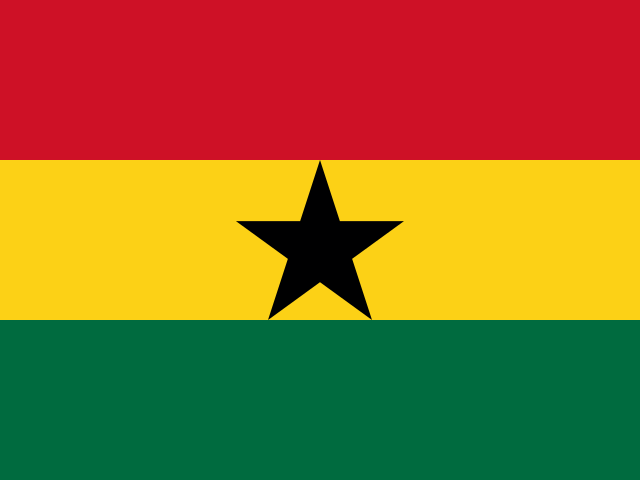
Location
Ghana is in Western Africa, bordering the Gulf of Guinea, between Cote d'Ivoire and Togo. It shares land borders with Togo (1,098 km), Cote d'Ivoire (720 km) and Burkina Faso (602 km) and has 539 km of coastline. The capital is Accra.
Ghana population 2026: 35.7 Million — growth, rank & history →Key Statistics for 2026
Total population
Population Change
Median age of population
Population density
Life expectancy at birth
Agricultural land
Current Bank Rate
Dam capacity per capita
Female population of reproductive age
Health Care Spending per Capita
Learning-adjusted years of school
History
The history of Ghana is rich and complex, tracing back to ancient times when it was home to various ethnic groups and kingdoms. The earliest known inhabitants were the Akan people, who settled in the region around 1000 BCE. Ghana's name is derived from the ancient Ghana Empire, which existed from the 6th to the 13th centuries, located in what is now southeastern Mauritania and western Mali. This empire was renowned for its wealth derived from gold and trade, facilitating connections between North Africa and sub-Saharan Africa. The rise of the Mali Empire in the 13th century overshadowed the Ghana Empire, leading to significant shifts in trade routes and political power in the region.
During the medieval period, the area that is now Ghana witnessed the emergence of powerful states, such as the Ashanti Empire in the late 17th century. Founded around 1670, the Ashanti Empire became a formidable force in West Africa, known for its military prowess and rich cultural heritage. The Ashanti engaged in extensive trade with European powers, particularly the British and the Dutch, exchanging gold, ivory, and slaves. This period was marked by significant development in governance, with sophisticated political systems and a flourishing economy based on trade and agriculture.
The colonial era began in the late 19th century when the British established the Gold Coast colony in 1874. The British colonial rule brought profound changes, including the introduction of cash crops and the disruption of local economies. Resistance to colonial rule was met with oppression, leading to numerous uprisings, such as the Ashanti-British wars. The struggle for independence gained momentum after World War II, culminating in Ghana becoming the first sub-Saharan African country to gain independence from colonial rule on March 6, 1957, under the leadership of Kwame Nkrumah. This milestone not only marked the birth of a nation but also inspired a wave of decolonization across Africa.
In recent history, Ghana has been significant for its stable democracy and economic growth in the West African region. Following a series of military coups and political instability in the late 20th century, Ghana transitioned to a multi-party democracy in 1992, setting a precedent for democratic governance in Africa. The country has since enjoyed relative peace and has become an influential player in regional politics and economics. Additionally, Ghana's rich cultural heritage, diverse population, and commitment to democratic principles continue to attract global attention and foster international relations.
Geography
Ghana is located along the Gulf of Guinea in West Africa, bordered by Côte d'Ivoire to the west, Burkina Faso to the north, and Togo to the east. The country spans approximately 238,533 square kilometers (92,099 square miles) and features a diverse range of geographical landscapes. Ghana's coastline extends for about 539 kilometers (335 miles), characterized by sandy beaches, lagoons, and estuaries. The capital city, Accra, is situated on the southeastern coast, serving as a significant political, economic, and cultural hub in the region.
The physical features of Ghana are marked by a variety of terrains, including low plains, hills, and mountainous regions. The Akwapim-Togo Mountain Range runs along the eastern border, with the highest peak, Afadja, reaching an elevation of 885 meters (2,904 feet). Major rivers, such as the Volta River, which flows from the north to the south, are vital for transportation and irrigation. The Volta Dam, located on this river, creates Lake Volta, one of the world's largest artificial lakes, which provides hydroelectric power and supports local fisheries.
Ghana experiences a tropical climate, characterized by two main seasons: a wet season and a dry season. The wet season typically lasts from April to October, bringing heavy rainfall, while the dry season, known as Harmattan, occurs from November to March, marked by dry and dusty northeast trade winds. Average temperatures range from 24°C to 32°C (75°F to 90°F) depending on the region, with the northern areas generally experiencing higher temperatures compared to the coastal regions.
The country is rich in natural resources, including gold, cocoa, and oil, which significantly contribute to its economy. Ghana is one of the world's largest cocoa producers, and its gold reserves make it one of Africa's top gold exporters. Additionally, the diverse ecosystems range from coastal wetlands to savannas and tropical forests, which host a variety of wildlife and plant species. However, environmental challenges such as deforestation, land degradation, and pollution threaten these resources, prompting the government and various organizations to implement conservation measures aimed at preserving Ghana's rich natural heritage.
Government
The Republic of Ghana operates under a unitary presidential constitutional democracy, characterized by a multi-party political system. The President of Ghana serves as both the head of state and the head of government, wielding considerable executive powers. The political framework is based on the 1992 Constitution, which establishes the principles of democratic governance, human rights, and the rule of law. Ghana’s political landscape has evolved significantly since gaining independence from British colonial rule in 1957, transitioning from periods of military rule to a stable democratic environment that has fostered regular elections and the peaceful transfer of power.
The structure of government in Ghana is divided into three branches: the executive, legislative, and judicial. The executive branch is led by the President, who is elected for a four-year term and may serve a maximum of two terms. The President appoints a Vice President and other ministers to oversee various government departments. The legislative branch consists of a unicameral Parliament, which is composed of 275 members elected by direct popular vote. This body is responsible for making laws, scrutinizing government actions, and representing the interests of Ghanaians. The judicial branch operates independently of the executive and legislature, with the Supreme Court being the highest court in the country. It ensures the interpretation of laws and the protection of constitutional rights.
Several key institutions play a crucial role in Ghana's governance, including the Electoral Commission, which oversees the electoral process, ensuring free and fair elections. The National Commission for Civic Education promotes civic awareness and participation among citizens, while the Office of the Special Prosecutor focuses on combating corruption and ensuring accountability in public office. Leadership is marked by prominent figures such as the current President, who leads the ruling party, and the Minority Leader in Parliament, who represents the opposition. These individuals are pivotal in shaping the nation’s policies and political discourse.
The electoral system in Ghana is based on universal suffrage, allowing all citizens aged 18 and above to vote in national and local elections. Elections are held every four years, with the President and Members of Parliament being elected simultaneously. The political landscape is dominated by two major parties: the National Democratic Congress (NDC) and the New Patriotic Party (NPP), although other parties also participate in the political process. Ghana is often lauded for its vibrant democracy and active civil society, which contribute to a dynamic political climate where diverse voices are heard and represented.
Economy
The economy of Ghana operates as a mixed economy, characterized by a combination of private enterprise and government involvement. As of 2023, Ghana's nominal Gross Domestic Product (GDP) is approximately $78 billion, with a GDP per capita of around $2,500. The economy has shown resilience and growth, driven by key sectors such as agriculture, services, and industry. Ghana has been recognized as one of the fastest-growing economies in Africa, largely due to its rich natural resources and strategic economic reforms.
Major industries in Ghana include agriculture, which employs a significant portion of the population, particularly in the cultivation of cocoa, which is one of the country's largest export commodities. Other important sectors include gold mining, oil and gas, and services such as telecommunications and tourism. The nation is one of the world's leading producers of cocoa and gold, contributing significantly to its export revenues. The industrial sector, although smaller compared to agriculture, is growing steadily, with investments in manufacturing and processing industries aimed at adding value to raw materials.
Ghana maintains a diverse trade network, with its primary trading partners including China, the United States, and the European Union. The country exports a range of commodities, with gold, cocoa, and oil being the top exports. In contrast, Ghana imports machinery, transport equipment, and petroleum products. The trade balance has varied, influenced by fluctuating commodity prices and the global economic environment. Efforts to enhance trade relationships, particularly within the African Continental Free Trade Area (AfCFTA), present opportunities for increased economic integration and market access.
Despite its economic progress, Ghana faces several challenges, including inflation, currency depreciation, and high public debt. These factors can hinder sustainable growth and economic stability. Additionally, the nation must address infrastructural deficits and improve its business environment to attract foreign investment. However, opportunities exist in the form of agricultural modernization, renewable energy initiatives, and digital technology advancements, all of which could spur economic diversification and enhance resilience against external shocks.
Culture
Ghana is a vibrant tapestry of cultures, shaped by its rich history and diverse ethnic groups. The country is home to over 100 distinct ethnic groups, with the Akan, Mole-Dagbani, Ewe, and Ga-Dangme being the most prominent. This diversity is reflected in the various languages spoken across the nation, with English serving as the official language. Additionally, the major indigenous languages, such as Twi, Ewe, and Dagbani, are widely spoken and play a crucial role in local identity. Religion in Ghana is equally diverse, with approximately 71% of the population identifying as Christian, about 18% as Muslim, and the remainder practicing traditional African religions or other faiths, showcasing the country’s pluralistic society.
The cultural traditions and customs of Ghana are deeply rooted in its history and reflect the values of its people. Festivals such as the Homowo of the Ga people and the Odambea of the Akuapem serve not only as significant social gatherings but also as platforms for celebrating heritage, agricultural abundance, and community spirit. Traditional ceremonies, including weddings and naming rites, are vibrant events characterized by elaborate attire, drumming, and dancing, emphasizing the importance of community and family bonds. These customs are often interwoven with spiritual beliefs, highlighting the significance of ancestral worship and the connection to the past.
Ghanaian arts and music are renowned for their creativity and vibrancy. The nation boasts a rich tradition of storytelling, poetry, and visual arts, often inspired by historical events and social issues. The music scene is equally dynamic, with genres like highlife and hiplife blending traditional rhythms with contemporary influences. Prominent musicians such as Osibisa and E.T. Mensah have gained international acclaim, while traditional drumming and dance remain integral to cultural expression. Literature also flourishes in Ghana, with writers like Ayi Kwei Armah and Ama Ata Aidoo contributing significantly to African literature, often exploring themes of identity, post-colonialism, and the human experience.
Ghanaian cuisine reflects its cultural diversity and agricultural abundance, featuring staples like rice, cassava, and yams, often paired with rich, spicy stews. Dishes such as jollof rice, fufu, and banku are popular throughout the country and are often enjoyed during communal gatherings and celebrations. Daily life in Ghana is characterized by a blend of traditional practices and modern influences, where communal living and hospitality are paramount. The importance of family and community is evident in everyday interactions, as Ghanaians prioritize social connections and support networks, contributing to the nation’s warm and welcoming atmosphere.
About This Data
This page displays comprehensive statistical data for Ghana for the year 2026. All data points are sourced from authoritative international organizations and are regularly updated to ensure accuracy and reliability.
Click on any statistic to explore more detailed information, see how Ghana compares with other countries, and view historical trends.
Primary Data Sources
CIA World Factbook
Comprehensive country profiles and demographic statistics from the Central Intelligence Agency
Learn moreUnited Nations Statistics
Global demographic data and population projections from UN agencies and research divisions
Learn moreWorld Bank Open Data
Development indicators and comprehensive population metrics from the World Bank database
Learn moreCompare Ghana with other countries
Side-by-side comparisons across population, GDP, geography, and more.
Frequently Asked Questions About Ghana
Which continent is Ghana in?▾
Ghana is in Africa, in the Western Africa subregion according to the UN geoscheme.
What is the population of Ghana in 2026?▾
The population of Ghana in 2026 is projected to be approximately 35,701,131 persons.
What is the GDP of Ghana?▾
The Gross Domestic Product (GDP) of Ghana is 87,512,411,893.5 US dollars.
What is the life expectancy in Ghana?▾
The life expectancy at birth in Ghana is approximately 68.98 years.
What is the official language of Ghana?▾
The official language of Ghana is English.
What is the population density of Ghana?▾
The population density of Ghana is approximately 156.90 persons per square kilometer.
What is the total fertility rate in Ghana?▾
The total fertility rate in Ghana is 3.25 children per woman.