
France Under-five mortality rate 2026: 3.49 per live births
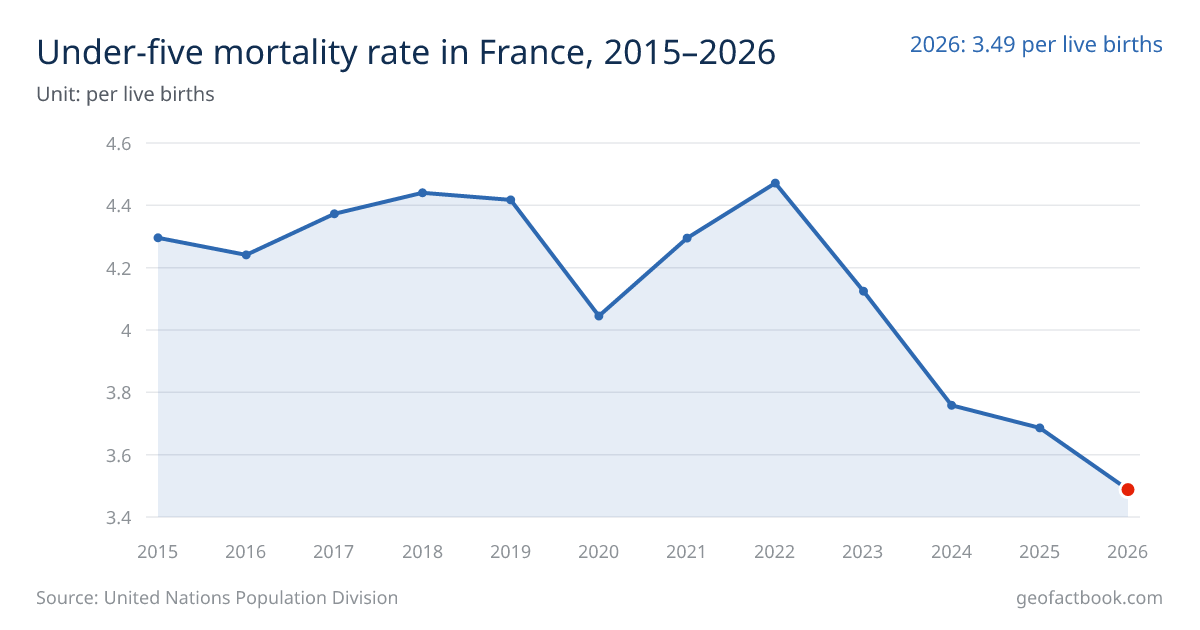
France's under-five mortality rate in 2026 is 3.49 per live births (estimate), down 5.4% from 2025. It ranks #203 of 236 countries.
The under-five mortality rate measures the number of deaths per 1,000 live births for children under five. This critical statistic highlights child health and development, reflecting a country's healthcare quality and socioeconomic conditions. Understanding these rates is vital for improving global health initiatives.
Estimated value for 2026 (interpolated, no direct source).
Where France ranks (2026)
#203 of 236- #201
 Croatia3.57 per live births
- #202
 Switzerland3.5 per live births
- #203
 France3.49 per live births
- #204
 Netherlands3.41 per live births
- #205
 Poland3.4 per live births
Under-five mortality rate over timeSome values are estimated based on historical trends
| Year | Value | Change | % Change | Actions |
|---|---|---|---|---|
| 2026 | 3.49 per live births | 0.2 per live births | -5.37% | |
| 2025 | 3.69 per live births | 0.07 per live births | -1.93% | |
| 2024 | 3.76 per live births | 0.37 per live births | -8.88% | |
| 2023 | 4.12 per live births | 0.35 per live births | -7.75% | |
| 2022 | 4.47 per live births | +0.18 per live births | +4.11% | |
| 2021 | 4.29 per live births | +0.25 per live births | +6.18% | |
| 2020 | 4.04 per live births | 0.37 per live births | -8.43% | |
| 2019 | 4.42 per live births | 0.02 per live births | -0.51% | |
| 2018 | 4.44 per live births | +0.07 per live births | +1.54% | |
| 2017 | 4.37 per live births | +0.13 per live births | +3.11% | |
| 2016 | 4.24 per live births | 0.05 per live births | -1.27% | |
| 2015 | 4.3 per live births | — | — |
Under-five mortality rate in France, 2015–2026: chart
Cite this page
Geo Factbook. (n.d.). France: Under-five mortality rate. Retrieved November 28, 2026, from https://geofactbook.com/countries/france/under-five-mortality-rate
The figures on this page come from United Nations Population Division. For academic work, cite the original source as well.
Frequently Asked Questions About France Under-five mortality rate
What is France's under-five mortality rate in 2026?▾
France's under-five mortality rate is 3.49 per live births in 2026 (estimate), according to United Nations Population Division.
Is France's under-five mortality rate increasing or decreasing?▾
France's under-five mortality rate fell by 5.4% from 2025 (3.69 per live births) to 2026 (3.49 per live births). Over the past decade (2016–2026) it fell by 17.8%.
How does France rank for under-five mortality rate?▾
In 2026, France has the 203rd highest under-five mortality rate out of 236 countries with data.
What was France's under-five mortality rate in 2015?▾
In 2015, France's under-five mortality rate was 4.30 per live births. By 2026 it fell by 18.8%.
Explore additional statistical insights
Total deaths in France
Total deaths in countries measure the number of individuals who have passed away within a specific timeframe. This statistic is crucial for understanding health trends, mortality rates, and the impact of various factors on population dynamics.
Total fertility rate in France
The total fertility rate measures the average number of children a woman is expected to have during her lifetime, reflecting population growth and demographic trends. Understanding this statistic is crucial for analyzing economic development, healthcare needs, and societal changes across countries.
Share of Population Born Abroad in France
Share of the population born in another country; reflects immigration impact on demographics; varies widely across nations.
Mean Years of Schooling in France
Mean Years of Schooling indicates the average number of years of education received by people aged 25 and older.
Contraceptive Prevalence Rate in France
Contraceptive Prevalence Rate indicates the percentage of women using contraception. Explore global rankings, compare countries, and view trends.
Population Change in France
This statistic measures population change across countries, highlighting shifts in demographics. Understanding these changes is crucial for planning resources, economic growth, and social services.