
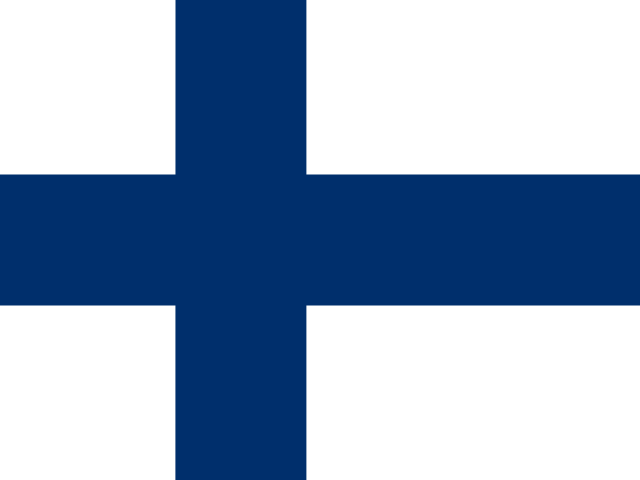
Location
Finland is in Northern Europe, bordering the Baltic Sea, Gulf of Bothnia, and Gulf of Finland, between Sweden and Russia. It shares land borders with Russia (1,309 km), Norway (709 km) and Sweden (545 km) and has 1,250 km of coastline. The capital is Helsinki.
Finland population 2026: 5.63 Million — growth, rank & history →Key Statistics for 2026
Total population
Population Change
Median age of population
Population density
Life expectancy at birth
Agricultural land
Apple Import Volume
Average Female Breast Size by Country: Worldwide Data & Rankings
Dam capacity per capita
Female population of reproductive age
Health Care Spending per Capita
History
Finland's history traces back to ancient times, with evidence of human habitation dating back to at least 8500 BC. The early inhabitants were hunter-gatherers who migrated from the south and east, utilizing the rich natural resources of the region. As the Bronze Age approached around 1500 BC, trade networks began to form, linking Finland with neighboring cultures in Scandinavia and the Baltic region. The arrival of the Sámi people, who adapted to the northern wilderness, also marks a significant period in early Finnish history, as they developed distinct cultural practices that remain part of Finland's heritage today.
During the medieval period, Finland was influenced heavily by the expansion of the Kingdom of Sweden. In 1155, the first Swedish crusade led by Bishop Henrik marked the beginning of Swedish rule over Finland. This era saw the establishment of Christianity in the region, which further integrated Finland into European political and cultural spheres. By the end of the 13th century, Finland was firmly under Swedish control, and several towns were founded, including Turku, which became a significant cultural and administrative center. The medieval period also witnessed conflicts, such as the Finnish War of 1808-1809, which ultimately resulted in Finland being ceded to Russia.
Finland declared independence from Russia on December 6, 1917, amidst the turmoil of the Russian Revolution. This pivotal moment was followed by a brief civil war in 1918 between the Red Guards, who supported socialist ideals, and the White Guards, who sought to establish a conservative government. The conflict ended in favor of the Whites, solidifying a republican form of governance. Throughout the interwar years, Finland developed a strong national identity, facing challenges such as economic instability and regional tensions, notably with the Soviet Union.
In recent history, Finland has played a significant role on the global stage, particularly noted for its position during the Cold War as a neutral state. The Winter War with the Soviet Union in 1939-1940 and the Continuation War from 1941-1944 were significant events that shaped its modern borders and defense policies. Post-World War II, Finland focused on rebuilding and fostering relations with Western Europe, joining the European Union in 1995. Today, Finland is recognized for its high quality of life, education system, and commitment to social welfare, making it a model for many nations worldwide.
Geography
Finland is located in Northern Europe, bordered by Sweden to the west, Norway to the north, and Russia to the east. The country also has a coastline along the Baltic Sea to the south, featuring the Gulf of Finland and the Gulf of Bothnia. With an area of approximately 338,424 square kilometers, Finland ranks as the eighth largest country in Europe. Its geographical position grants it a unique cultural and climatic blend, making it a significant point of interest in the Nordic region.
The physical features of Finland are characterized by its predominantly flat terrain, with about 75% of the land area covered by forests. The country is known for its thousands of lakes—approximately 188,000—which contribute to its stunning landscapes. The most significant of these is Lake Saimaa, the largest lake in Finland. The northwestern part of the country is home to the Scandinavian Mountains, which extend into Norway. The highest peak, Halti, reaches an elevation of 1,324 meters above sea level. Additionally, Finland's geography includes numerous rivers, such as the Kemijoki and Oulujoki, which play crucial roles in the country’s hydrology and ecosystem.
Finland experiences a varied climate, classified as a humid continental climate in most areas, with a subarctic climate prevailing in the northern regions. Winters are long and cold, with temperatures often dropping below -30°C in the north. Conversely, summers are short and mild, with average temperatures ranging from 15°C to 25°C. The country experiences significant variations in daylight hours, particularly in the summer, where the phenomenon known as the "Midnight Sun" occurs, while winter brings long periods of darkness. Precipitation is relatively evenly distributed throughout the year, with snow cover persisting from late autumn to early spring.
Finland is rich in natural resources, including timber, minerals, and fresh water. The extensive forests provide a sustainable source of timber, which is a vital component of the Finnish economy. The country also has significant deposits of minerals, such as copper, nickel, and gold, contributing to its mining industry. Environmental characteristics include a commitment to sustainability and conservation, with numerous national parks and protected areas that preserve Finland's unique flora and fauna. The Finnish government actively promotes environmental awareness, ensuring that the natural landscapes remain pristine for future generations.
Government
Finland operates as a parliamentary republic, characterized by a multi-party system that emphasizes democratic governance and the rule of law. The political structure is defined by a division of powers among the executive, legislative, and judicial branches. The President of Finland serves as the head of state, while the Prime Minister, typically the leader of the majority party in the Eduskunta (Parliament), acts as the head of government. This dual leadership framework allows for a balance of powers and responsibilities, fostering a stable political environment.
The Finnish government is structured into three main branches: the executive, legislative, and judicial branches. The executive branch is led by the President, who is directly elected for a six-year term and eligible for re-election once. The Prime Minister and the Cabinet, composed of ministers from various parties, are responsible for the administration of government policies. The legislative power resides in the Eduskunta, a unicameral parliament consisting of 200 members elected through a proportional representation system. This structure ensures that various political voices are represented in the decision-making process.
Key institutions within the Finnish government include the Supreme Court, which oversees the judicial system, and the Parliamentary Ombudsman, who ensures that public authorities act in accordance with the law. The President also plays a significant role in foreign affairs and has the authority to appoint ambassadors and approve treaties. The independent judiciary upholds the Constitution and ensures the protection of citizens' rights, thereby reinforcing democratic principles across the nation.
The electoral system in Finland is based on proportional representation, allowing for a diverse political landscape that includes numerous parties. Elections are held every four years, and citizens aged 18 and over are eligible to vote. This system encourages coalition governments, as no single party typically gains an outright majority. Finland's political landscape is marked by a strong commitment to social welfare, environmental sustainability, and human rights, reflecting the values of its citizens and influencing policy decisions at both national and local levels.
Economy
Finland operates under a mixed economic system, combining elements of both capitalism and social welfare. The country's gross domestic product (GDP) was approximately $300 billion in 2022, with a GDP per capita of around $54,000, placing it among the wealthiest nations in the world. The Finnish economy is characterized by a high level of technological advancement and innovation, contributing significantly to its economic resilience and growth. A strong emphasis on education and research has propelled Finland to the forefront of various sectors, particularly in technology and renewable energy.
The major industries in Finland include manufacturing, services, and agriculture, with the manufacturing sector accounting for a substantial portion of the GDP. Key industries encompass electronics, machinery, and the timber and paper industries, which have historically been vital to the Finnish economy. Notable Finnish companies such as Nokia and Kone highlight the strength of the technology and telecommunications sectors. The services sector, which includes trade, transportation, and tourism, is also a significant contributor to economic output, employing a large swath of the population.
In terms of trade relationships, Finland is an active participant in the global market, with exports accounting for approximately 40% of its GDP. The European Union is Finland's largest trading partner, with Germany and Sweden being the most significant markets for Finnish goods. Major exports include machinery, electronic products, and forest industry products, while imports mainly consist of raw materials, energy, and consumer goods. Finland's strategic location and well-developed infrastructure enhance its role as a gateway for trade between Europe and Russia, further bolstering its economic landscape.
Despite its strong economic performance, Finland faces several challenges, including an aging population, which poses risks to its labor market and social welfare systems. Additionally, Finland must navigate global economic uncertainties, including fluctuations in trade and energy prices. However, opportunities exist in the fields of green technology and digitalization, where Finland aims to leverage its expertise to drive sustainable growth. By focusing on innovation and maintaining a robust education system, Finland is well-positioned to meet these challenges and capitalize on emerging economic trends.
Culture
Finland is a nation characterized by its rich cultural tapestry, where the predominant language is Finnish, a unique member of the Uralic language family, alongside Swedish, which holds co-official status. Approximately 5% of the population speaks Swedish, primarily in the coastal regions. The Finnish population is predominantly ethnic Finns, but the country is also home to the indigenous Sámi people, who have their own distinct languages and cultural practices. In terms of religion, Finland is largely Lutheran, with the Evangelical Lutheran Church of Finland being the largest denomination. Other religious beliefs, including Orthodox Christianity and various minority faiths, contribute to the nation's cultural diversity.
Finnish culture is deeply rooted in traditions and customs that reflect the country's history and natural environment. One of the most significant cultural events is Juhannus, or Midsummer, celebrated with bonfires and gatherings to mark the summer solstice. The Finnish sauna also holds a central place in daily life, serving as a space for relaxation and socialization, and is considered a vital part of Finnish identity. Other customs include the celebration of Christmas, where traditions such as the "Joulupukki," or Christmas goat, and the preparation of special dishes like "joulutorttu" (Christmas tarts) are widely practiced.
The arts in Finland are vibrant and diverse, encompassing a broad spectrum of music, literature, and visual arts. Finland has produced renowned composers such as Jean Sibelius, whose symphonies reflect the landscapes of his homeland. The country boasts a thriving contemporary music scene, with genres ranging from classical to heavy metal. In literature, Finnish authors like Franz Kafkas and Tove Jansson have made significant contributions, with works often reflecting themes of nature, identity, and societal issues. The annual Helsinki Book Fair and events like the Turku Medieval Market celebrate this literary heritage, allowing writers and readers to connect.
Finnish cuisine is a reflection of the country's geographical features and seasonal availability of ingredients. Traditional dishes often include rye bread, fish, and root vegetables, with "karjalanpiirakka" (Karelian pasties) being a beloved staple. The concept of "sisu," which translates to perseverance and resilience, pervades daily life in Finland, influencing everything from work ethics to social interactions. The Finnish lifestyle often emphasizes a strong connection with nature, which is evident in the popularity of outdoor activities such as hiking and berry picking, fostering a sense of community and appreciation for the natural world.
About This Data
This page displays comprehensive statistical data for Finland for the year 2026. All data points are sourced from authoritative international organizations and are regularly updated to ensure accuracy and reliability.
Click on any statistic to explore more detailed information, see how Finland compares with other countries, and view historical trends.
Primary Data Sources
CIA World Factbook
Comprehensive country profiles and demographic statistics from the Central Intelligence Agency
Learn moreUnited Nations Statistics
Global demographic data and population projections from UN agencies and research divisions
Learn moreWorld Bank Open Data
Development indicators and comprehensive population metrics from the World Bank database
Learn moreCompare Finland with other countries
Side-by-side comparisons across population, GDP, geography, and more.
Frequently Asked Questions About Finland
Which continent is Finland in?▾
Finland is in Europe, in the Northern Europe subregion according to the UN geoscheme.
What is the population of Finland in 2026?▾
The population of Finland in 2026 is approximately 5,629,348.5 persons.
What is the GDP of Finland in 2026?▾
The GDP of Finland in 2026 is 310,915,941,574.26 US dollars.
What is the life expectancy in Finland?▾
The life expectancy at birth in Finland is 85.05 years.
What is the official language of Finland?▾
The official languages of Finland are Finnish and Swedish.
What is the capital of Finland?▾
The capital of Finland is Helsinki.
What is the population density of Finland in 2026?▾
The population density of Finland in 2026 is approximately 18.70 persons per square kilometer.