
Fiji Population 2026: 937,525
The population of Fiji in 2026 is 937,525 people (estimate), up 0.5% from 2025. It is the 162nd most populous of 236 countries.
Discover the latest total population statistics for every country and region worldwide. Explore accurate, up-to-date data on global population growth, density, and demographic trends — sourced from trusted international databases like the UN and World Bank. Perfect for researchers, students, and data enthusiasts looking to understand how the world’s population is changing.
Estimated value for 2026 (interpolated, no direct source).
Where Fiji ranks (2026)
#162 of 236- #160
 Mauritius1.27M persons
- #161
 Djibouti1.2M persons
- #162
 Fiji937,525 persons
- #163
 Comoros899,067 persons
- #164
 Réunion886,220.5 persons
Total population over timeSome values are estimated based on historical trends
| Year | Value | Change | % Change | Actions |
|---|---|---|---|---|
| 2026 | 937.52K persons | +4.37K persons | +0.47% | |
| 2025 | 933.15K persons | +4.37K persons | +0.47% | |
| 2024 | 928.78K persons | +4.64K persons | +0.50% | |
| 2023 | 924.15K persons | +4.72K persons | +0.51% | |
| 2022 | 919.42K persons | +2.71K persons | +0.30% | |
| 2021 | 916.71K persons | +1.75K persons | +0.19% | |
| 2020 | 914.96K persons | +63.5 persons | +0.01% | |
| 2019 | 914.90K persons | 2.28K persons | -0.25% | |
| 2018 | 917.18K persons | 1.58K persons | -0.17% | |
| 2017 | 918.76K persons | 407.5 persons | -0.04% | |
| 2016 | 919.17K persons | +588 persons | +0.06% | |
| 2015 | 918.58K persons | +993.5 persons | +0.11% | |
| 2014 | 917.58K persons | +1.23K persons | +0.13% | |
| 2013 | 916.35K persons | +1.43K persons | +0.16% | |
| 2012 | 914.92K persons | +1.93K persons | +0.21% | |
| 2011 | 912.99K persons | +2.57K persons | +0.28% | |
| 2010 | 910.42K persons | +3.18K persons | +0.35% | |
| 2009 | 907.24K persons | +3.84K persons | +0.43% | |
| 2008 | 903.40K persons | +5.57K persons | +0.62% | |
| 2007 | 897.83K persons | +7.47K persons | +0.84% | |
| 2006 | 890.37K persons | +7.99K persons | +0.91% | |
| 2005 | 882.38K persons | +8.01K persons | +0.92% | |
| 2004 | 874.37K persons | +8.08K persons | +0.93% | |
| 2003 | 866.29K persons | +8.24K persons | +0.96% | |
| 2002 | 858.05K persons | +8.45K persons | +1.00% | |
| 2001 | 849.60K persons | +8.69K persons | +1.03% | |
| 2000 | 840.91K persons | +9.08K persons | +1.09% | |
| 1999 | 831.83K persons | +9.57K persons | +1.16% | |
| 1998 | 822.26K persons | +10.12K persons | +1.25% | |
| 1997 | 812.14K persons | +8.35K persons | +1.04% | |
| 1996 | 803.79K persons | +5.04K persons | +0.63% | |
| 1995 | 798.75K persons | +3.98K persons | +0.50% | |
| 1994 | 794.77K persons | +4.40K persons | +0.56% | |
| 1993 | 790.37K persons | +5.02K persons | +0.64% | |
| 1992 | 785.35K persons | +5.69K persons | +0.73% | |
| 1991 | 779.66K persons | +6.34K persons | +0.82% | |
| 1990 | 773.32K persons | +7.00K persons | +0.91% | |
| 1989 | 766.32K persons | +7.62K persons | +1.00% | |
| 1988 | 758.70K persons | +8.16K persons | +1.09% | |
| 1987 | 750.54K persons | +11.23K persons | +1.52% | |
| 1986 | 739.31K persons | +15.54K persons | +2.15% | |
| 1985 | 723.76K persons | +17.05K persons | +2.41% | |
| 1984 | 706.72K persons | +16.88K persons | +2.45% | |
| 1983 | 689.84K persons | +16.42K persons | +2.44% | |
| 1982 | 673.41K persons | +15.94K persons | +2.42% | |
| 1981 | 657.47K persons | +15.50K persons | +2.41% | |
| 1980 | 641.97K persons | +15.11K persons | +2.41% | |
| 1979 | 626.86K persons | +14.77K persons | +2.41% | |
| 1978 | 612.09K persons | +14.29K persons | +2.39% | |
| 1977 | 597.80K persons | +12.27K persons | +2.10% | |
| 1976 | 585.53K persons | +9.63K persons | +1.67% | |
| 1975 | 575.91K persons | — | — |
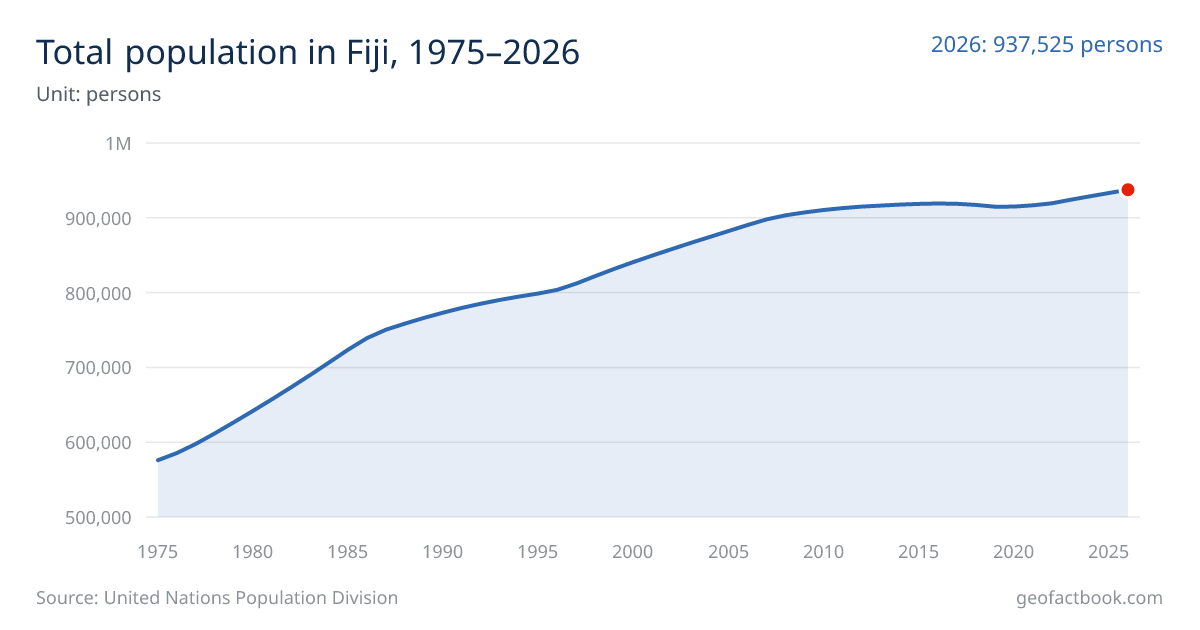
Total population in Fiji, 1975–2026: chart
Cite this page
Geo Factbook. (n.d.). Fiji: Total population. Retrieved November 27, 2026, from https://geofactbook.com/countries/fiji/total-population
The figures on this page come from UNdata. For academic work, cite the original source as well.
Frequently Asked Questions About Fiji Population
What is the population of Fiji in 2026?▾
Fiji has a population of 937,525 people in 2026 (estimate), according to United Nations Population Division.
Is the population of Fiji growing?▾
Fiji's population rose by 0.5% from 2025 (933,155) to 2026 (937,525). Over the past decade (2016–2026) it rose by 2.0%.
How does Fiji rank by population?▾
In 2026, Fiji is the 162nd most populous country out of 236 countries with data.
What was the population of Fiji in 1975?▾
In 1975, Fiji's population was 575,906 people. By 2026 it rose by 62.8%.
Explore additional statistical insights
Wine Consumption Per Capita in Fiji
Wine consumption per capita measures the average liters of wine consumed by individuals in a country annually.
Female Homicide Rate in Fiji
Female homicide rate measures the number of women murdered per 100,000 women annually, highlighting gender-based violence levels.
Major Urban Areas Population in Fiji
Explore population figures for major urban areas worldwide. Compare cities, view rankings, and interact with detailed maps.
Female population of reproductive age in Fiji
The female population of reproductive age is a crucial demographic statistic that influences healthcare, economic growth, and social policies in countries. Understanding this population helps address reproductive health needs and support family planning initiatives.
Percentage of population by degree of urbanization in Fiji
Explore the percentage of population by degree of urbanization across countries, highlighting the shift towards urban living and its impact on economic growth and development. Understanding these trends is crucial for addressing urban planning and resource allocation.
Under-five mortality rate in Fiji
The under-five mortality rate measures the number of deaths per 1,000 live births for children under five. This critical statistic highlights child health and development, reflecting a country's healthcare quality and socioeconomic conditions. Understanding these rates is vital for improving global health initiatives.