
Europe, Northern America, Australia, and New Zealand Physician Density 2025: 0.25 people/sq km
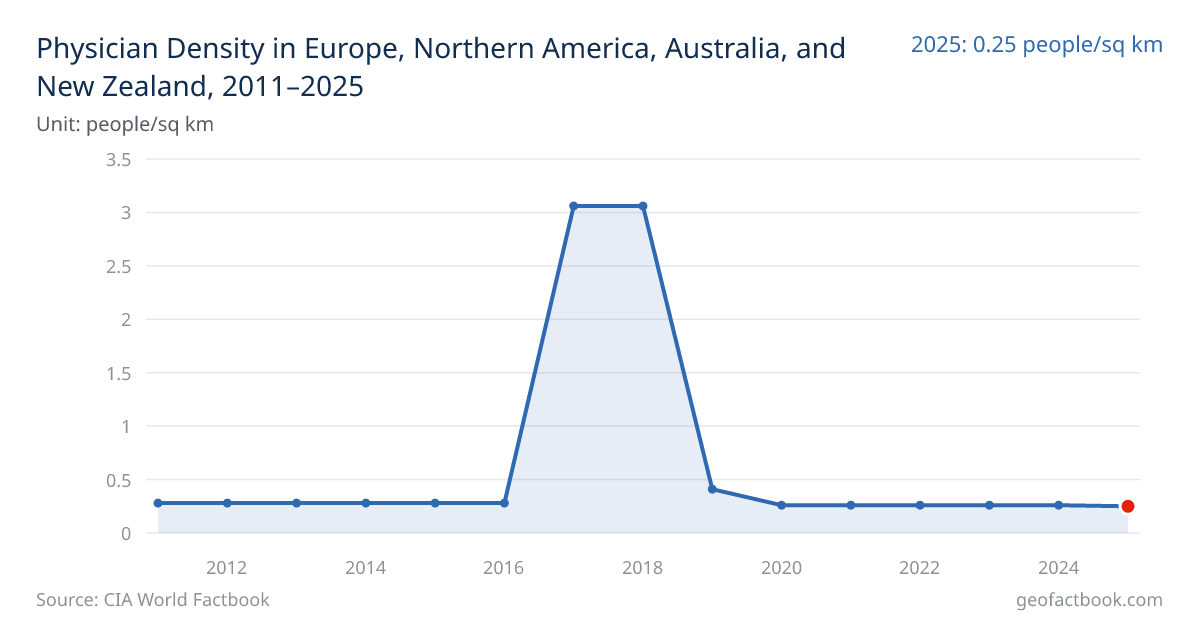
Europe, Northern America, Australia, and New Zealand's physician density in 2025 is 0.25 people/sq km, down 3.8% from 2024.
Physician density measures healthcare access, showing the number of doctors per square kilometer. Compare countries and explore interactive maps.
More about Europe, Northern America, Australia, and New Zealand
Physician Density by country 2025 →All 59 statistics about Europe, Northern America, Australia, and New Zealand →Physician Density over time
| Year | Value | Change | % Change | Actions |
|---|---|---|---|---|
| 2025 | 0.25 people/sq km | 0.01 people/sq km | -3.85% | |
| 2024 | 0.26 people/sq km | 0 people/sq km | 0.00% | |
| 2023 | 0.26 people/sq km | 0 people/sq km | 0.00% | |
| 2022 | 0.26 people/sq km | 0 people/sq km | 0.00% | |
| 2021 | 0.26 people/sq km | 0 people/sq km | 0.00% | |
| 2020 | 0.26 people/sq km | 0.15 people/sq km | -36.59% | |
| 2019 | 0.41 people/sq km | 2.65 people/sq km | -86.60% | |
| 2018 | 3.06 people/sq km | 0 people/sq km | 0.00% | |
| 2017 | 3.06 people/sq km | +2.78 people/sq km | +992.86% | |
| 2016 | 0.28 people/sq km | 0 people/sq km | 0.00% | |
| 2015 | 0.28 people/sq km | 0 people/sq km | 0.00% | |
| 2014 | 0.28 people/sq km | 0 people/sq km | 0.00% | |
| 2013 | 0.28 people/sq km | 0 people/sq km | 0.00% | |
| 2012 | 0.28 people/sq km | 0 people/sq km | 0.00% | |
| 2011 | 0.28 people/sq km | — | — |
Physician Density in Europe, Northern America, Australia, and New Zealand, 2011–2025: chart
Cite this page
Geo Factbook. (n.d.). Europe, Northern America, Australia, and New Zealand: Physician Density. Retrieved November 29, 2026, from https://geofactbook.com/countries/europe-northern-america-australia-and-new-zealand/physician-density
The figures on this page come from CIA World Factbook. For academic work, cite the original source as well.
Frequently Asked Questions About Europe, Northern America, Australia, and New Zealand Physician Density
What is Europe, Northern America, Australia, and New Zealand's physician density in 2025?▾
Europe, Northern America, Australia, and New Zealand's physician density is 0.25 people/sq km in 2025, according to CIA World Factbook.
Is Europe, Northern America, Australia, and New Zealand's physician density increasing or decreasing?▾
Europe, Northern America, Australia, and New Zealand's physician density fell by 3.8% from 2024 (0.26 people/sq km) to 2025 (0.25 people/sq km). Over the past decade (2015–2025) it fell by 10.7%.
What was Europe, Northern America, Australia, and New Zealand's physician density in 2011?▾
In 2011, Europe, Northern America, Australia, and New Zealand's physician density was 0.28 people/sq km. By 2025 it fell by 10.7%.
Explore additional statistical insights
Total net-migration in Europe, Northern America, Australia, and New Zealand
Total net-migration measures the difference between the number of immigrants and emigrants in a country, reflecting population shifts and economic opportunities. Understanding this statistic is crucial for analyzing demographic trends and policy impacts in nations worldwide.
Population Growth Rate in Europe, Northern America, Australia, and New Zealand
Explore the Population Growth Rate across 266+ countries. Compare trends, view rankings, and interact with detailed maps.
Underweight Children Under 5 in Europe, Northern America, Australia, and New Zealand
Underweight children under 5 highlights global health disparities. Explore country rankings and interactive maps to see trends and comparisons.
HIV/AIDS Adult Prevalence Rate in Europe, Northern America, Australia, and New Zealand
HIV/AIDS Adult Prevalence Rate reveals the percentage of adults affected. Compare countries, explore rankings, and view historical trends.
Military Service Age and Obligation in Europe, Northern America, Australia, and New Zealand
Military service age and obligation details for 266+ countries. Compare requirements, explore rankings, and view interactive maps.
Median age of population in Europe, Northern America, Australia, and New Zealand
The median age of a population is a key demographic indicator, reflecting the age distribution within a country. Understanding median age helps assess economic development, healthcare needs, and social dynamics. Countries with a higher median age may face challenges related to aging populations, while younger populations often indicate growth potential.