
Egypt Urban Population Share 2050 2025: 42.90 %
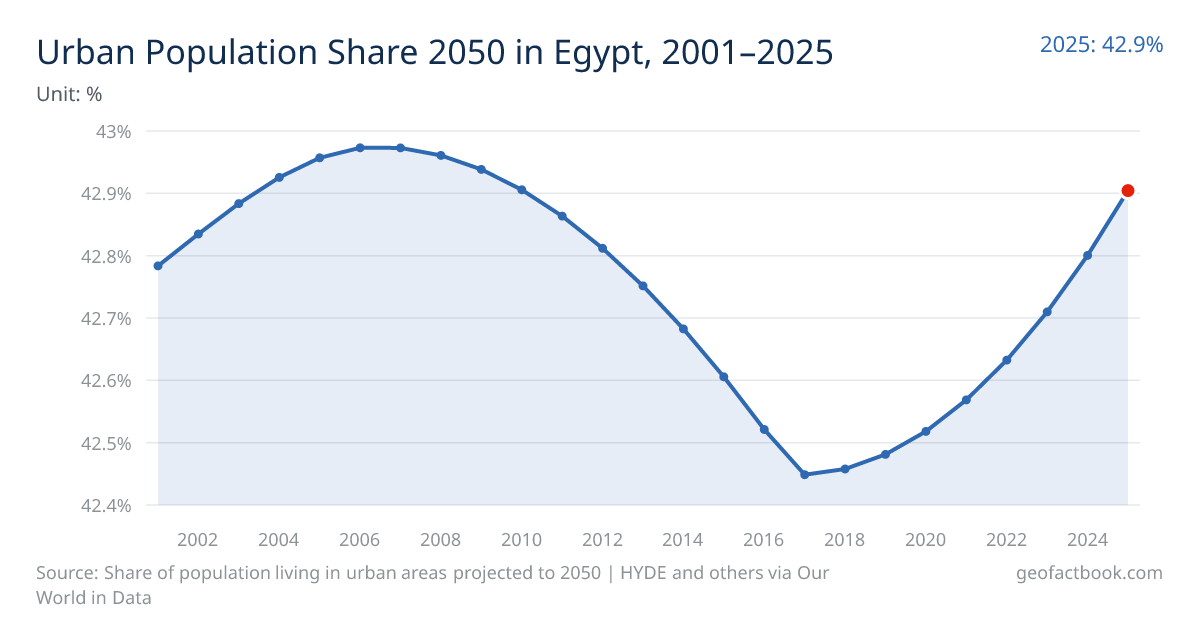
Egypt's urban population share 2050 in 2025 is 42.90 %, up 0.2% from 2024. It ranks #180 of 236 countries.
Urban population share by 2050 shows urbanization trends. Discover which countries will be most urbanized.
Source (2025): Share of population living in urban areas projected to 2050 | Our World in Data
Where Egypt ranks (2025)
#180 of 236




Urban Population Share 2050 over time
| Year | Value | Change | % Change | Actions |
|---|---|---|---|---|
| 2025 | 42.9 % | +0.1 % | +0.24% | |
| 2024 | 42.8 % | +0.09 % | +0.21% | |
| 2023 | 42.71 % | +0.08 % | +0.18% | |
| 2022 | 42.63 % | +0.06 % | +0.15% | |
| 2021 | 42.57 % | +0.05 % | +0.12% | |
| 2020 | 42.52 % | +0.04 % | +0.09% | |
| 2019 | 42.48 % | +0.02 % | +0.06% | |
| 2018 | 42.46 % | +0.01 % | +0.02% | |
| 2017 | 42.45 % | 0.07 % | -0.17% | |
| 2016 | 42.52 % | 0.08 % | -0.20% | |
| 2015 | 42.61 % | 0.08 % | -0.18% | |
| 2014 | 42.68 % | 0.07 % | -0.16% | |
| 2013 | 42.75 % | 0.06 % | -0.14% | |
| 2012 | 42.81 % | 0.05 % | -0.12% | |
| 2011 | 42.86 % | 0.04 % | -0.10% | |
| 2010 | 42.91 % | 0.03 % | -0.08% | |
| 2009 | 42.94 % | 0.02 % | -0.05% | |
| 2008 | 42.96 % | 0.01 % | -0.03% | |
| 2007 | 42.97 % | 0 % | -0.00% | |
| 2006 | 42.97 % | +0.02 % | +0.04% | |
| 2005 | 42.96 % | +0.03 % | +0.07% | |
| 2004 | 42.93 % | +0.04 % | +0.10% | |
| 2003 | 42.88 % | +0.05 % | +0.11% | |
| 2002 | 42.83 % | +0.05 % | +0.12% | |
| 2001 | 42.78 % | — | — |
Urban Population Share 2050 in Egypt, 2001–2025: chart
Cite this page
Geo Factbook. (n.d.). Egypt: Urban Population Share 2050. Retrieved November 29, 2026, from https://geofactbook.com/countries/egypt/urban-population-share-2050
The figures on this page come from Share of population living in urban areas projected to 2050 | HYDE and others via Our World in Data. For academic work, cite the original source as well.
Frequently Asked Questions About Egypt Urban Population Share 2050
What is Egypt's urban population share 2050 in 2025?▾
Egypt's urban population share 2050 is 42.90 % in 2025, according to Share of population living in urban areas projected to 2050 | HYDE and others via Our World in Data.
Is Egypt's urban population share 2050 increasing or decreasing?▾
Egypt's urban population share 2050 rose by 0.2% from 2024 (42.80 %) to 2025 (42.90 %). Over the past decade (2015–2025) it rose by 0.7%.
How does Egypt rank for urban population share 2050?▾
In 2025, Egypt has the 180th highest urban population share 2050 out of 236 countries with data.
What was Egypt's urban population share 2050 in 2001?▾
In 2001, Egypt's urban population share 2050 was 42.78 %. By 2025 it rose by 0.3%.
Explore additional statistical insights
Human Development Index in Egypt
The Human Development Index combines indicators of health, education, and income to assess development levels.
Length of paid parental leave for mother in Egypt
Discover how the length of paid parental leave for mothers varies by country, impacting family well-being and workforce participation. Explore the statistics that highlight this critical social issue.
Mean Years of Schooling in Egypt
Mean Years of Schooling indicates the average number of years of education received by people aged 25 and older.
Female population of reproductive age in Egypt
The female population of reproductive age is a crucial demographic statistic that influences healthcare, economic growth, and social policies in countries. Understanding this population helps address reproductive health needs and support family planning initiatives.
Currently married (Percent) in Egypt
The percentage of currently married individuals by country highlights societal trends in family structure and relationships. Understanding these statistics can provide insights into cultural norms and demographic shifts, influencing policies and social programs.
Under-five mortality rate in Egypt
The under-five mortality rate measures the number of deaths per 1,000 live births for children under five. This critical statistic highlights child health and development, reflecting a country's healthcare quality and socioeconomic conditions. Understanding these rates is vital for improving global health initiatives.