
Egypt Hospital Beds per Capita 2021: 1.06 beds per 1,000
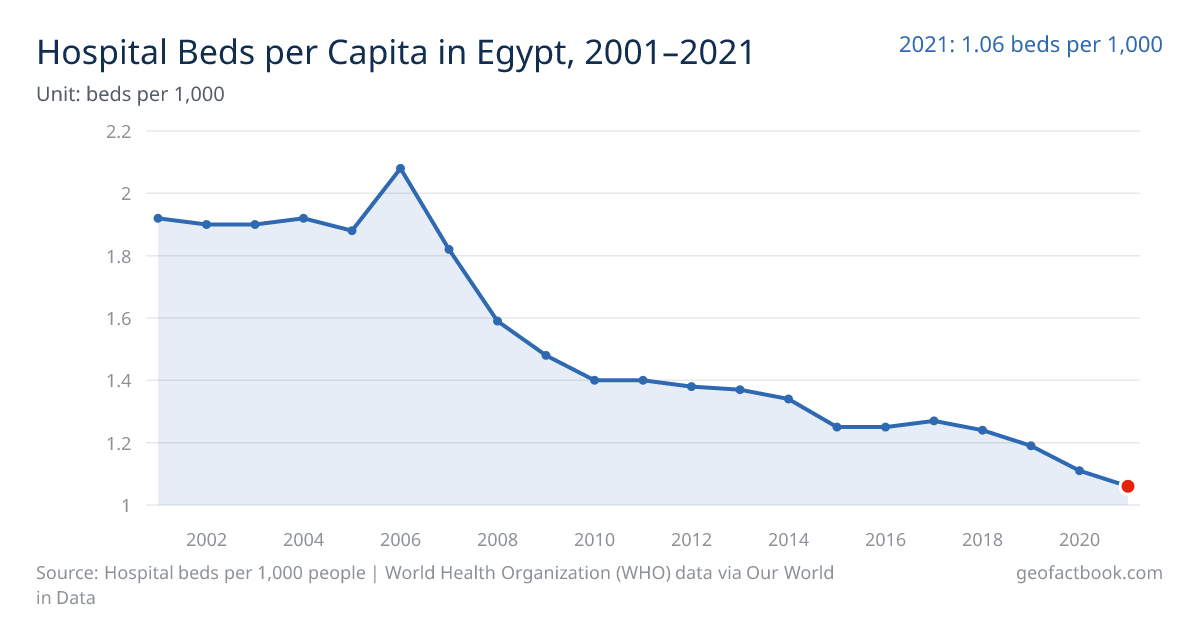
Egypt's hospital beds per capita in 2021 is 1.06 beds per 1,000, down 4.5% from 2020. It ranks #107 of 125 countries.
Hospital beds per capita highlights healthcare infrastructure by showing available hospital beds per 1,000 people globally.
Source (2021): Hospital beds per 1,000 people | Our World in Data
Where Egypt ranks (2021)
#107 of 125- #105
 Paraguay1.13 beds per 1,000
- #106
 Belize1.09 beds per 1,000
- #107
 Egypt1.06 beds per 1,000
- #107
 Eritrea1.06 beds per 1,000
- #109
 Mexico1.01 beds per 1,000
Hospital Beds per Capita over time
| Year | Value | Change | % Change | Actions |
|---|---|---|---|---|
| 2021 | 1.06 beds per 1,000 | 0.05 beds per 1,000 | -4.50% | |
| 2020 | 1.11 beds per 1,000 | 0.08 beds per 1,000 | -6.72% | |
| 2019 | 1.19 beds per 1,000 | 0.05 beds per 1,000 | -4.03% | |
| 2018 | 1.24 beds per 1,000 | 0.03 beds per 1,000 | -2.36% | |
| 2017 | 1.27 beds per 1,000 | +0.02 beds per 1,000 | +1.60% | |
| 2016 | 1.25 beds per 1,000 | 0 beds per 1,000 | 0.00% | |
| 2015 | 1.25 beds per 1,000 | 0.09 beds per 1,000 | -6.72% | |
| 2014 | 1.34 beds per 1,000 | 0.03 beds per 1,000 | -2.19% | |
| 2013 | 1.37 beds per 1,000 | 0.01 beds per 1,000 | -0.72% | |
| 2012 | 1.38 beds per 1,000 | 0.02 beds per 1,000 | -1.43% | |
| 2011 | 1.4 beds per 1,000 | 0 beds per 1,000 | 0.00% | |
| 2010 | 1.4 beds per 1,000 | 0.08 beds per 1,000 | -5.41% | |
| 2009 | 1.48 beds per 1,000 | 0.11 beds per 1,000 | -6.92% | |
| 2008 | 1.59 beds per 1,000 | 0.23 beds per 1,000 | -12.64% | |
| 2007 | 1.82 beds per 1,000 | 0.26 beds per 1,000 | -12.50% | |
| 2006 | 2.08 beds per 1,000 | +0.2 beds per 1,000 | +10.64% | |
| 2005 | 1.88 beds per 1,000 | 0.04 beds per 1,000 | -2.08% | |
| 2004 | 1.92 beds per 1,000 | +0.02 beds per 1,000 | +1.05% | |
| 2003 | 1.9 beds per 1,000 | 0 beds per 1,000 | 0.00% | |
| 2002 | 1.9 beds per 1,000 | 0.02 beds per 1,000 | -1.04% | |
| 2001 | 1.92 beds per 1,000 | — | — |
Hospital Beds per Capita in Egypt, 2001–2021: chart
Cite this page
Geo Factbook. (n.d.). Egypt: Hospital Beds per Capita. Retrieved November 28, 2026, from https://geofactbook.com/countries/egypt/hospital-beds-per-capita
The figures on this page come from Hospital beds per 1,000 people | World Health Organization (WHO) data via Our World in Data. For academic work, cite the original source as well.
Frequently Asked Questions About Egypt Hospital Beds per Capita
What is Egypt's hospital beds per capita in 2021?▾
Egypt's hospital beds per capita is 1.06 beds per 1,000 in 2021, according to Hospital beds per 1,000 people | World Health Organization (WHO) data via Our World in Data.
Is Egypt's hospital beds per capita increasing or decreasing?▾
Egypt's hospital beds per capita fell by 4.5% from 2020 (1.11 beds per 1,000) to 2021 (1.06 beds per 1,000). Over the past decade (2011–2021) it fell by 24.3%.
How does Egypt rank for hospital beds per capita?▾
In 2021, Egypt has the 107th highest hospital beds per capita out of 125 countries with data.
What was Egypt's hospital beds per capita in 2001?▾
In 2001, Egypt's hospital beds per capita was 1.92 beds per 1,000. By 2021 it fell by 44.8%.
Explore additional statistical insights
Male Smoking Prevalence in Egypt
Male smoking prevalence indicates the percentage of men who smoke in each country. Understand global trends and health impacts.
Hepatitis B Immunization Rate in Children in Egypt
Tracks the vaccination rate for hepatitis B in children, crucial for preventing liver disease.
Hospital Bed Density in Egypt
Hospital Bed Density measures healthcare access per area. Compare countries, explore interactive maps, and view historical trends.
Physicians per 1,000 People in Egypt
The total number of doctors in each country reflects healthcare workforce size and capacity to serve the population.
Stomach Cancer Mortality Rate in Egypt
Stomach cancer mortality rate measures deaths per 100,000 people annually, highlighting regional health challenges.
Women Tobacco Use by Age Group in Egypt
Women tobacco use by age group; compare age-specific smoking and tobacco habits among females globally.