
Egypt Fertilizer Use Per Hectare 2024: 597.78 kg/ha
Egypt's fertilizer use per hectare in 2024 is 597.78 kg/ha, down 3.3% from 2023. It ranks #8 of 189 countries.
Fertilizer use per hectare shows how much fertilizer is applied to agricultural land in different countries, impacting crop yield.
Source (2024): Fertilizer use per hectare
Where Egypt ranks (2024)
#8 of 189- #6
 Ireland986.62 kg/ha
- #7
 Bahrain769.05 kg/ha
- #8
 Egypt597.78 kg/ha
- #9
 Faroe Islands571.43 kg/ha
- #10
 China, Hong Kong SAR482.5 kg/ha
Fertilizer Use Per Hectare over time
| Year | Value | Change | % Change | Actions |
|---|---|---|---|---|
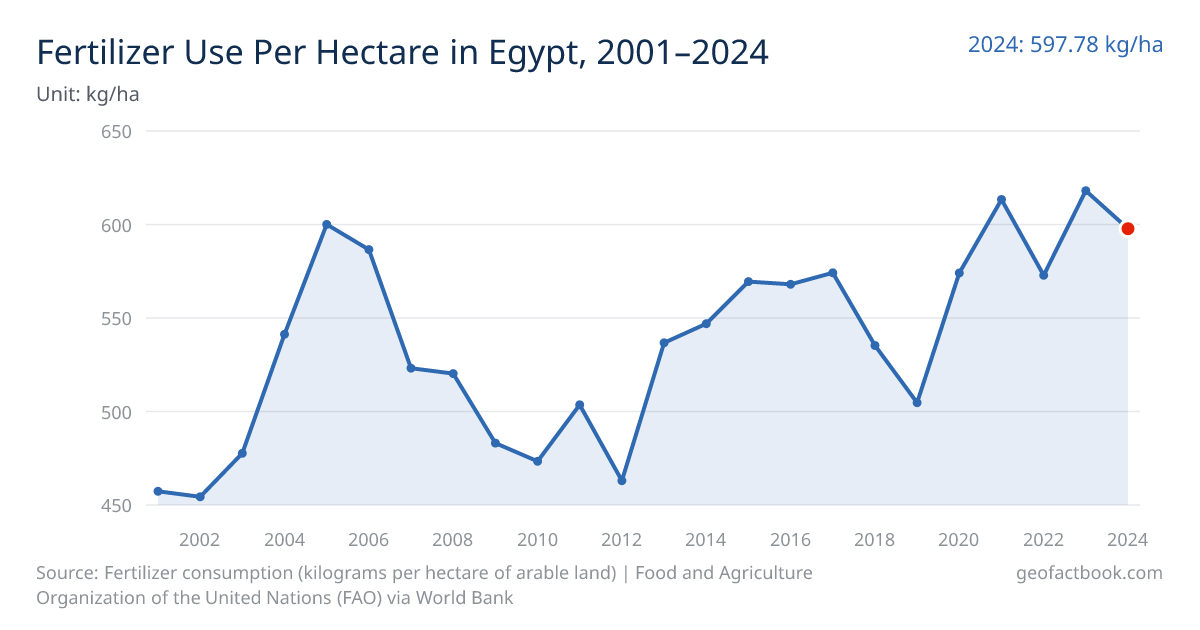
| 2024 | 597.78 kg/ha | 20.3 kg/ha | -3.28% | |
| 2023 | 618.08 kg/ha | +45.22 kg/ha | +7.89% | |
| 2022 | 572.85 kg/ha | 40.51 kg/ha | -6.60% | |
| 2021 | 613.36 kg/ha | +39.3 kg/ha | +6.85% | |
| 2020 | 574.07 kg/ha | +69.35 kg/ha | +13.74% | |
| 2019 | 504.72 kg/ha | 30.57 kg/ha | -5.71% | |
| 2018 | 535.29 kg/ha | 38.89 kg/ha | -6.77% | |
| 2017 | 574.18 kg/ha | +6.14 kg/ha | +1.08% | |
| 2016 | 568.04 kg/ha | 1.42 kg/ha | -0.25% | |
| 2015 | 569.46 kg/ha | +22.49 kg/ha | +4.11% | |
| 2014 | 546.97 kg/ha | +10.22 kg/ha | +1.90% | |
| 2013 | 536.75 kg/ha | +73.76 kg/ha | +15.93% | |
| 2012 | 462.99 kg/ha | 40.57 kg/ha | -8.06% | |
| 2011 | 503.56 kg/ha | +30.19 kg/ha | +6.38% | |
| 2010 | 473.37 kg/ha | 9.71 kg/ha | -2.01% | |
| 2009 | 483.08 kg/ha | 37.17 kg/ha | -7.14% | |
| 2008 | 520.25 kg/ha | 2.92 kg/ha | -0.56% | |
| 2007 | 523.17 kg/ha | 63.4 kg/ha | -10.81% | |
| 2006 | 586.56 kg/ha | 13.51 kg/ha | -2.25% | |
| 2005 | 600.08 kg/ha | +58.8 kg/ha | +10.86% | |
| 2004 | 541.28 kg/ha | +63.61 kg/ha | +13.32% | |
| 2003 | 477.67 kg/ha | +23.31 kg/ha | +5.13% | |
| 2002 | 454.36 kg/ha | 2.94 kg/ha | -0.64% | |
| 2001 | 457.3 kg/ha | — | — |
Fertilizer Use Per Hectare in Egypt, 2001–2024: chart
Cite this page
Geo Factbook. (n.d.). Egypt: Fertilizer Use Per Hectare. Retrieved November 27, 2026, from https://geofactbook.com/countries/egypt/fertilizer-use-per-hectare
The figures on this page come from Fertilizer consumption (kilograms per hectare of arable land) | Food and Agriculture Organization of the United Nations (FAO) via World Bank. For academic work, cite the original source as well.
Frequently Asked Questions About Egypt Fertilizer Use Per Hectare
What is Egypt's fertilizer use per hectare in 2024?▾
Egypt's fertilizer use per hectare is 597.78 kg/ha in 2024, according to Fertilizer consumption (kilograms per hectare of arable land) | Food and Agriculture Organization of the United Nations (FAO) via World Bank.
Is Egypt's fertilizer use per hectare increasing or decreasing?▾
Egypt's fertilizer use per hectare fell by 3.3% from 2023 (618.08 kg/ha) to 2024 (597.78 kg/ha). Over the past decade (2014–2024) it rose by 9.3%.
How does Egypt rank for fertilizer use per hectare?▾
In 2024, Egypt has the 8th highest fertilizer use per hectare out of 189 countries with data.
What was Egypt's fertilizer use per hectare in 2001?▾
In 2001, Egypt's fertilizer use per hectare was 457.30 kg/ha. By 2024 it rose by 30.7%.
Explore additional statistical insights
Total Renewable Groundwater Resources by Country in Egypt
Total renewable groundwater represents the combined volume of internally generated and externally sourced groundwater that is naturally replenished and available for use.
Electricity from Nuclear Fuels in Egypt
Electricity from nuclear fuels measures energy production in countries. Compare data, explore rankings, and visualize trends with interactive maps.
Protected Land Area Percentage in Egypt
Protected land area percentage shows the share of a country's land dedicated to conservation and biodiversity.
Total Renewable Water Resources in Egypt
Total renewable water resources indicate a country's water abundance. Explore global rankings, compare nations, and view interactive maps.
Annual Area Burnt by Wildfires in Egypt
Annual area burnt by wildfires measures the total land affected by wildfires each year in hectares.
Tree Cover Loss in Egypt
Tree cover loss measures the annual reduction in tree cover across countries, indicating deforestation and environmental impact.