
Eastern Europe Life expectancy at birth 2026: 81.63 years
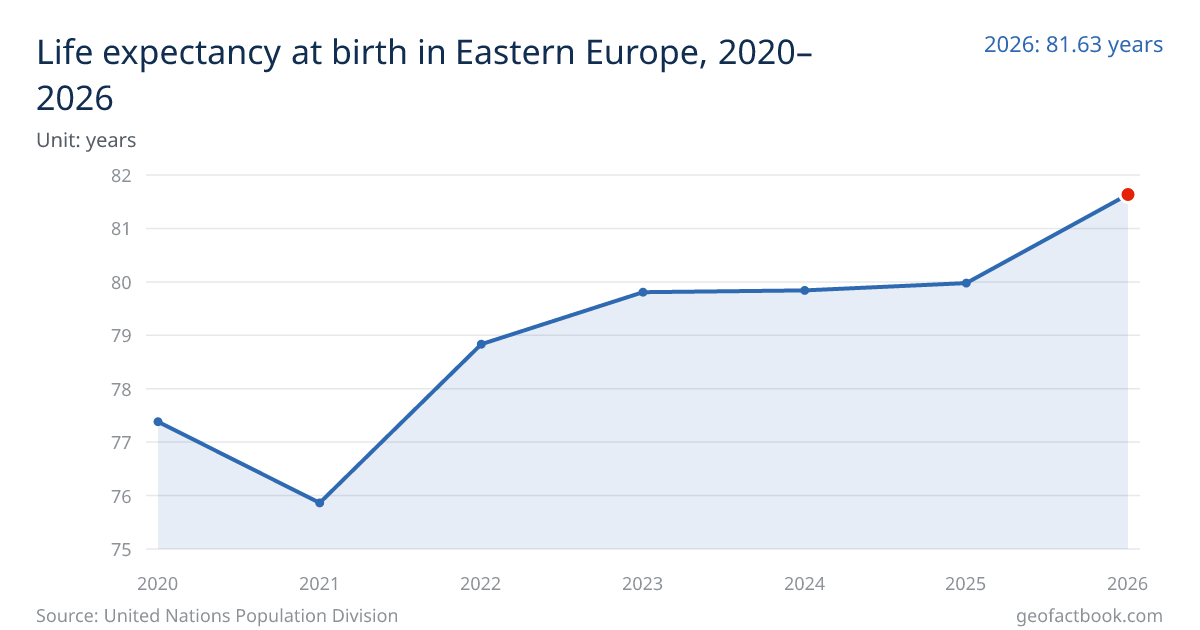
Eastern Europe's life expectancy at birth in 2026 is 81.63 years (estimate), up 2.1% from 2025.
Life expectancy at birth measures the average years a newborn is expected to live, reflecting a country's health standards and quality of life. This vital statistic highlights disparities in healthcare and living conditions across nations, making it essential for global health assessments.
Estimated value for 2026 (interpolated, no direct source).
Life expectancy at birth over timeSome values are estimated based on historical trends
| Year | Value | Change | % Change | Actions |
|---|---|---|---|---|
| 2026 | 81.63 years | +1.66 years | +2.07% | |
| 2025 | 79.98 years | +0.14 years | +0.17% | |
| 2024 | 79.84 years | +0.03 years | +0.04% | |
| 2023 | 79.81 years | +0.97 years | +1.24% | |
| 2022 | 78.83 years | +2.97 years | +3.91% | |
| 2021 | 75.86 years | 1.52 years | -1.96% | |
| 2020 | 77.38 years | — | — |
Life expectancy at birth in Eastern Europe, 2020–2026: chart
Cite this page
Geo Factbook. (n.d.). Eastern Europe: Life expectancy at birth. Retrieved November 29, 2026, from https://geofactbook.com/countries/eastern-europe/life-expectancy-at-birth
The figures on this page come from United Nations Population Division. For academic work, cite the original source as well.
Frequently Asked Questions About Eastern Europe Life expectancy at birth
What is Eastern Europe's life expectancy at birth in 2026?▾
Eastern Europe's life expectancy at birth is 81.63 years in 2026 (estimate), according to United Nations Population Division.
Is Eastern Europe's life expectancy at birth increasing or decreasing?▾
Eastern Europe's life expectancy at birth rose by 2.1% from 2025 (79.98 years) to 2026 (81.63 years).
What was Eastern Europe's life expectancy at birth in 2020?▾
In 2020, Eastern Europe's life expectancy at birth was 77.38 years. By 2026 it rose by 5.5%.
Explore additional statistical insights
Total fertility rate in Eastern Europe
The total fertility rate measures the average number of children a woman is expected to have during her lifetime, reflecting population growth and demographic trends. Understanding this statistic is crucial for analyzing economic development, healthcare needs, and societal changes across countries.
Female population of reproductive age in Eastern Europe
The female population of reproductive age is a crucial demographic statistic that influences healthcare, economic growth, and social policies in countries. Understanding this population helps address reproductive health needs and support family planning initiatives.
Under-five mortality rate in Eastern Europe
The under-five mortality rate measures the number of deaths per 1,000 live births for children under five. This critical statistic highlights child health and development, reflecting a country's healthcare quality and socioeconomic conditions. Understanding these rates is vital for improving global health initiatives.
Median age of population in Eastern Europe
The median age of a population is a key demographic indicator, reflecting the age distribution within a country. Understanding median age helps assess economic development, healthcare needs, and social dynamics. Countries with a higher median age may face challenges related to aging populations, while younger populations often indicate growth potential.
Total net-migration in Eastern Europe
Total net-migration measures the difference between the number of immigrants and emigrants in a country, reflecting population shifts and economic opportunities. Understanding this statistic is crucial for analyzing demographic trends and policy impacts in nations worldwide.
Total deaths in Eastern Europe
Total deaths in countries measure the number of individuals who have passed away within a specific timeframe. This statistic is crucial for understanding health trends, mortality rates, and the impact of various factors on population dynamics.