
Dominica Beer Consumption per Capita 2022: 1.82 liters
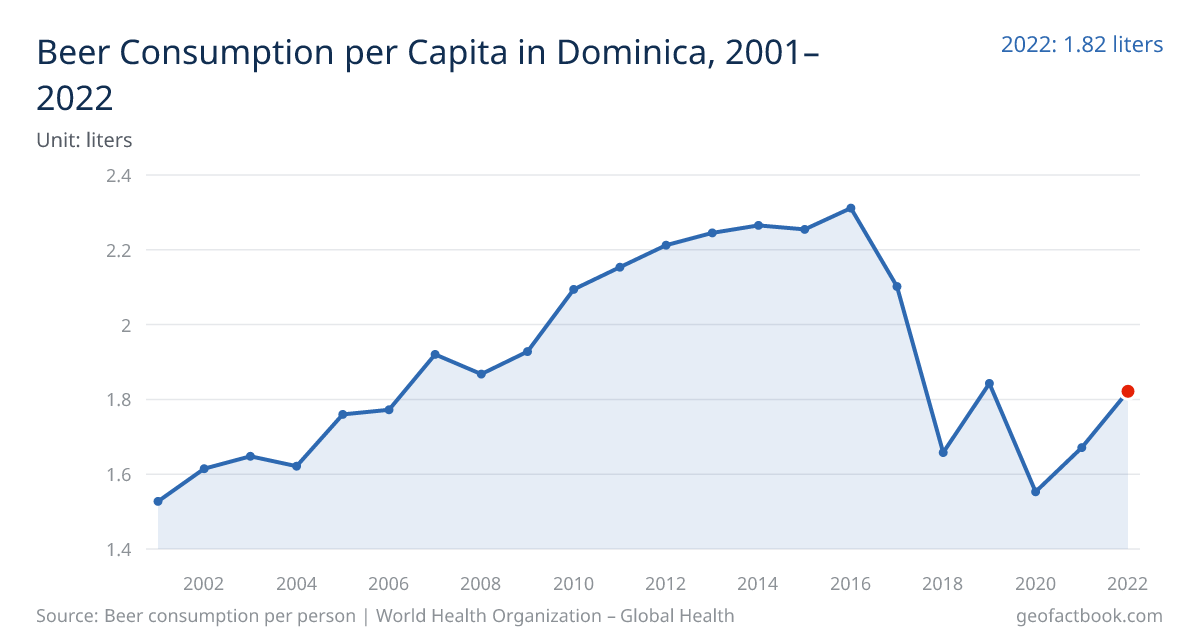
Dominica's beer consumption per capita in 2022 is 1.82 liters, up 9.0% from 2021. It ranks #91 of 186 countries.
Beer consumption per capita measures the average liters of beer consumed by each person in a country annually.
Source (2022): Beer consumption per person | Our World in Data
Where Dominica ranks (2022)
#91 of 186- #89
 Republic of Moldova1.84 liters
- #90
 Uruguay1.83 liters
- #91
 Dominica1.82 liters
- #92
 Angola1.78 liters
- #93
 Rwanda1.71 liters
Beer Consumption per Capita over time
| Year | Value | Change | % Change | Actions |
|---|---|---|---|---|
| 2022 | 1.82 liters | +0.15 liters | +9.01% | |
| 2021 | 1.67 liters | +0.12 liters | +7.61% | |
| 2020 | 1.55 liters | 0.29 liters | -15.73% | |
| 2019 | 1.84 liters | +0.18 liters | +11.16% | |
| 2018 | 1.66 liters | 0.44 liters | -21.12% | |
| 2017 | 2.1 liters | 0.21 liters | -9.07% | |
| 2016 | 2.31 liters | +0.06 liters | +2.52% | |
| 2015 | 2.25 liters | 0.01 liters | -0.47% | |
| 2014 | 2.27 liters | +0.02 liters | +0.90% | |
| 2013 | 2.25 liters | +0.03 liters | +1.49% | |
| 2012 | 2.21 liters | +0.06 liters | +2.73% | |
| 2011 | 2.15 liters | +0.06 liters | +2.84% | |
| 2010 | 2.09 liters | +0.17 liters | +8.63% | |
| 2009 | 1.93 liters | +0.06 liters | +3.21% | |
| 2008 | 1.87 liters | 0.05 liters | -2.74% | |
| 2007 | 1.92 liters | +0.15 liters | +8.36% | |
| 2006 | 1.77 liters | +0.01 liters | +0.69% | |
| 2005 | 1.76 liters | +0.14 liters | +8.55% | |
| 2004 | 1.62 liters | 0.03 liters | -1.62% | |
| 2003 | 1.65 liters | +0.03 liters | +2.07% | |
| 2002 | 1.61 liters | +0.09 liters | +5.72% | |
| 2001 | 1.53 liters | — | — |
Beer Consumption per Capita in Dominica, 2001–2022: chart
Cite this page
Geo Factbook. (n.d.). Dominica: Beer Consumption per Capita. Retrieved November 27, 2026, from https://geofactbook.com/countries/dominica/beer-consumption-per-capita
The figures on this page come from Beer consumption per person | World Health Organization – Global Health Observatory via Our World in Data. For academic work, cite the original source as well.
Frequently Asked Questions About Dominica Beer Consumption per Capita
What is Dominica's beer consumption per capita in 2022?▾
Dominica's beer consumption per capita is 1.82 liters in 2022, according to Beer consumption per person | World Health Organization – Global Health Observatory via Our World in Data.
Is Dominica's beer consumption per capita increasing or decreasing?▾
Dominica's beer consumption per capita rose by 9.0% from 2021 (1.67 liters) to 2022 (1.82 liters). Over the past decade (2012–2022) it fell by 17.7%.
How does Dominica rank for beer consumption per capita?▾
In 2022, Dominica has the 91st highest beer consumption per capita out of 186 countries with data.
What was Dominica's beer consumption per capita in 2001?▾
In 2001, Dominica's beer consumption per capita was 1.53 liters. By 2022 it rose by 19.3%.
Explore additional statistical insights
Mean Years of Schooling in Dominica
Mean Years of Schooling indicates the average number of years of education received by people aged 25 and older.
Firearm Homicides per 100,000 in Dominica
Firearm homicides per 100,000 measure murders by guns; reflects crime levels and enforcement effectiveness.
Old-Age Dependency Ratio in Dominica
Old-age dependency ratio compares the number of elderly dependents to working-age people, affecting economic sustainability.
Total net-migration in Dominica
Total net-migration measures the difference between the number of immigrants and emigrants in a country, reflecting population shifts and economic opportunities. Understanding this statistic is crucial for analyzing demographic trends and policy impacts in nations worldwide.
Education Expenditure (% of GDP) in Dominica
Education expenditure measures the percentage of GDP spent on education. Compare countries and explore interactive rankings and trends.
Human Capital Index in Dominica
The Human Capital Index measures a country's investment in education and health, reflecting its potential for economic growth and productivity. This vital statistic highlights the importance of nurturing human resources for sustainable development.