
Denmark Fertilizer Use Per Hectare 2024: 117.25 kg/ha
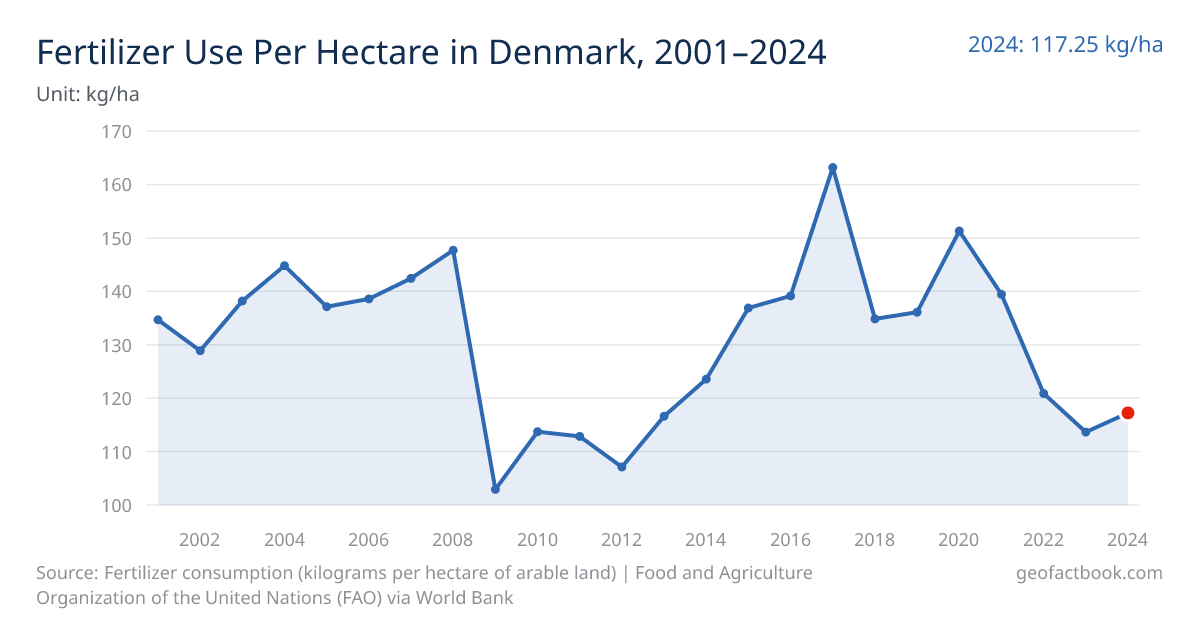
Denmark's fertilizer use per hectare in 2024 is 117.25 kg/ha, up 3.2% from 2023. It ranks #83 of 189 countries.
Fertilizer use per hectare shows how much fertilizer is applied to agricultural land in different countries, impacting crop yield.
Source (2024): Fertilizer use per hectare
Where Denmark ranks (2024)
#83 of 189- #81
 State of Palestine118.71 kg/ha
- #82
 Hungary117.77 kg/ha
- #83
 Denmark117.25 kg/ha
- #84
 Austria117.09 kg/ha
- #85
 Laos115.4 kg/ha
Fertilizer Use Per Hectare over time
| Year | Value | Change | % Change | Actions |
|---|---|---|---|---|
| 2024 | 117.25 kg/ha | +3.6 kg/ha | +3.17% | |
| 2023 | 113.64 kg/ha | 7.23 kg/ha | -5.98% | |
| 2022 | 120.87 kg/ha | 18.55 kg/ha | -13.31% | |
| 2021 | 139.42 kg/ha | 11.86 kg/ha | -7.84% | |
| 2020 | 151.28 kg/ha | +15.2 kg/ha | +11.17% | |
| 2019 | 136.08 kg/ha | +1.25 kg/ha | +0.93% | |
| 2018 | 134.84 kg/ha | 28.33 kg/ha | -17.36% | |
| 2017 | 163.17 kg/ha | +24.02 kg/ha | +17.27% | |
| 2016 | 139.14 kg/ha | +2.26 kg/ha | +1.65% | |
| 2015 | 136.88 kg/ha | +13.31 kg/ha | +10.78% | |
| 2014 | 123.57 kg/ha | +6.94 kg/ha | +5.95% | |
| 2013 | 116.62 kg/ha | +9.51 kg/ha | +8.88% | |
| 2012 | 107.11 kg/ha | 5.74 kg/ha | -5.08% | |
| 2011 | 112.85 kg/ha | 0.86 kg/ha | -0.76% | |
| 2010 | 113.71 kg/ha | +10.79 kg/ha | +10.49% | |
| 2009 | 102.92 kg/ha | 44.76 kg/ha | -30.31% | |
| 2008 | 147.68 kg/ha | +5.26 kg/ha | +3.70% | |
| 2007 | 142.41 kg/ha | +3.83 kg/ha | +2.76% | |
| 2006 | 138.58 kg/ha | +1.46 kg/ha | +1.07% | |
| 2005 | 137.12 kg/ha | 7.67 kg/ha | -5.30% | |
| 2004 | 144.78 kg/ha | +6.6 kg/ha | +4.78% | |
| 2003 | 138.18 kg/ha | +9.31 kg/ha | +7.22% | |
| 2002 | 128.87 kg/ha | 5.8 kg/ha | -4.30% | |
| 2001 | 134.67 kg/ha | — | — |
Fertilizer Use Per Hectare in Denmark, 2001–2024: chart
Cite this page
Geo Factbook. (n.d.). Denmark: Fertilizer Use Per Hectare. Retrieved November 27, 2026, from https://geofactbook.com/countries/denmark/fertilizer-use-per-hectare
The figures on this page come from Fertilizer consumption (kilograms per hectare of arable land) | Food and Agriculture Organization of the United Nations (FAO) via World Bank. For academic work, cite the original source as well.
Frequently Asked Questions About Denmark Fertilizer Use Per Hectare
What is Denmark's fertilizer use per hectare in 2024?▾
Denmark's fertilizer use per hectare is 117.25 kg/ha in 2024, according to Fertilizer consumption (kilograms per hectare of arable land) | Food and Agriculture Organization of the United Nations (FAO) via World Bank.
Is Denmark's fertilizer use per hectare increasing or decreasing?▾
Denmark's fertilizer use per hectare rose by 3.2% from 2023 (113.64 kg/ha) to 2024 (117.25 kg/ha). Over the past decade (2014–2024) it fell by 5.1%.
How does Denmark rank for fertilizer use per hectare?▾
In 2024, Denmark has the 83rd highest fertilizer use per hectare out of 189 countries with data.
What was Denmark's fertilizer use per hectare in 2001?▾
In 2001, Denmark's fertilizer use per hectare was 134.67 kg/ha. By 2024 it fell by 12.9%.
Explore additional statistical insights
Energy Consumption per Capita (USD) in Denmark
Energy Consumption per Capita (USD) measures how much energy is consumed per person. Compare countries and explore interactive maps.
Total Threatened Mammal Species in Denmark
Total threatened mammal species highlight biodiversity risks. Track conservation efforts worldwide.
Population Distribution in Denmark
Explore population distribution across 266+ countries. Compare data, view interactive maps, and analyze trends over time.
Tree Cover Loss in Denmark
Tree cover loss measures the annual reduction in tree cover across countries, indicating deforestation and environmental impact.
Refined Petroleum Products Production in Denmark
Refined Petroleum Products Production data reveals insights into global energy trends. Compare countries and explore interactive maps and rankings.
Electricity from Fossil Fuels in Denmark
Electricity from fossil fuels measures energy generation trends. Compare countries, explore rankings, and analyze historical data with interactive maps.