
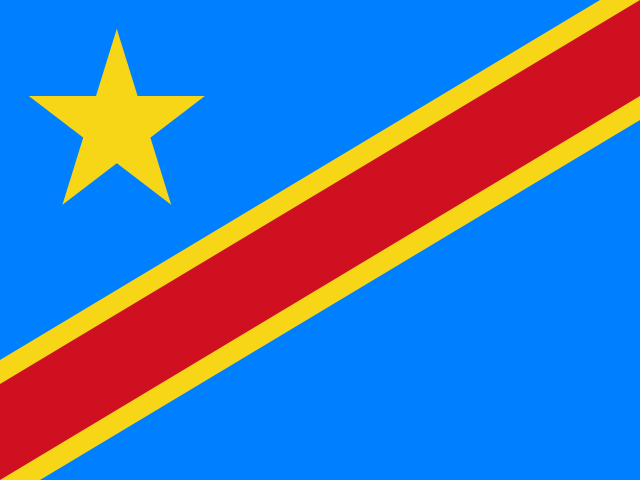
Location
Congo, Democratic Republic of the is in Central Africa, northeast of Angola. It shares land borders with Angola (2,646 km), Republic of the Congo (1,775 km), Central African Republic (1,747 km), South Sudan (714 km), Burundi (236 km) and Rwanda (221 km) and has 37 km of coastline. The capital is Kinshasa.
Congo, Democratic Republic of the population 2026: 116.39 Million — growth, rank & history →Key Statistics for 2026
Total population
Population Change
Median age of population
Population density
Life expectancy at birth
Agricultural land
Current Bank Rate
Dam capacity per capita
Female population of reproductive age
Health Care Spending per Capita
Learning-adjusted years of school
History
The history of the Democratic Republic of the Congo (DRC) is rich and complex, with roots tracing back to ancient civilizations. Early inhabitants of the region included Bantu-speaking peoples who migrated from West Africa around the first millennium BCE. These communities developed agriculture and established trade networks, laying the foundation for the Kingdom of Kongo in the late 14th century. The Kingdom of Kongo emerged as a powerful state, characterized by a centralized government and extensive trade links with European nations, particularly the Portuguese, who arrived in the late 15th century. This period marked significant cultural exchanges, including the introduction of Christianity and new agricultural practices.
During the medieval period, the DRC saw the rise of several other important kingdoms, including the Luba and Lunda empires, which contributed to the region's political and economic landscapes. The Luba Kingdom, founded in the 16th century, became known for its sophisticated governance and rich cultural traditions. The Lunda Empire, which followed, expanded its influence across large swaths of Central Africa through trade and political alliances. The interactions between these kingdoms and European powers led to increased external influences, culminating in the scramble for Africa in the late 19th century, when European nations sought to colonize the continent.
The modern history of the DRC began with the establishment of the Congo Free State in 1885, under the personal rule of King Leopold II of Belgium. His regime was marked by severe exploitation and atrocities, leading to widespread international condemnation. In 1908, the Belgian government took control, transforming the Congo Free State into a Belgian colony. The struggle for independence gained momentum after World War II, culminating in the DRC's independence on June 30, 1960. However, independence was soon marred by political instability, including the assassination of Prime Minister Patrice Lumumba and subsequent military coups.
In recent decades, the DRC has faced significant challenges, including two brutal civil wars from 1996 to 1997 and 1998 to 2003, which resulted in millions of deaths and widespread human rights abuses. Despite the formal end of these conflicts, the country continues to grapple with political instability, economic challenges, and social issues. The DRC's vast natural resources, particularly minerals like coltan and diamonds, have made it a focal point of international interest and conflict. The historical significance of the DRC thus lies not only in its rich cultural heritage but also in its ongoing quest for peace and stability amidst a backdrop of complex historical legacies.
Geography
The Democratic Republic of the Congo (DRC), commonly referred to as Congo-Kinshasa, is located in Central Africa. It is bordered by nine countries: Angola to the southwest, Zambia to the southeast, Tanzania to the east, Uganda, Rwanda, and Burundi to the northeast, and South Sudan to the north. The Republic of the Congo lies to the west, with the Congo River forming part of the boundary. The DRC's vast territory spans approximately 2.34 million square kilometers, making it the second-largest country in Africa and the 11th largest in the world.
The country's geography is marked by a diverse range of physical features. The eastern region is dominated by the Albertine Rift, which includes the Rwenzori Mountains, often referred to as the "Mountains of the Moon," with peaks exceeding 5,000 meters. In contrast, the central part of the country is characterized by extensive plateaus and lowlands, while the western region consists of riverine plains and savannas. The DRC is home to the Congo River, the world's second-largest river by discharge volume and one of the most important waterways on the continent, along with numerous tributaries that contribute to its vast network.
The climate of the DRC varies significantly across its vast territory, influenced by factors such as elevation and proximity to the equator. Generally, the country experiences a tropical climate, with a wet season and a dry season. The northern regions typically experience more humid conditions, while the southern areas have a more pronounced dry season. Average temperatures range from 20°C to 30°C, with higher elevations in the east experiencing cooler temperatures. Rainfall is abundant, particularly in the equatorial regions, where it can exceed 2,000 mm annually, supporting rich biodiversity.
The DRC is endowed with abundant natural resources, which include vast deposits of minerals such as copper, cobalt, diamonds, gold, and coltan, a crucial component in electronic devices. The country also has extensive forests, particularly in the basin of the Congo River, which is the second-largest rainforest in the world, providing habitat for a diverse range of flora and fauna. However, the extraction of these resources poses significant environmental challenges, including deforestation and habitat destruction, impacting both the ecosystem and local communities. Efforts are ongoing to balance resource management with environmental conservation in this ecologically rich country.
Government
The Democratic Republic of the Congo (DRC) operates under a semi-presidential system, characterized by a complex political landscape that blends elements of democracy with challenges related to governance and stability. The DRC was established as a republic in 1960, but its political trajectory has been marked by periods of dictatorship, conflict, and democratic transitions. The current constitution, adopted in 2006, enshrines the principles of democracy, human rights, and the separation of powers, although the practical implementation of these principles has often faced significant obstacles.
The structure of the government in the DRC consists of three main branches: the executive, legislative, and judicial branches. The executive is headed by the President, who is elected by popular vote for a five-year term and can serve a maximum of two terms. The President appoints the Prime Minister, who leads the government and coordinates the activities of the cabinet. The legislative branch is bicameral, comprising the National Assembly and the Senate. Members of the National Assembly are elected for a five-year term, while Senators serve for six years, with half of the Senate being renewed every three years. The judicial branch is independent, with the Supreme Court of Justice serving as the highest court in the land.
Key institutions supporting the DRC’s governance include the Independent National Electoral Commission (CENI), which is responsible for overseeing elections and ensuring their integrity. The political leadership in the DRC has seen a variety of figures, with President Félix Tshisekedi currently in office, having taken power in January 2019. His administration has faced the ongoing challenge of managing a diverse political landscape that includes numerous parties and movements, often influenced by regional and ethnic considerations.
The electoral system in the DRC is based on universal suffrage, with a mixed voting system that combines both proportional representation and majority voting in various electoral contests. The political landscape is fragmented, with multiple parties vying for power, often resulting in coalitions. Despite the formal structures in place, the DRC has experienced political turbulence, including allegations of electoral malfeasance and civil unrest, which have hindered the consolidation of democratic governance. As the DRC continues to navigate its political challenges, the pursuit of stability and effective governance remains a critical focus for both its leaders and the international community.
Economy
The economy of the Democratic Republic of the Congo (DRC) operates as a mixed economy, characterized by a combination of state-owned and private enterprises. As of 2023, the country's Gross Domestic Product (GDP) is approximately $50 billion, with a per capita GDP of about $600. The DRC's economy has shown signs of recovery following years of conflict and instability, primarily driven by its vast natural resources. The DRC is one of the richest countries in the world in terms of natural resources, with significant reserves of minerals such as copper, cobalt, gold, and diamonds, which contribute heavily to its GDP.
Major industries in the DRC include mining, agriculture, and forestry. The mining sector is the most critical, accounting for a substantial portion of the nation's exports and foreign investment. The DRC is the world's largest producer of cobalt, a key component in batteries and electric vehicles, which has seen increasing global demand. Agriculture remains a vital part of the economy, employing a large percentage of the population; however, it primarily consists of subsistence farming. Additionally, the forestry sector is significant, with the DRC hosting the second-largest rainforest in the world, which provides timber and other forest products.
In terms of trade relationships, the DRC has established partnerships with various countries, primarily in Asia and Europe. China is a particularly important trade partner, with significant investments in mining and infrastructure. The country exports mainly minerals, which account for over 90% of its export revenues, while imports consist of machinery, food, and consumer goods. The DRC's trade balance fluctuates due to its reliance on commodity prices, making it vulnerable to global market changes.
Despite its rich resources, the DRC faces numerous economic challenges, including political instability, inadequate infrastructure, and corruption. The lack of stable governance often hampers economic growth and discourages foreign investment. However, there are considerable opportunities for development, particularly in improving infrastructure and diversifying the economy beyond mining. Sustainable management of resources and investment in education and healthcare could further enhance economic prospects and improve the quality of life for the Congolese people.
Culture
The Democratic Republic of the Congo (DRC) is a nation rich in cultural diversity, characterized by its multitude of languages, religions, and ethnic groups. The country is home to over 200 ethnic groups, with the largest being the Mongo, Luba, and Kongo. This ethnic diversity contributes to a vibrant cultural tapestry, where more than 240 languages are spoken, primarily belonging to the Bantu language family. The official language is French, but Lingala, Swahili, Kikongo, and Tshiluba are widely used in daily communication. In terms of religion, the DRC is predominantly Christian, with approximately 95% of the population adhering to various denominations, including Roman Catholicism and Protestantism. Traditional beliefs and practices also persist, often interwoven with Christian customs, reflecting the country's complex spiritual landscape.
Cultural traditions and customs in the DRC are deeply rooted in the country's history and social structures. Celebrations and ceremonies play an essential role in community life, often marking significant events such as births, marriages, and funerals. Traditional music and dance are integral to these festivities, with vibrant performances showcasing the talents of local artisans and reflecting the community's identity. The use of masks and costumes during rituals is common, symbolizing ancestral spirits and cultural heritage. Additionally, storytelling remains a vital tradition, with oral histories passed down through generations, preserving the wisdom and values of the ancestors.
The arts in the DRC are diverse and dynamic, with a strong emphasis on music, visual arts, and literature. Congolese music, particularly genres like soukous and rumba, has gained international acclaim, influencing various global music styles. Prominent musicians, such as Franco Luambo Makiadi and Papa Wemba, have contributed significantly to the world music scene. In literature, writers like Sony Labou Tansi and Alain Mabanckou have garnered recognition for their contributions, often exploring themes of identity, colonialism, and the complexities of modern African life. The visual arts, including sculpture and painting, often incorporate traditional motifs and contemporary issues, further enriching the cultural landscape.
The cuisine of the DRC reflects the country's agricultural abundance and cultural influences, with staples such as cassava, plantains, and rice forming the foundation of many meals. Dishes often incorporate local ingredients, including fish, meat, and a variety of vegetables, seasoned with spices that enhance their flavors. Daily life in the DRC varies significantly between urban and rural areas, with urban centers like Kinshasa exhibiting a more modern lifestyle, while rural communities retain traditional practices and communal living. Family and community bonds are strong, often defining social structures and daily interactions. The DRC’s rich cultural heritage continues to evolve, showcasing the resilience and creativity of its people amidst challenges.
About This Data
This page displays comprehensive statistical data for Congo, Democratic Republic of the for the year 2026. All data points are sourced from authoritative international organizations and are regularly updated to ensure accuracy and reliability.
Click on any statistic to explore more detailed information, see how Congo, Democratic Republic of the compares with other countries, and view historical trends.
Primary Data Sources
CIA World Factbook
Comprehensive country profiles and demographic statistics from the Central Intelligence Agency
Learn moreUnited Nations Statistics
Global demographic data and population projections from UN agencies and research divisions
Learn moreWorld Bank Open Data
Development indicators and comprehensive population metrics from the World Bank database
Learn moreCompare Congo, Democratic Republic of the with other countries
Side-by-side comparisons across population, GDP, geography, and more.
Frequently Asked Questions About Congo, Democratic Republic of the
Which continent is Congo, Democratic Republic of the in?▾
Congo, Democratic Republic of the is in Africa, in the Middle Africa subregion according to the UN geoscheme.
What is the population of the Democratic Republic of the Congo in 2026?▾
The population of the Democratic Republic of the Congo in 2026 is approximately 116,388,682 persons.
What is the GDP of the Democratic Republic of the Congo?▾
The GDP of the Democratic Republic of the Congo is 87,124,196,510.29 US dollars.
What is the life expectancy in the Democratic Republic of the Congo?▾
The life expectancy at birth in the Democratic Republic of the Congo is 65.27 years.
What is the total fertility rate in the Democratic Republic of the Congo?▾
The total fertility rate in the Democratic Republic of the Congo is 5.85 children per woman.
What is the population density of the Democratic Republic of the Congo?▾
The population density of the Democratic Republic of the Congo is 51.24 persons per square kilometer.
What is the human capital index of the Democratic Republic of the Congo?▾
The Human Capital Index of the Democratic Republic of the Congo is 0.3719.