
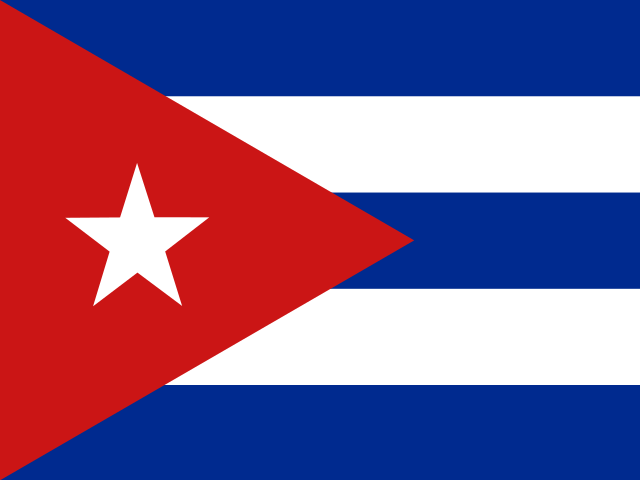
Location
Cuba is in the Caribbean, island between the Caribbean Sea and the North Atlantic Ocean, 150 km south of Key West, Florida. It shares land borders with US Naval Base at Guantanamo Bay (29 km) and has 3,735 km of coastline. The capital is Havana.
Cuba population 2026: 10.89 Million — growth, rank & history →Key Statistics for 2026
Total population
Population Change
Median age of population
Population density
Life expectancy at birth
Agricultural land
Average Female Breast Size by Country: Worldwide Data & Rankings
Dam capacity per capita
Female population of reproductive age
Health Care Spending per Capita
Percentage of population by degree of urbanization
History
Cuba's history is rich and complex, beginning with its early inhabitants, the Taíno and Ciboney peoples, who arrived around 4000 BCE. These indigenous groups developed a society based on agriculture and fishing, with notable achievements in pottery and social organization. The arrival of Spanish explorers in the late 15th century, particularly Christopher Columbus in 1492, marked a significant turning point. Columbus claimed the island for Spain, leading to the establishment of settlements and the devastating impact of European colonization on the native population through disease and forced labor.
During the medieval period, Cuba became a critical supply station for Spanish fleets traveling to the Americas. The establishment of sugar plantations in the 17th century transformed the island's economy, leading to the importation of enslaved Africans to work the fields. This period also saw the rise of powerful families and the development of a colonial society characterized by racial and economic stratification. By the 19th century, the desire for independence grew, culminating in the Ten Years' War (1868-1878), which marked the first significant armed struggle against Spanish rule.
The late 19th and early 20th centuries were pivotal for Cuba, culminating in the Cuban War of Independence (1895-1898) and the subsequent intervention by the United States, leading to the Spanish-American War. Following the war, Cuba became a U.S. protectorate, culminating in the Platt Amendment of 1901, which allowed American intervention in Cuban affairs. The first half of the 20th century was marked by political instability and dictatorship, particularly under Fulgencio Batista, whose regime was characterized by corruption and repression.
The modern history of Cuba took a dramatic turn with the Cuban Revolution in 1959, led by Fidel Castro and Ernesto "Che" Guevara, which resulted in the establishment of a socialist state. The revolution significantly altered Cuba's political and economic landscape, aligning it with the Soviet Union during the Cold War. The U.S. embargo imposed in 1960 has had lasting effects on the island's economy and international relations. In recent years, Cuba has sought to reform its economy and improve diplomatic ties, notably with the restoration of relations with the United States in 2014. As of 2023, Cuba continues to navigate its unique historical legacy while addressing contemporary challenges in governance, economy, and society.
Geography
Cuba is an island nation located in the northern Caribbean, approximately 150 kilometers south of the United States, with the Gulf of Mexico to the northwest and the Atlantic Ocean to the north. It is bordered by the Straits of Florida to the north, which separate it from the Florida Keys, and the Caribbean Sea to the south. The country comprises the main island of Cuba, the second-largest island in the Caribbean, along with several smaller islands, including Isla de la Juventud. Cuba’s strategic location has historically made it a focal point for trade and military interests in the Caribbean region.
The physical features of Cuba are diverse and striking, characterized by a mix of mountainous terrain, plains, and coastal regions. The Sierra Maestra mountain range, located in the southeast, is the highest in Cuba, with its peak, Pico Turquino, reaching an elevation of 2,005 meters (6,578 feet). The island is also home to several significant rivers, including the Cauto River, which is the longest river in Cuba, flowing eastward across the island. The terrain varies from fertile plains, particularly in the central and western regions, to rugged hills and mountains, contributing to a rich biodiversity that includes various ecosystems.
Cuba experiences a tropical climate, which is divided into two distinct seasons: a wet season from May to October and a dry season from November to April. Average temperatures range from 20°C (68°F) in winter to above 30°C (86°F) in summer, with humidity levels often high, especially during the summer months. The country is also susceptible to hurricanes, particularly during the Atlantic hurricane season, which can lead to significant weather-related impacts. Precipitation varies across the island, with the western regions generally receiving more rainfall compared to the eastern areas.
The natural resources of Cuba are abundant and include minerals such as nickel, cobalt, and chromium, as well as agricultural products like sugarcane, tobacco, and coffee. The country's rich soil supports a variety of crops, making agriculture a vital part of its economy. Environmental characteristics include extensive coastal ecosystems, such as mangroves and coral reefs, which play crucial roles in maintaining biodiversity and protecting shorelines. However, Cuba faces environmental challenges, including deforestation and the impacts of climate change, which threaten its natural landscapes and agricultural productivity.
Government
Cuba operates under a socialist state framework, characterized by a one-party political system dominated by the Communist Party of Cuba (PCC). The country's government is defined as a socialist republic, where the state plays a central role in the economy and society. The Constitution of the Republic of Cuba, established in 2019, affirms the leading role of the PCC, making it the only legal political party, thus restricting political pluralism and dissenting opinions. This structure has resulted in a highly centralized government that prioritizes collective interests over individual rights, a hallmark of its socialist ideology.
The structure of the Cuban government is divided into three branches: the executive, legislative, and judicial. The Executive branch is headed by the President, who also serves as the Prime Minister and is supported by a Council of Ministers. The President is elected by the National Assembly of People's Power (Asamblea Nacional del Poder Popular), which also plays a significant role in legislative functions. The Legislative branch consists of the National Assembly, which is a unicameral body responsible for enacting laws, ratifying budgets, and electing the President and other key officials. The Judicial branch is independent in theory; however, it is heavily influenced by the executive and legislative branches, with the Supreme Court overseeing the judicial system and ensuring alignment with Communist Party policies.
Key institutions within Cuba's government include the National Assembly of People's Power, the Council of Ministers, and the Communist Party of Cuba. The National Assembly meets twice a year and consists of deputies elected for five-year terms, although candidates must be approved by the PCC. The leadership of the country has been notably influenced by historical figures such as Fidel Castro and, more recently, Miguel Díaz-Canel, who became President in 2018. Under Díaz-Canel’s administration, there has been a cautious approach to reforms, focusing on economic modernization while maintaining strict political control.
The electoral system in Cuba is characterized by a lack of competitive elections. While the Cuban Constitution allows for elections, the process is tightly regulated by the PCC, and candidates are often members of the party or its affiliates. Voter turnout is typically high, often exceeding 90%, but critics argue that this is more indicative of state pressures than genuine electoral engagement. The political landscape is further complicated by the limited avenues for political expression and the suppression of dissent, creating a climate where opposition parties are effectively nonexistent. Consequently, the political environment in Cuba remains one of strong state control, with limited scope for reform or democratic processes.
Economy
Cuba operates under a socialist economic system, characterized by state ownership of the means of production and centralized planning. The country's Gross Domestic Product (GDP) was estimated at approximately $100 billion as of 2022, with a per capita GDP of around $8,000. The economy has historically been heavily influenced by the government, which sets prices and influences production levels. Despite these efforts, economic growth has been hampered by prolonged U.S. sanctions and internal inefficiencies.
The major industries in Cuba include tourism, biotechnology, pharmaceuticals, and agriculture. The tourism sector, which is a vital component of the economy, attracts millions of visitors annually and significantly contributes to foreign exchange earnings. The country is also known for its production of tobacco and sugar, with tobacco being a key export commodity. Other sectors such as biotechnology and pharmaceuticals have seen growth, particularly as Cuba has developed a reputation for its innovative healthcare solutions and medical research.
Cuba's trade relationships are primarily with countries in Latin America and Europe, as well as China and Russia. Major exports include pharmaceuticals, biotechnology products, sugar, and tobacco, while imports consist mainly of food, fuel, and machinery. In recent years, Cuba has sought to diversify its trade partners to mitigate the impact of U.S. sanctions, establishing stronger economic ties with nations such as Venezuela and Mexico.
Despite its potential, the Cuban economy faces numerous challenges, including limited access to international markets, outdated infrastructure, and the need for significant reforms to attract foreign investment. Economic opportunities exist in expanding the tourism sector and leveraging its strengths in biotechnology. The government has initiated some reforms aimed at increasing private sector involvement and enhancing productivity, which could pave the way for sustainable economic growth in the future.
Culture
Cuba's rich cultural tapestry is woven from the threads of its diverse languages, religions, and ethnic groups. The official language is Spanish, reflecting the island's colonial history, while English, Haitian Creole, and various indigenous languages also contribute to the linguistic landscape. The population is predominantly of mixed descent, including European, African, and indigenous ancestry, which shapes not only the demographics but also the cultural expressions found throughout the nation. Religion plays a significant role in Cuban life, with Roman Catholicism being the most widely practiced faith, followed by Protestantism and a notable presence of Santería, a syncretic religion that blends African spiritual traditions with Catholicism.
Cuban cultural traditions are rich and varied, often reflecting a blend of African, Spanish, and indigenous influences. Festivals and celebrations, such as Carnaval and Fiesta de la Virgen de la Caridad, showcase colorful parades, music, and dance, highlighting the island’s vibrant community spirit. Traditional customs emphasize family and social cohesion, with gatherings often centered around communal meals and storytelling. The importance of dance in Cuban culture cannot be overstated, with styles such as salsa, son, and rumba serving as vital expressions of identity and heritage.
The arts are a cornerstone of Cuban culture, encompassing a wide array of influences that enrich its music, literature, and visual arts. Cuban music is globally recognized, giving rise to genres like jazz and reggaeton, and notable figures such as Bebé and Buena Vista Social Club have brought Cuban rhythms to international audiences. Literature has flourished in Cuba, with renowned authors like José Martí and Alejo Carpentier contributing to the global literary canon. The visual arts thrive in Cuba as well, with artists like Wifredo Lam and contemporary collectives pushing the boundaries of creativity.
Cuban cuisine is a delightful fusion of flavors influenced by its diverse history, characterized by staples such as rice, beans, and plantains, often complemented by meats seasoned with garlic and citrus. Traditional dishes like ropa vieja and moros y cristianos reflect the island's agricultural bounty and culinary heritage. Daily life in Cuba is marked by a strong sense of community, with social interactions often taking place in public spaces such as plazas and parks. The culture of hospitality is evident in the warmth with which Cubans welcome visitors, making it a truly enriching experience for anyone exploring the island.
About This Data
This page displays comprehensive statistical data for Cuba for the year 2026. All data points are sourced from authoritative international organizations and are regularly updated to ensure accuracy and reliability.
Click on any statistic to explore more detailed information, see how Cuba compares with other countries, and view historical trends.
Primary Data Sources
CIA World Factbook
Comprehensive country profiles and demographic statistics from the Central Intelligence Agency
Learn moreUnited Nations Statistics
Global demographic data and population projections from UN agencies and research divisions
Learn moreWorld Bank Open Data
Development indicators and comprehensive population metrics from the World Bank database
Learn moreCompare Cuba with other countries
Side-by-side comparisons across population, GDP, geography, and more.
Frequently Asked Questions About Cuba
Which continent is Cuba in?▾
Cuba is in North America, in the Caribbean subregion according to the UN geoscheme.
What is the population of Cuba in 2026?▾
The population of Cuba in 2026 is approximately 10,894,624 persons.
What is the GDP of Cuba?▾
The Gross Domestic Product (GDP) of Cuba is 130,642,246,340 US dollars.
What is the life expectancy in Cuba?▾
The life expectancy at birth in Cuba is 82.72 years.
What is the population density of Cuba?▾
The population density of Cuba is 101.99 persons per square kilometer.
What percentage of Cuba's population is urbanized?▾
82.58% of Cuba's population lives in urban areas.