
Comoros Fertilizer Use Per Hectare 2024: 8.26 kg/ha
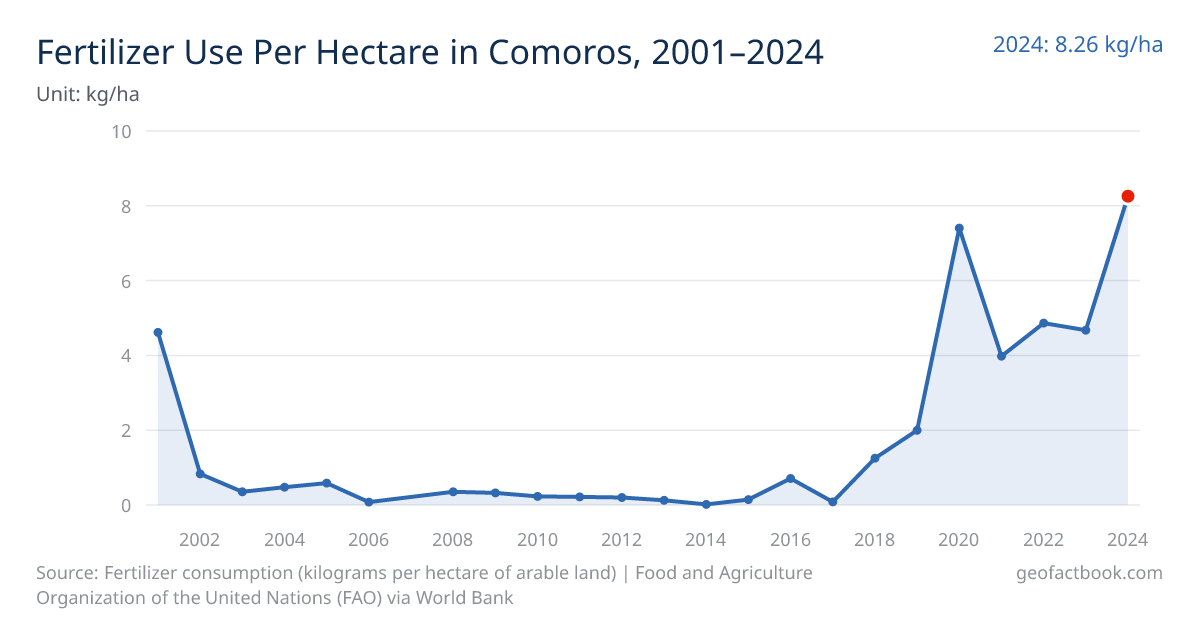
Comoros's fertilizer use per hectare in 2024 is 8.26 kg/ha, up 76.7% from 2023. It ranks #163 of 189 countries.
Fertilizer use per hectare shows how much fertilizer is applied to agricultural land in different countries, impacting crop yield.
Source (2024): Fertilizer use per hectare
Where Comoros ranks (2024)
#163 of 189- #161
 North Korea9.53 kg/ha
- #162
 Bolivia9.33 kg/ha
- #163
 Comoros8.26 kg/ha
- #164
 Mauritania8.01 kg/ha
- #165
 Liberia7.55 kg/ha
Fertilizer Use Per Hectare over time
| Year | Value | Change | % Change | Actions |
|---|---|---|---|---|
| 2024 | 8.26 kg/ha | +3.58 kg/ha | +76.68% | |
| 2023 | 4.67 kg/ha | 0.19 kg/ha | -3.94% | |
| 2022 | 4.86 kg/ha | +0.89 kg/ha | +22.25% | |
| 2021 | 3.98 kg/ha | 3.42 kg/ha | -46.25% | |
| 2020 | 7.4 kg/ha | +5.41 kg/ha | +270.89% | |
| 2019 | 2 kg/ha | +0.74 kg/ha | +59.45% | |
| 2018 | 1.25 kg/ha | +1.17 kg/ha | +1388.54% | |
| 2017 | 0.08 kg/ha | 0.62 kg/ha | -88.13% | |
| 2016 | 0.71 kg/ha | +0.56 kg/ha | +387.93% | |
| 2015 | 0.15 kg/ha | +0.13 kg/ha | +817.13% | |
| 2014 | 0.02 kg/ha | 0.11 kg/ha | -87.40% | |
| 2013 | 0.13 kg/ha | 0.08 kg/ha | -37.50% | |
| 2012 | 0.2 kg/ha | 0.02 kg/ha | -7.24% | |
| 2011 | 0.22 kg/ha | 0.01 kg/ha | -6.07% | |
| 2010 | 0.23 kg/ha | 0.09 kg/ha | -28.57% | |
| 2009 | 0.32 kg/ha | 0.03 kg/ha | -8.70% | |
| 2008 | 0.35 kg/ha | +0.28 kg/ha | +360.00% | |
| 2006 | 0.08 kg/ha | 0.51 kg/ha | -86.84% | |
| 2005 | 0.58 kg/ha | +0.11 kg/ha | +22.58% | |
| 2004 | 0.48 kg/ha | +0.12 kg/ha | +34.78% | |
| 2003 | 0.35 kg/ha | 0.48 kg/ha | -57.41% | |
| 2002 | 0.83 kg/ha | 3.78 kg/ha | -82.00% | |
| 2001 | 4.62 kg/ha | — | — |
Fertilizer Use Per Hectare in Comoros, 2001–2024: chart
Cite this page
Geo Factbook. (n.d.). Comoros: Fertilizer Use Per Hectare. Retrieved November 27, 2026, from https://geofactbook.com/countries/comoros/fertilizer-use-per-hectare
The figures on this page come from Fertilizer consumption (kilograms per hectare of arable land) | Food and Agriculture Organization of the United Nations (FAO) via World Bank. For academic work, cite the original source as well.
Frequently Asked Questions About Comoros Fertilizer Use Per Hectare
What is Comoros's fertilizer use per hectare in 2024?▾
Comoros's fertilizer use per hectare is 8.26 kg/ha in 2024, according to Fertilizer consumption (kilograms per hectare of arable land) | Food and Agriculture Organization of the United Nations (FAO) via World Bank.
Is Comoros's fertilizer use per hectare increasing or decreasing?▾
Comoros's fertilizer use per hectare rose by 76.7% from 2023 (4.67 kg/ha) to 2024 (8.26 kg/ha). Over the past decade (2014–2024) it rose by 52064.9%.
How does Comoros rank for fertilizer use per hectare?▾
In 2024, Comoros has the 163rd highest fertilizer use per hectare out of 189 countries with data.
What was Comoros's fertilizer use per hectare in 2001?▾
In 2001, Comoros's fertilizer use per hectare was 4.62 kg/ha. By 2024 it rose by 78.9%.
Explore additional statistical insights
Carbon Dioxide Emissions in Comoros
Carbon dioxide emissions reveal environmental impact. Explore rankings, compare countries, and analyze historical trends with interactive maps.
Annual Forest Area Change Rate in Comoros
Annual forest area change rate indicates how quickly a country's forests are expanding or shrinking each year.
Global Precipitation Distribution in Comoros
Explore how precipitation is distributed globally, influencing ecosystems, agriculture, and water supply systems.
Total Threatened Mammal Species in Comoros
Total threatened mammal species highlight biodiversity risks. Track conservation efforts worldwide.
Access to Clean Cooking Fuels in Comoros
Explore the percentage of households with access to clean cooking fuels and technologies in various countries worldwide.
Population living in slums in Comoros
This statistic measures the percentage of a country's population living in slums, highlighting urban poverty and living conditions. Understanding slum populations is crucial for addressing housing challenges and improving the quality of life.