
Heilongjiang in Numbers
Population, economy, income, urbanization and births in Heilongjiang, how it ranks among the 31 provincial-level regions, and which countries it is comparable to. Every number shows its official source and year.
Population
#20 of 3130.3 million
12th lowest in China · full ranking
2024 · National Bureau of Statistics of China, China Statistical Yearbook, population at year-end by region
GDP
#25 of 31$229 billion
7th lowest in China · full ranking
2024 · National Bureau of Statistics of China, China Statistical Yearbook, gross regional product, converted from yuan at the year's average exchange rate (World Bank PA.NUS.FCRF)
GDP per capita
#30 of 31$7,517
2nd lowest in China · full ranking
2024 · National Bureau of Statistics of China, China Statistical Yearbook, per capita gross regional product, converted from yuan at the year's average exchange rate (World Bank PA.NUS.FCRF)
Disposable income per capita
#25 of 31$4,344
7th lowest in China · full ranking
2024 · National Bureau of Statistics of China, China Statistical Yearbook, per capita disposable income of residents, converted from yuan at the year's average exchange rate (World Bank PA.NUS.FCRF)
Urban population
#12 of 3168.1%
12th highest in China · full ranking
2024 · National Bureau of Statistics of China, China Statistical Yearbook, share of urban population by region
Services share of GDP
#12 of 3155.4%
12th highest in China · full ranking
2024 · National Bureau of Statistics of China, China Statistical Yearbook, tertiary industry value added divided by gross regional product
If Heilongjiang were a country
Population like
🇨🇲 CameroonHeilongjiang has about as many people as Cameroon: 30.3 million vs 29.9 million.
Heilongjiang vs Cameroon →Economy like
🇸🇰 SlovakiaHeilongjiang's economy is roughly the size of Slovakia's: $229 billion vs about $230 billion.
Heilongjiang vs Slovakia →Country figures are 2025 estimates from Gapminder. Country GDP is measured in international dollars (purchasing power parity), while province GDP is in current prices, so treat the economy match as a rough size comparison.
More about Heilongjiang
Birth rate
#31 of 313.4 per 1,000
lowest in China · full ranking
2024 · National Bureau of Statistics of China, China Statistical Yearbook, birth rate by region
Death rate
#1 of 319.7 per 1,000
highest in China · full ranking
2024 · National Bureau of Statistics of China, China Statistical Yearbook, death rate by region
How Heilongjiang ranks
- Heilongjiang has the 12th lowest population of any province (30.3 million in 2024). See the ranking
- Heilongjiang has the 7th lowest GDP of any province ($229 billion in 2024). See the ranking
- Heilongjiang has the 2nd lowest GDP per person of any province ($7,517 in 2024). See the ranking
- Heilongjiang has the 7th lowest disposable income per person of any province ($4,344 in 2024). See the ranking
- Heilongjiang has the 12th highest share of people in cities of any province (68.1% in 2024). See the ranking
- Heilongjiang has the 12th highest services share of the economy of any province (55.4% in 2024). See the ranking
- Heilongjiang has the lowest birth rate of any province (3.4 per 1,000 in 2024). See the ranking
- Heilongjiang has the highest death rate of any province (9.7 per 1,000 in 2024). See the ranking
Frequently Asked Questions About Heilongjiang
What is the population of Heilongjiang?▾
Heilongjiang had 30.3 million people in 2024, the 12th lowest of the 31 provincial-level regions. Source: National Bureau of Statistics of China.
What is the GDP of Heilongjiang?▾
Heilongjiang's GDP was $229 billion in 2024 (current dollars), the 7th lowest in China. Source: National Bureau of Statistics of China.
Which country has a similar population to Heilongjiang?▾
Heilongjiang has about as many people as Cameroon: 30.3 million vs 29.9 million.
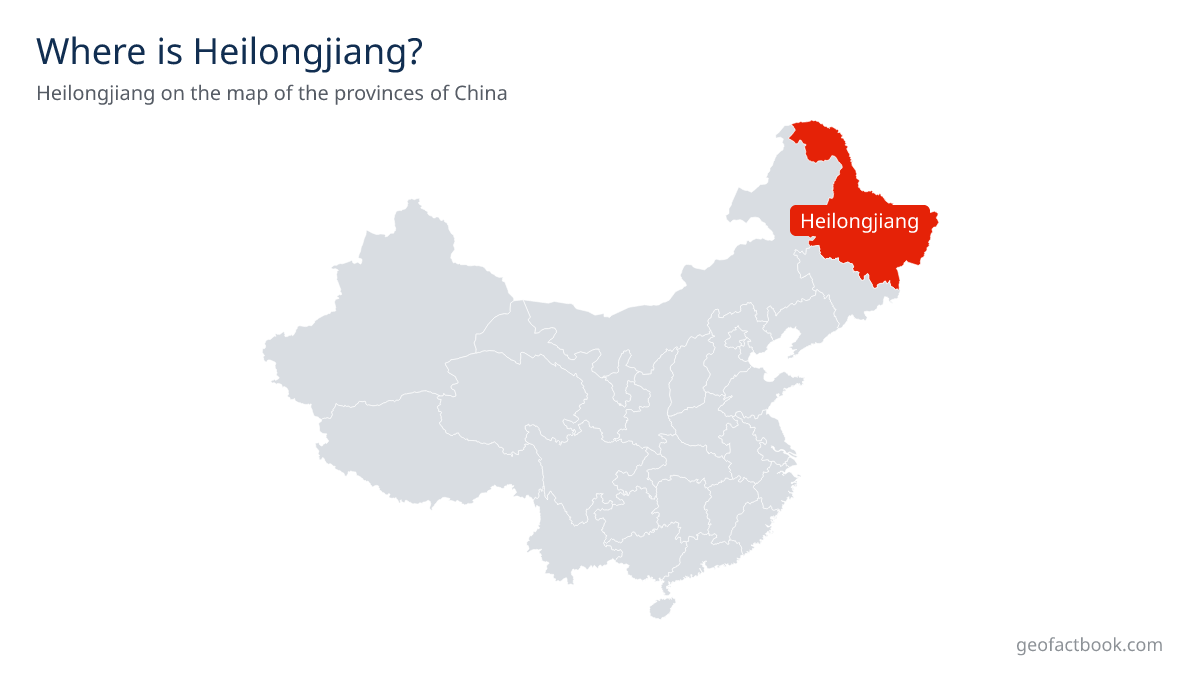
Where is Heilongjiang?
Compare Heilongjiang with another province
Explore More
Cite this page
Geo Factbook. (n.d.). Heilongjiang in Numbers. Retrieved November 27, 2026, from https://geofactbook.com/countries/china/provinces/heilongjiang
The figures on this page come from National Bureau of Statistics of China. For academic work, cite the original source as well.