
Central African Republic Percentage of land area by degree of urbanization 2026: 0.16 %
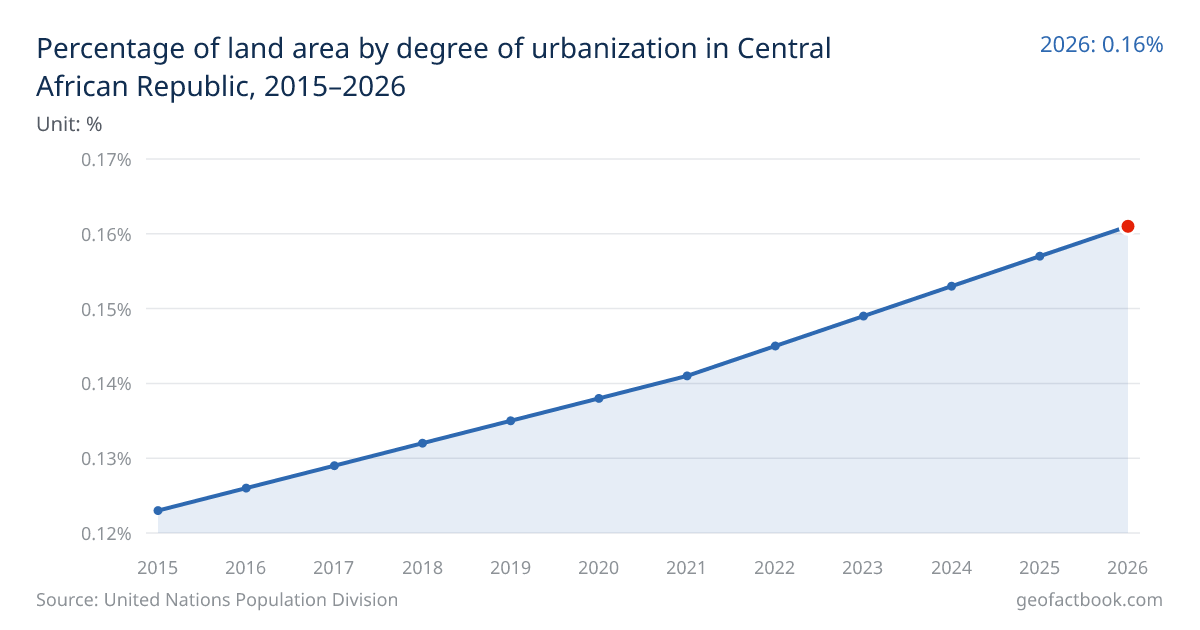
Central African Republic's percentage of land area by degree of urbanization in 2026 is 0.16 % (estimate), up 2.5% from 2025. It ranks #220 of 237 countries.
Explore the percentage of land area by degree of urbanization, highlighting how urban development shapes countries' landscapes and influences economic growth. Understanding this statistic reveals the balance between urban and rural spaces, essential for sustainable planning.
Estimated value for 2026 (interpolated, no direct source).
Where Central African Republic ranks (2026)
#220 of 237- #218
 Guyana0.2%
- #219
 Australia0.18%
- #220
 Central African Republic0.16%
- #221
 Canada0.16%
- #222
 Iceland0.16%
Percentage of land area by degree of urbanization over timeSome values are estimated based on historical trends
| Year | Value | Change | % Change | Actions |
|---|---|---|---|---|
| 2026 | 0.16 % | +0 % | +2.55% | |
| 2025 | 0.16 % | +0 % | +2.61% | |
| 2024 | 0.15 % | +0 % | +2.68% | |
| 2023 | 0.15 % | +0 % | +2.76% | |
| 2022 | 0.15 % | +0 % | +2.84% | |
| 2021 | 0.14 % | +0 % | +2.17% | |
| 2020 | 0.14 % | +0 % | +2.22% | |
| 2019 | 0.14 % | +0 % | +2.27% | |
| 2018 | 0.13 % | +0 % | +2.33% | |
| 2017 | 0.13 % | +0 % | +2.38% | |
| 2016 | 0.13 % | +0 % | +2.44% | |
| 2015 | 0.12 % | — | — |
Percentage of land area by degree of urbanization in Central African Republic, 2015–2026: chart
Cite this page
Geo Factbook. (n.d.). Central African Republic: Percentage of land area by degree of urbanization. Retrieved November 29, 2026, from https://geofactbook.com/countries/central-african-republic/percentage-of-land-area-by-degree-of-urbanization
The figures on this page come from United Nations Population Division. For academic work, cite the original source as well.
Frequently Asked Questions About Central African Republic Percentage of land area by degree of urbanization
What is Central African Republic's percentage of land area by degree of urbanization in 2026?▾
Central African Republic's percentage of land area by degree of urbanization is 0.16 % in 2026 (estimate), according to United Nations Population Division.
Is Central African Republic's percentage of land area by degree of urbanization increasing or decreasing?▾
Central African Republic's percentage of land area by degree of urbanization rose by 2.5% from 2025 (0.16 %) to 2026 (0.16 %). Over the past decade (2016–2026) it rose by 27.8%.
How does Central African Republic rank for percentage of land area by degree of urbanization?▾
In 2026, Central African Republic has the 220th highest percentage of land area by degree of urbanization out of 237 countries with data.
What was Central African Republic's percentage of land area by degree of urbanization in 2015?▾
In 2015, Central African Republic's percentage of land area by degree of urbanization was 0.12 %. By 2026 it rose by 30.9%.
Explore additional statistical insights
Agricultural land in Central African Republic
Agricultural land measures the area dedicated to farming and cultivation in countries, impacting food production and sustainability. Understanding this statistic is crucial for assessing agricultural capacity and economic development.
Banana Yield Per Hectare in Central African Republic
Compare the efficiency of banana production by examining yield per hectare across different countries.
Above-Ground Biomass in Forest (tonnes/ha) in Central African Republic
Above-ground biomass in forest measures carbon storage per hectare. Explore rankings and compare data across 266+ countries with interactive maps.
Share of Women in Ministerial Positions in Central African Republic
Share of women in ministerial roles shows gender equality in government leadership worldwide.
Average Non-HDL Cholesterol Levels in Central African Republic
Average non-HDL cholesterol levels indicate heart disease risk and vary across countries.
Population Change in Central African Republic
This statistic measures population change across countries, highlighting shifts in demographics. Understanding these changes is crucial for planning resources, economic growth, and social services.