
Canada Provinces by Population Growth (2026)
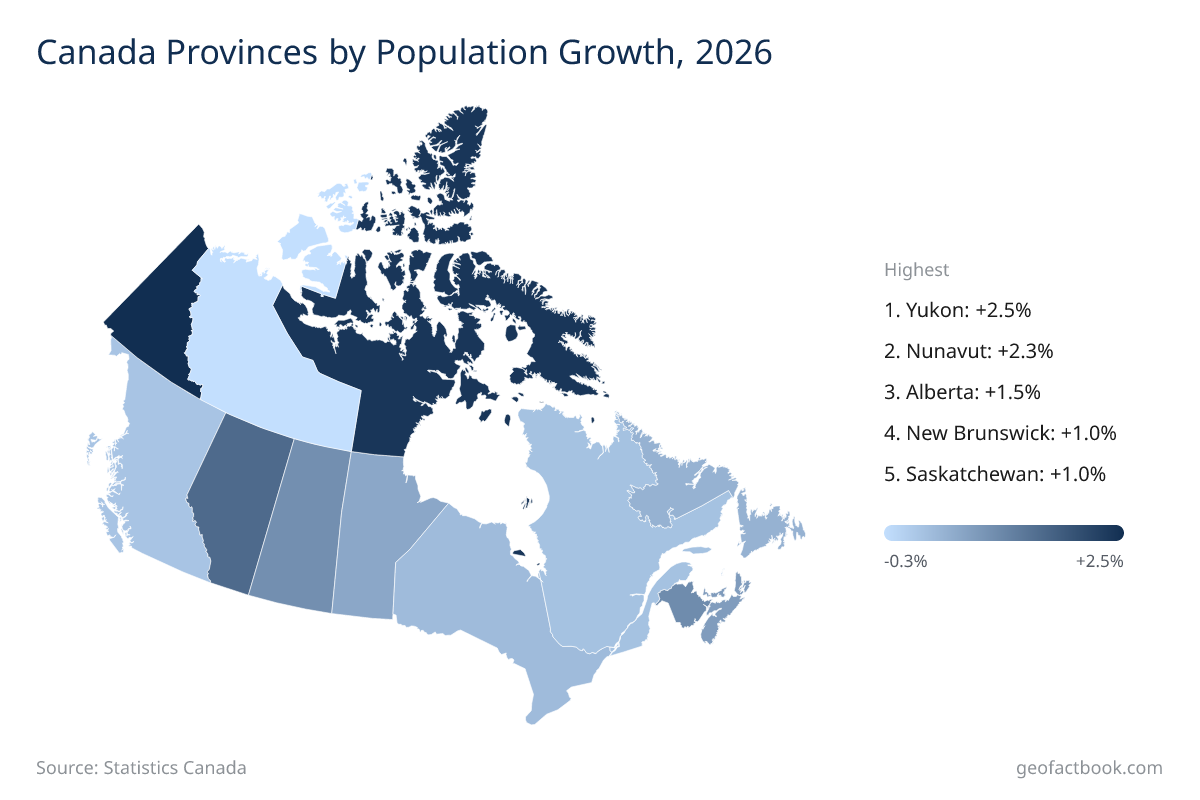
Yukon has the highest population growth of any province at +2.5% in 2026, followed by Nunavut (+2.3%) and Alberta (+1.5%). Northwest Territories has the lowest, at -0.3%. The middle province is at +0.8%.
| Rank | province | Population growth (2026) | Change since 2021 |
|---|---|---|---|
| 1 |  Yukon | +2.5% | +0.1 pts |
| 2 |  Nunavut | +2.3% | +0.8 pts |
| 3 |  Alberta | +1.5% | +1.0 pts |
| 4 |  New Brunswick | +1.0% | +0.1 pts |
| 5 |  Saskatchewan | +1.0% | +0.9 pts |
| 6 |  Prince Edward Island | +0.8% | −1.1 pts |
| 7 |  Nova Scotia | +0.8% | −0.3 pts |
| 8 |  Manitoba | +0.6% | −0.3 pts |
| 9 |  Newfoundland and Labrador | +0.4% | +0.4 pts |
| 10 |  Ontario | +0.3% | −0.3 pts |
| 11 |  Quebec | +0.2% | −0.1 pts |
| 12 |  British Columbia | +0.1% | −0.8 pts |
| 13 |  Northwest Territories | -0.3% | −0.4 pts |
2026 · Statistics Canada, Table 17-10-0005, change in the July 1 population estimate from the previous year. Unit: % change in population over the previous 12 months (July 1 to July 1). Rank 1 is the highest value.
Map: Canada Provinces by Population Growth, 2026
Frequently Asked Questions About Canada provinces and population growth
Which province has the highest population growth?▾
Yukon, with +2.5% in 2026. Source: Statistics Canada, Table 17-10-0005, change in the July 1 population estimate from the previous year.
Which province has the lowest population growth?▾
Northwest Territories, with -0.3% in 2026. Source: Statistics Canada, Table 17-10-0005, change in the July 1 population estimate from the previous year.
What are the top 5 provinces by population growth?▾
Yukon (+2.5%), Nunavut (+2.3%), Alberta (+1.5%), New Brunswick (+1.0%), Saskatchewan (+1.0%), in 2026.
More Canada provinces rankings
Cite this page
Geo Factbook. (n.d.). Canada Provinces by Population Growth (2026). Retrieved November 27, 2026, from https://geofactbook.com/countries/canada/provinces/rankings/population-growth
The figures on this page come from Statistics Canada. For academic work, cite the original source as well.