
Manitoba Unemployment Rate by Year (2015–2025)
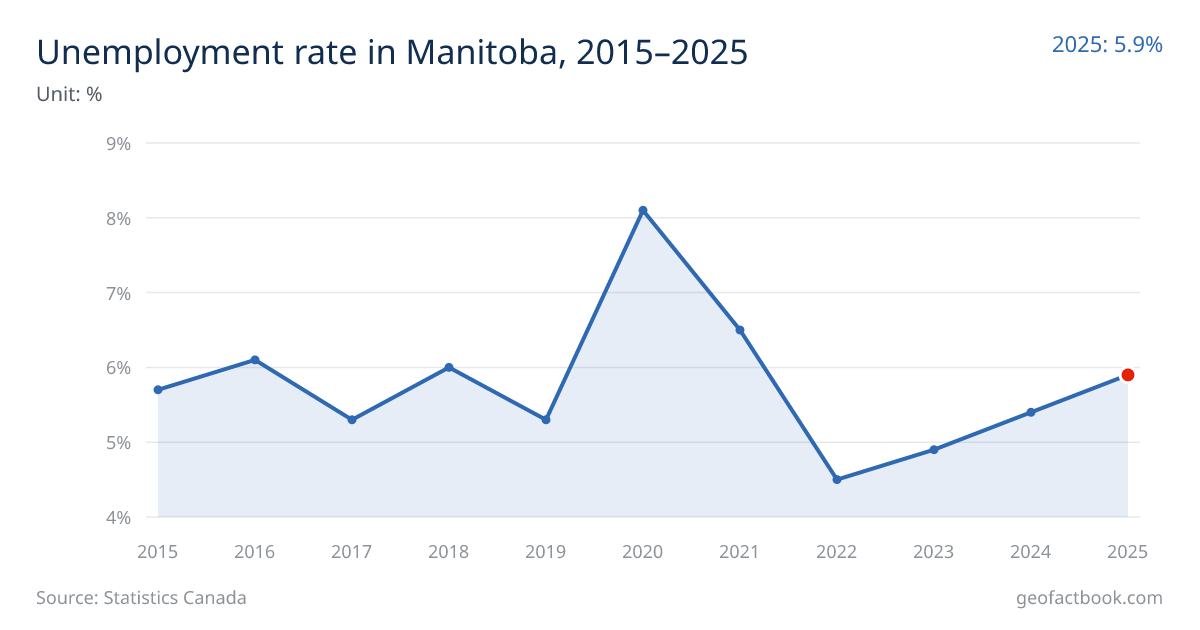
Manitoba's unemployment rate was 5.9% in 2025, the 5th lowest of any province. Since 2015 (5.7%) it changed by +0.2 pts. The highest value in this period was 8.1% in 2020. Its rank moved from 12th in 2015 to 9th in 2025.
Unemployment rate in Manitoba by year
| Year | Unemployment rate | Change | Rank among provinces |
|---|---|---|---|
| 2025 | 5.9% | +0.5 pts | 9 of 13 |
| 2024 | 5.4% | +0.5 pts | 10 of 13 |
| 2023 | 4.9% | +0.4 pts | 10 of 13 |
| 2022 | 4.5% | −2.0 pts | 11 of 13 |
| 2021 | 6.5% | −1.6 pts | 9 of 13 |
| 2020 | 8.1% | +2.8 pts | 12 of 13 |
| 2019 | 5.3% | −0.7 pts | 10 of 13 |
| 2018 | 6.0% | +0.7 pts | 9 of 13 |
| 2017 | 5.3% | −0.8 pts | 11 of 13 |
| 2016 | 6.1% | +0.4 pts | 12 of 13 |
| 2015 | 5.7% | — | 12 of 13 |
Statistics Canada, Table 14-10-0327, Labour Force Survey annual averages; territories from table 14-10-0292 (mean of the year's twelve unadjusted three-month moving averages). Unit: % of labor force (annual average, ages 15+). Rank 1 is the highest value that year; change is from the previous year shown.
Unemployment rate in Manitoba, 2015–2025: chart
Frequently Asked Questions About Manitoba unemployment rate
What is the unemployment rate of Manitoba?▾
Manitoba's unemployment rate was 5.9% in 2025, according to Statistics Canada (Table 14-10-0327, Labour Force Survey annual averages; territories from table 14-10-0292 (mean of the year's twelve unadjusted three-month moving averages)).
Where does Manitoba rank among Canada provinces in unemployment rate?▾
In 2025, Manitoba had the 5th lowest unemployment rate of any province: 9th of 13.
How has Manitoba's unemployment rate changed since 2015?▾
It went from 5.7% in 2015 to 5.9% in 2025 (+0.2 pts). The highest value in that period was 8.1% in 2020.
More about Manitoba
Cite this page
Geo Factbook. (n.d.). Manitoba Unemployment Rate by Year (2015–2025). Retrieved November 28, 2026, from https://geofactbook.com/countries/canada/provinces/manitoba/unemployment-rate
The figures on this page come from Statistics Canada. For academic work, cite the original source as well.