
Alberta Birth Rate by Year (2015–2025)
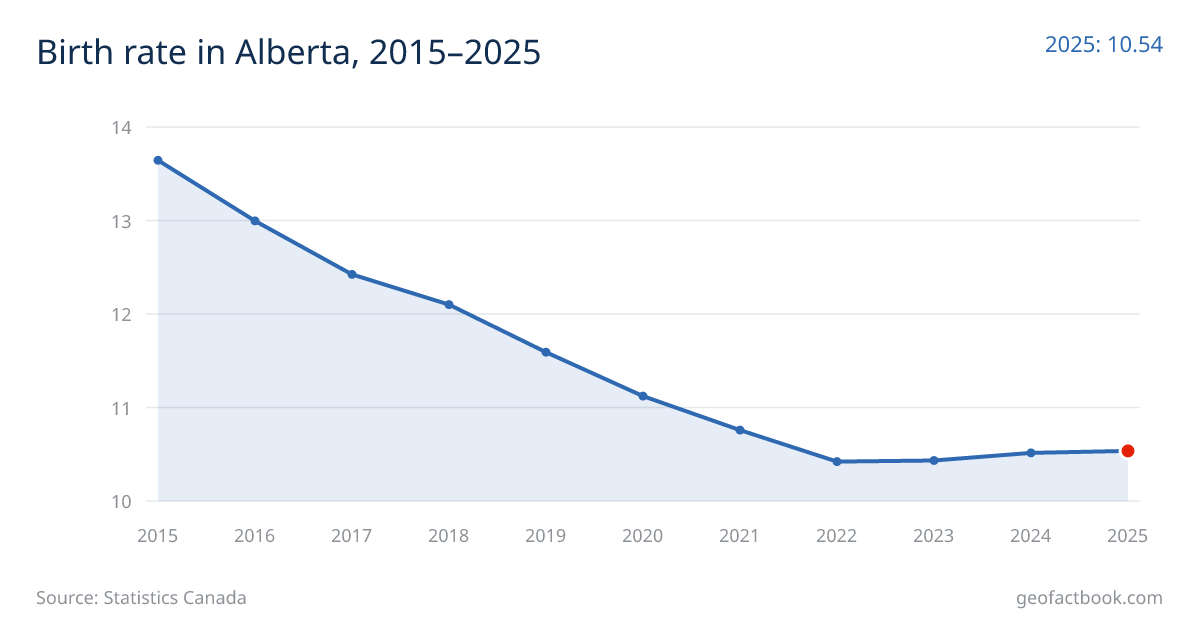
Alberta's birth rate was 10.5 per 1,000 in 2025, the 2nd highest of any province. Since 2015 (13.6 per 1,000) it changed by −22.8%. The highest value in this period was 13.6 per 1,000 in 2015. Its rank moved from 4th in 2015 to 2nd in 2025.
Birth rate in Alberta by year
| Year | Birth rate | Change | Rank among provinces |
|---|---|---|---|
| 2025 | 10.5 per 1,000 | +0.2% | 2 of 13 |
| 2024 | 10.5 per 1,000 | +0.8% | 3 of 13 |
| 2023 | 10.4 per 1,000 | +0.1% | 5 of 13 |
| 2022 | 10.4 per 1,000 | −3.1% | 5 of 13 |
| 2021 | 10.8 per 1,000 | −3.3% | 5 of 13 |
| 2020 | 11.1 per 1,000 | −4.0% | 5 of 13 |
| 2019 | 11.6 per 1,000 | −4.2% | 5 of 13 |
| 2018 | 12.1 per 1,000 | −2.6% | 5 of 13 |
| 2017 | 12.4 per 1,000 | −4.4% | 5 of 13 |
| 2016 | 13.0 per 1,000 | −4.8% | 4 of 13 |
| 2015 | 13.6 per 1,000 | — | 4 of 13 |
Statistics Canada, Table 17-10-0008, births from July 1 of the year to June 30 of the next, per 1,000 people (average of the two July 1 populations). Unit: births per 1,000 people (July 1 to June 30). Rank 1 is the highest value that year; change is from the previous year shown.
Birth rate in Alberta, 2015–2025: chart
Frequently Asked Questions About Alberta birth rate
What is the birth rate of Alberta?▾
Alberta's birth rate was 10.5 per 1,000 in 2025, according to Statistics Canada (Table 17-10-0008, births from July 1 of the year to June 30 of the next, per 1,000 people (average of the two July 1 populations)).
Where does Alberta rank among Canada provinces in birth rate?▾
In 2025, Alberta had the 2nd highest birth rate of any province: 2nd of 13.
How has Alberta's birth rate changed since 2015?▾
It went from 13.6 per 1,000 in 2015 to 10.5 per 1,000 in 2025 (−22.8%). The highest value in that period was 13.6 per 1,000 in 2015.
More about Alberta
Cite this page
Geo Factbook. (n.d.). Alberta Birth Rate by Year (2015–2025). Retrieved November 28, 2026, from https://geofactbook.com/countries/canada/provinces/alberta/birth-rate
The figures on this page come from Statistics Canada. For academic work, cite the original source as well.