
Canada Beer Consumption per Capita 2022: 3.12 liters
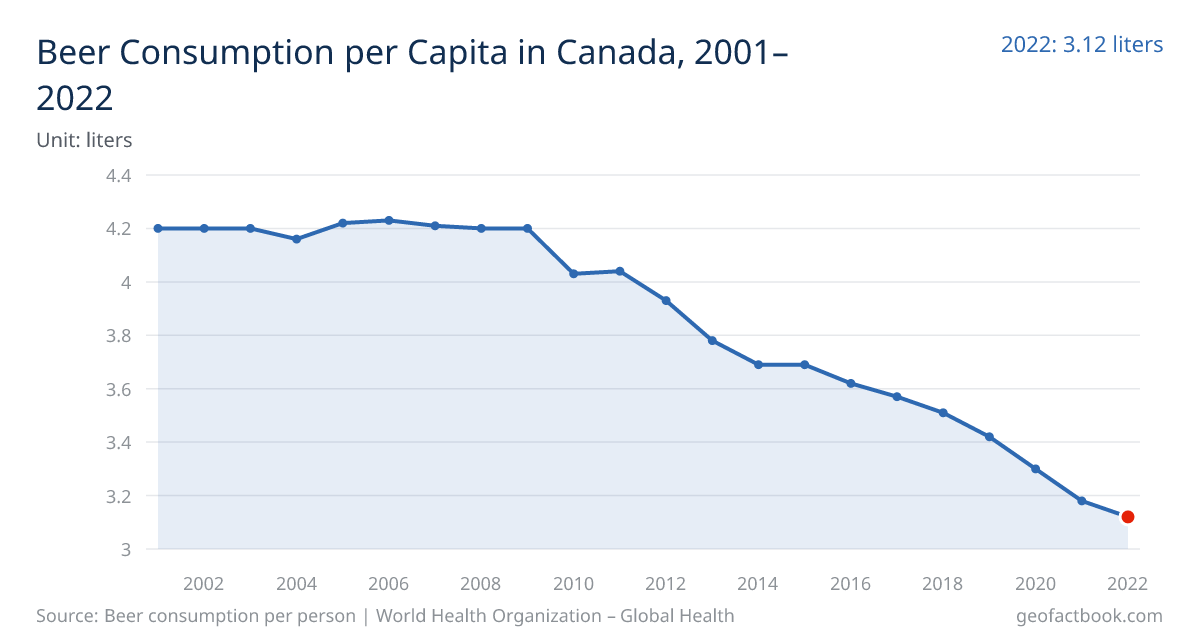
Canada's beer consumption per capita in 2022 is 3.12 liters, down 1.9% from 2021. It ranks #52 of 186 countries.
Beer consumption per capita measures the average liters of beer consumed by each person in a country annually.
Source (2022): Beer consumption per person | Our World in Data
Where Canada ranks (2022)
#52 of 186- #50
 Belize3.15 liters
- #51
 New Zealand3.13 liters
- #52
 Canada3.12 liters
- #53
 Russia3.07 liters
- #54
 Guyana3.03 liters
Beer Consumption per Capita over time
| Year | Value | Change | % Change | Actions |
|---|---|---|---|---|
| 2022 | 3.12 liters | 0.06 liters | -1.89% | |
| 2021 | 3.18 liters | 0.12 liters | -3.64% | |
| 2020 | 3.3 liters | 0.12 liters | -3.51% | |
| 2019 | 3.42 liters | 0.09 liters | -2.56% | |
| 2018 | 3.51 liters | 0.06 liters | -1.68% | |
| 2017 | 3.57 liters | 0.05 liters | -1.38% | |
| 2016 | 3.62 liters | 0.07 liters | -1.90% | |
| 2015 | 3.69 liters | 0 liters | 0.00% | |
| 2014 | 3.69 liters | 0.09 liters | -2.38% | |
| 2013 | 3.78 liters | 0.15 liters | -3.82% | |
| 2012 | 3.93 liters | 0.11 liters | -2.72% | |
| 2011 | 4.04 liters | +0.01 liters | +0.25% | |
| 2010 | 4.03 liters | 0.17 liters | -4.05% | |
| 2009 | 4.2 liters | 0 liters | 0.00% | |
| 2008 | 4.2 liters | 0.01 liters | -0.24% | |
| 2007 | 4.21 liters | 0.02 liters | -0.47% | |
| 2006 | 4.23 liters | +0.01 liters | +0.24% | |
| 2005 | 4.22 liters | +0.06 liters | +1.44% | |
| 2004 | 4.16 liters | 0.04 liters | -0.95% | |
| 2003 | 4.2 liters | 0 liters | 0.00% | |
| 2002 | 4.2 liters | 0 liters | 0.00% | |
| 2001 | 4.2 liters | — | — |
Beer Consumption per Capita in Canada, 2001–2022: chart
Cite this page
Geo Factbook. (n.d.). Canada: Beer Consumption per Capita. Retrieved November 27, 2026, from https://geofactbook.com/countries/canada/beer-consumption-per-capita
The figures on this page come from Beer consumption per person | World Health Organization – Global Health Observatory via Our World in Data. For academic work, cite the original source as well.
Frequently Asked Questions About Canada Beer Consumption per Capita
What is Canada's beer consumption per capita in 2022?▾
Canada's beer consumption per capita is 3.12 liters in 2022, according to Beer consumption per person | World Health Organization – Global Health Observatory via Our World in Data.
Is Canada's beer consumption per capita increasing or decreasing?▾
Canada's beer consumption per capita fell by 1.9% from 2021 (3.18 liters) to 2022 (3.12 liters). Over the past decade (2012–2022) it fell by 20.6%.
How does Canada rank for beer consumption per capita?▾
In 2022, Canada has the 52nd highest beer consumption per capita out of 186 countries with data.
What was Canada's beer consumption per capita in 2001?▾
In 2001, Canada's beer consumption per capita was 4.20 liters. By 2022 it fell by 25.7%.
Explore additional statistical insights
Length of paid parental leave for mother in Canada
Discover how the length of paid parental leave for mothers varies by country, impacting family well-being and workforce participation. Explore the statistics that highlight this critical social issue.
Female Homicide Rate in Canada
Female homicide rate measures the number of women murdered per 100,000 women annually, highlighting gender-based violence levels.
Fixed Broadband Penetration Rate in Canada
Fixed broadband penetration rate indicates the proportion of households with broadband access, reflecting connectivity.
Urban Population Annual Growth Rate in Canada
Urban population annual growth rate measures the year-over-year percentage increase in a country's urban population.
Share of Students Studying Abroad in Canada
Share of students studying abroad tracks the percentage of tertiary-level students enrolled outside their home country.
Currently married (Percent) in Canada
The percentage of currently married individuals by country highlights societal trends in family structure and relationships. Understanding these statistics can provide insights into cultural norms and demographic shifts, influencing policies and social programs.