
Bosnia and Herzegovina Urban Population Share 2050 2025: 52.69 %
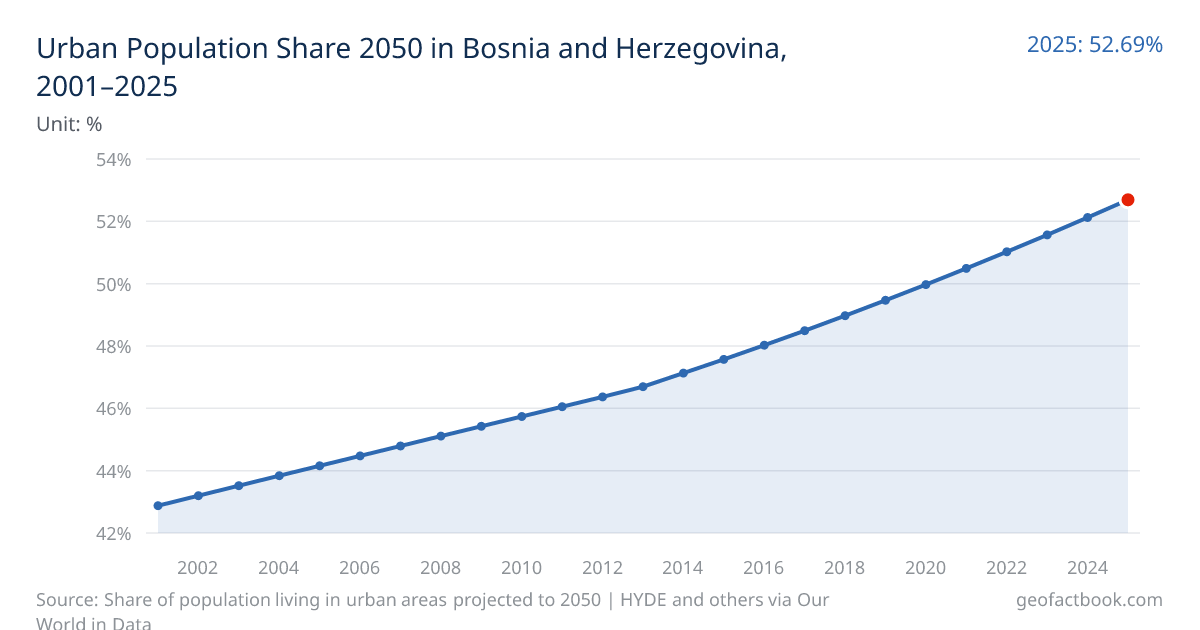
Bosnia and Herzegovina's urban population share 2050 in 2025 is 52.69 %, up 1.1% from 2024. It ranks #163 of 236 countries.
Urban population share by 2050 shows urbanization trends. Discover which countries will be most urbanized.
Source (2025): Share of population living in urban areas projected to 2050 | Our World in Data
Where Bosnia and Herzegovina ranks (2025)
#163 of 236- #161
 Benin53.36%
- #162
 Slovakia53.19%
- #163
 Bosnia and Herzegovina52.69%
- #164
 Romania52.17%
- #165
 Isle of Man52.14%
Urban Population Share 2050 over time
| Year | Value | Change | % Change | Actions |
|---|---|---|---|---|
| 2025 | 52.69 % | +0.57 % | +1.09% | |
| 2024 | 52.12 % | +0.56 % | +1.08% | |
| 2023 | 51.57 % | +0.54 % | +1.07% | |
| 2022 | 51.02 % | +0.53 % | +1.05% | |
| 2021 | 50.49 % | +0.52 % | +1.04% | |
| 2020 | 49.97 % | +0.51 % | +1.02% | |
| 2019 | 49.47 % | +0.49 % | +1.01% | |
| 2018 | 48.97 % | +0.48 % | +0.99% | |
| 2017 | 48.49 % | +0.47 % | +0.97% | |
| 2016 | 48.02 % | +0.45 % | +0.95% | |
| 2015 | 47.57 % | +0.44 % | +0.93% | |
| 2014 | 47.13 % | +0.44 % | +0.93% | |
| 2013 | 46.7 % | +0.33 % | +0.71% | |
| 2012 | 46.37 % | +0.31 % | +0.68% | |
| 2011 | 46.05 % | +0.31 % | +0.69% | |
| 2010 | 45.74 % | +0.31 % | +0.69% | |
| 2009 | 45.42 % | +0.32 % | +0.70% | |
| 2008 | 45.11 % | +0.32 % | +0.71% | |
| 2007 | 44.79 % | +0.32 % | +0.71% | |
| 2006 | 44.48 % | +0.32 % | +0.72% | |
| 2005 | 44.16 % | +0.32 % | +0.73% | |
| 2004 | 43.84 % | +0.32 % | +0.73% | |
| 2003 | 43.52 % | +0.32 % | +0.74% | |
| 2002 | 43.2 % | +0.32 % | +0.75% | |
| 2001 | 42.88 % | — | — |
Urban Population Share 2050 in Bosnia and Herzegovina, 2001–2025: chart
Cite this page
Geo Factbook. (n.d.). Bosnia and Herzegovina: Urban Population Share 2050. Retrieved November 29, 2026, from https://geofactbook.com/countries/bosnia-and-herzegovina/urban-population-share-2050
The figures on this page come from Share of population living in urban areas projected to 2050 | HYDE and others via Our World in Data. For academic work, cite the original source as well.
Frequently Asked Questions About Bosnia and Herzegovina Urban Population Share 2050
What is Bosnia and Herzegovina's urban population share 2050 in 2025?▾
Bosnia and Herzegovina's urban population share 2050 is 52.69 % in 2025, according to Share of population living in urban areas projected to 2050 | HYDE and others via Our World in Data.
Is Bosnia and Herzegovina's urban population share 2050 increasing or decreasing?▾
Bosnia and Herzegovina's urban population share 2050 rose by 1.1% from 2024 (52.12 %) to 2025 (52.69 %). Over the past decade (2015–2025) it rose by 10.8%.
How does Bosnia and Herzegovina rank for urban population share 2050?▾
In 2025, Bosnia and Herzegovina has the 163rd highest urban population share 2050 out of 236 countries with data.
What was Bosnia and Herzegovina's urban population share 2050 in 2001?▾
In 2001, Bosnia and Herzegovina's urban population share 2050 was 42.88 %. By 2025 it rose by 22.9%.
Explore additional statistical insights
Physician Density in Bosnia and Herzegovina
Physician density measures healthcare access, showing the number of doctors per square kilometer. Compare countries and explore interactive maps.
Female Tertiary Enrollment Rate (%) in Bosnia and Herzegovina
This measures the percentage of female students enrolling in tertiary education, reflecting gender parity in higher education globally.
Beer Consumption per Capita in Bosnia and Herzegovina
Beer consumption per capita measures the average liters of beer consumed by each person in a country annually.
Total demand for family planning (Percent) in Bosnia and Herzegovina
Total demand for family planning measures the percentage of individuals seeking access to reproductive health services. Understanding this statistic is crucial for addressing global population growth and improving health outcomes.
Female Homicide Rate in Bosnia and Herzegovina
Female homicide rate measures the number of women murdered per 100,000 women annually, highlighting gender-based violence levels.
Total net-migration in Bosnia and Herzegovina
Total net-migration measures the difference between the number of immigrants and emigrants in a country, reflecting population shifts and economic opportunities. Understanding this statistic is crucial for analyzing demographic trends and policy impacts in nations worldwide.