
Bosnia and Herzegovina GNI Per Capita (PPP) 2025: $25,810
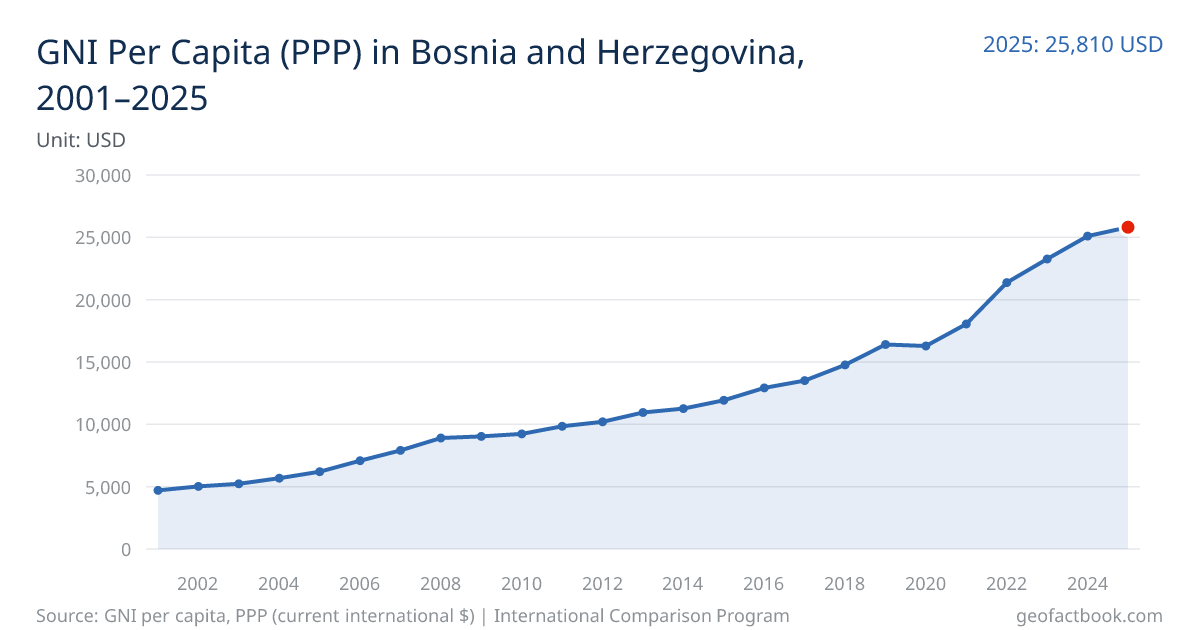
Bosnia and Herzegovina's gni per capita (ppp) in 2025 is $25,810, up 2.8% from 2024. It ranks #71 of 181 countries.
GNI per capita (PPP) shows the average income earned per person, adjusted for purchasing power.
Source (2025): GNI per capita (PPP)
Where Bosnia and Herzegovina ranks (2025)
#71 of 181- #69
 North Macedonia26,680 USD
- #70
 Saint Lucia26,180 USD
- #71
 Bosnia and Herzegovina25,810 USD
- #72
 Maldives25,600 USD
- #73
 Thailand25,570 USD
GNI Per Capita (PPP) over time
| Year | Value | Change | % Change | Actions |
|---|---|---|---|---|
| 2025 | 25.81K USD | +710 USD | +2.83% | |
| 2024 | 25.10K USD | +1.84K USD | +7.91% | |
| 2023 | 23.26K USD | +1.89K USD | +8.84% | |
| 2022 | 21.37K USD | +3.32K USD | +18.39% | |
| 2021 | 18.05K USD | +1.77K USD | +10.87% | |
| 2020 | 16.28K USD | 120 USD | -0.73% | |
| 2019 | 16.40K USD | +1.63K USD | +11.04% | |
| 2018 | 14.77K USD | +1.26K USD | +9.33% | |
| 2017 | 13.51K USD | +590 USD | +4.57% | |
| 2016 | 12.92K USD | +990 USD | +8.30% | |
| 2015 | 11.93K USD | +670 USD | +5.95% | |
| 2014 | 11.26K USD | +310 USD | +2.83% | |
| 2013 | 10.95K USD | +750 USD | +7.35% | |
| 2012 | 10.20K USD | +360 USD | +3.66% | |
| 2011 | 9.84K USD | +610 USD | +6.61% | |
| 2010 | 9.23K USD | +200 USD | +2.21% | |
| 2009 | 9.03K USD | +130 USD | +1.46% | |
| 2008 | 8.90K USD | +990 USD | +12.52% | |
| 2007 | 7.91K USD | +830 USD | +11.72% | |
| 2006 | 7.08K USD | +880 USD | +14.19% | |
| 2005 | 6.20K USD | +520 USD | +9.15% | |
| 2004 | 5.68K USD | +450 USD | +8.60% | |
| 2003 | 5.23K USD | +210 USD | +4.18% | |
| 2002 | 5.02K USD | +320 USD | +6.81% | |
| 2001 | 4.70K USD | — | — |
GNI Per Capita (PPP) in Bosnia and Herzegovina, 2001–2025: chart
Cite this page
Geo Factbook. (n.d.). Bosnia and Herzegovina: GNI Per Capita (PPP). Retrieved November 28, 2026, from https://geofactbook.com/countries/bosnia-and-herzegovina/gni-per-capita-ppp
The figures on this page come from GNI per capita, PPP (current international $) | International Comparison Program (ICP), World Bank (WB) and others via World Bank. For academic work, cite the original source as well.
Frequently Asked Questions About Bosnia and Herzegovina GNI Per Capita (PPP)
What is Bosnia and Herzegovina's gni per capita (ppp) in 2025?▾
Bosnia and Herzegovina's gni per capita (ppp) is $25,810 in 2025, according to GNI per capita, PPP (current international $) | International Comparison Program (ICP), World Bank (WB) and others via World Bank.
Is Bosnia and Herzegovina's gni per capita (ppp) increasing or decreasing?▾
Bosnia and Herzegovina's gni per capita (ppp) rose by 2.8% from 2024 ($25,100) to 2025 ($25,810). Over the past decade (2015–2025) it rose by 116.3%.
How does Bosnia and Herzegovina rank for gni per capita (ppp)?▾
In 2025, Bosnia and Herzegovina has the 71st highest gni per capita (ppp) out of 181 countries with data.
What was Bosnia and Herzegovina's gni per capita (ppp) in 2001?▾
In 2001, Bosnia and Herzegovina's gni per capita (ppp) was $4,700. By 2025 it rose by 449.1%.
Explore additional statistical insights
Tax Burden (% of GDP) in Bosnia and Herzegovina
Tax Burden measures the proportion of GDP collected by governments as taxes, influencing economic freedom.
Share of population in poverty ($3 a day) in Bosnia and Herzegovina
Share of population in poverty ($3 a day) statistics by country with historical data from Our World in Data.
Income Share of Richest 1% Before Tax in Bosnia and Herzegovina
Income share of the richest 1% before tax reveals wealth concentration across nations. High interest due to inequality debates.
Healthy Diet Cost Index in Bosnia and Herzegovina
The Healthy Diet Cost Index compares the relative expense of nutritious food options in countries worldwide.
Milk Production Volume in Bosnia and Herzegovina
Milk production volume measures the total amount of milk produced in a country annually, highlighting agricultural capacity.
Urban Informal Employment Share in Bosnia and Herzegovina
Urban informal employment share indicates the percentage of workers in informal jobs within urban areas.