
Bonaire, Sint Eustatius and Saba Population density 2026: 99.38 per sq. km
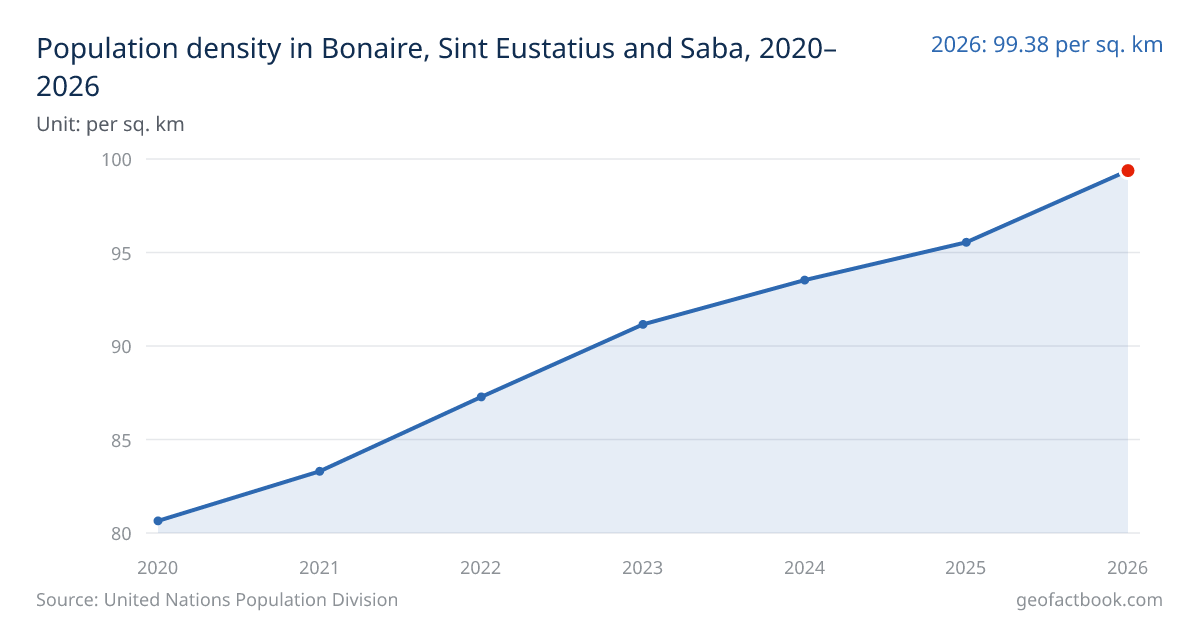
Bonaire, Sint Eustatius and Saba's population density in 2026 is 99.38 per sq. km (estimate), up 4.0% from 2025. It ranks #121 of 236 countries.
Population density measures how many people live per square kilometer in a country, highlighting urbanization and resource distribution. Understanding this statistic is crucial for assessing living conditions, infrastructure needs, and environmental impact.
Estimated value for 2026 (interpolated, no direct source).
Where Bonaire, Sint Eustatius and Saba ranks (2026)
#121 of 236- #119
 Albania100.47 per sq. km
- #120
 Cambodia99.83 per sq. km
- #121
 Bonaire, Sint Eustatius and Saba99.38 per sq. km
- #122
 Timor-Leste96.5 per sq. km
- #123
 Spain95.5 per sq. km
Population density over timeSome values are estimated based on historical trends
| Year | Value | Change | % Change | Actions |
|---|---|---|---|---|
| 2026 | 99.38 per sq. km | +3.83 per sq. km | +4.01% | |
| 2025 | 95.54 per sq. km | +2.02 per sq. km | +2.16% | |
| 2024 | 93.52 per sq. km | +2.37 per sq. km | +2.60% | |
| 2023 | 91.15 per sq. km | +3.88 per sq. km | +4.44% | |
| 2022 | 87.28 per sq. km | +3.98 per sq. km | +4.77% | |
| 2021 | 83.3 per sq. km | +2.65 per sq. km | +3.29% | |
| 2020 | 80.65 per sq. km | — | — |
Population density in Bonaire, Sint Eustatius and Saba, 2020–2026: chart
Cite this page
Geo Factbook. (n.d.). Bonaire, Sint Eustatius and Saba: Population density. Retrieved November 27, 2026, from https://geofactbook.com/countries/bonaire-sint-eustatius-and-saba/population-density
The figures on this page come from United Nations Population Division. For academic work, cite the original source as well.
Frequently Asked Questions About Bonaire, Sint Eustatius and Saba Population density
What is Bonaire, Sint Eustatius and Saba's population density in 2026?▾
Bonaire, Sint Eustatius and Saba's population density is 99.38 per sq. km in 2026 (estimate), according to United Nations Population Division.
Is Bonaire, Sint Eustatius and Saba's population density increasing or decreasing?▾
Bonaire, Sint Eustatius and Saba's population density rose by 4.0% from 2025 (95.54 per sq. km) to 2026 (99.38 per sq. km).
How does Bonaire, Sint Eustatius and Saba rank for population density?▾
In 2026, Bonaire, Sint Eustatius and Saba has the 121st highest population density out of 236 countries with data.
What was Bonaire, Sint Eustatius and Saba's population density in 2020?▾
In 2020, Bonaire, Sint Eustatius and Saba's population density was 80.65 per sq. km. By 2026 it rose by 23.2%.
Explore additional statistical insights
Global Average Sex Ratio at Birth in Bonaire, Sint Eustatius and Saba
Explore the global average sex ratio at birth, highlighting the natural baseline in different countries.
Life expectancy at birth in Bonaire, Sint Eustatius and Saba
Life expectancy at birth measures the average years a newborn is expected to live, reflecting a country's health standards and quality of life. This vital statistic highlights disparities in healthcare and living conditions across nations, making it essential for global health assessments.
Total net-migration in Bonaire, Sint Eustatius and Saba
Total net-migration measures the difference between the number of immigrants and emigrants in a country, reflecting population shifts and economic opportunities. Understanding this statistic is crucial for analyzing demographic trends and policy impacts in nations worldwide.
Under-five mortality rate in Bonaire, Sint Eustatius and Saba
The under-five mortality rate measures the number of deaths per 1,000 live births for children under five. This critical statistic highlights child health and development, reflecting a country's healthcare quality and socioeconomic conditions. Understanding these rates is vital for improving global health initiatives.
Percentage of population by degree of urbanization in Bonaire, Sint Eustatius and Saba
Explore the percentage of population by degree of urbanization across countries, highlighting the shift towards urban living and its impact on economic growth and development. Understanding these trends is crucial for addressing urban planning and resource allocation.
Median age of population in Bonaire, Sint Eustatius and Saba
The median age of a population is a key demographic indicator, reflecting the age distribution within a country. Understanding median age helps assess economic development, healthcare needs, and social dynamics. Countries with a higher median age may face challenges related to aging populations, while younger populations often indicate growth potential.