
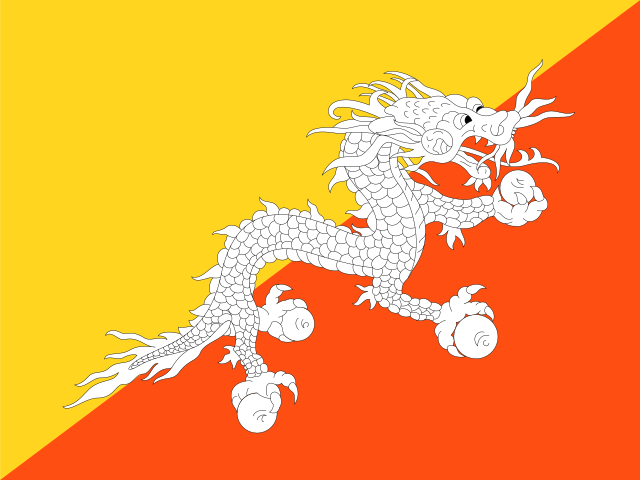
Location
Bhutan is in Southern Asia, between China and India. It shares land borders with India (659 km) and China (477 km) and is landlocked. The capital is Thimphu.
Bhutan population 2026: 801,839 — growth, rank & history →Key Statistics for 2026
Total population
Population Change
Median age of population
Population density
Life expectancy at birth
Agricultural land
Dam capacity per capita
Female population of reproductive age
Health Care Spending per Capita
Learning-adjusted years of school
Length of paid parental leave for mother
History
Bhutan's history dates back to ancient times, with its origins intertwined with the spread of Buddhism in the region. The earliest known inhabitants were likely nomadic tribes, and by the 7th century, significant developments took place with the introduction of Buddhism. According to historical texts, the Tibetan king Songtsen Gampo sent the missionary monk Padmasambhava to Bhutan, which played a pivotal role in establishing Buddhism as a dominant force. This early influence laid the groundwork for Bhutan's cultural and spiritual identity, which remains central to its society today.
The medieval period saw the consolidation of power among various local rulers and the establishment of the dual system of governance that characterizes Bhutan's political framework. In the 17th century, the unification of Bhutan occurred under the leadership of Shabdrung Ngawang Namgyal, who is credited with founding the country as a unified entity. He introduced a centralized monastic government and promoted the Drukpa school of Buddhism, which became the state religion. This period also marked the construction of numerous dzongs (fortresses), which served both religious and administrative purposes, further solidifying the country's identity and governance structure.
In the early 20th century, Bhutan transitioned into a modern nation-state under the rule of the first king, Ugyen Wangchuck, who was crowned in 1907. His reign initiated a period of relative stability and modernization, as he sought to balance traditional practices with contemporary governance. The signing of the Treaty of Punakha in 1910 with British India established Bhutan's foreign policy under British influence while maintaining internal autonomy. Following India’s independence in 1947, Bhutan navigated a new era of diplomacy, signing a treaty with India in 1949, which emphasized mutual respect and non-interference.
In recent decades, Bhutan has garnered international attention for its unique approach to development, emphasizing Gross National Happiness (GNH) over traditional economic metrics. The peaceful transition to democracy began with the first democratic elections in 2008, marking a significant milestone in the nation's political evolution. Bhutan's commitment to environmental conservation and cultural preservation has also positioned it as a model for sustainable development in the global arena. As the country faces contemporary challenges such as climate change and modernization, its historical significance continues to shape its path forward, reflecting a blend of tradition and progressive ideals.
Geography
Located in South Asia, Bhutan is a landlocked country nestled in the eastern Himalayas. It shares its borders with the People’s Republic of China to the north and India to the south, east, and west. The country’s unique geography has played a crucial role in shaping its cultural identity and influencing its socio-economic dynamics. Bhutan's strategic position in the Himalayas has historically made it a significant buffer state between India and China, contributing to its relatively stable political landscape.
The terrain of Bhutan is predominantly mountainous, with the Himalayan mountain range dominating the northern part of the country. The highest peak, Gangkhar Puensum, rises to 7,570 meters (24,836 feet) and is considered sacred. The country is characterized by deep valleys and steep slopes, which create a stunningly varied landscape. Notable rivers such as the Drangme Chhu and Wang Chhu flow through these valleys, contributing to the rich biodiversity and fertile plains found in the lower regions. The diverse topography supports a range of ecosystems, from subtropical forests in the south to alpine meadows in the north.
Bhutan experiences a varied climate, influenced by its elevation and geography. The southern regions typically enjoy a warm, humid climate, while the northern areas experience a colder, alpine climate. The country has four distinct seasons: spring, summer, autumn, and winter. The monsoon season, which lasts from June to September, brings substantial rainfall, particularly in the southern regions, while winter is marked by dry and cold conditions in the north. This climatic variability contributes to the rich agricultural practices seen throughout the nation.
Natural resources in Bhutan include forests, which cover approximately 72% of the land area, providing a wealth of timber and non-timber products. The country is also rich in hydropower potential, with numerous rivers that offer opportunities for electricity generation, making it a significant asset for the economy. Additionally, Bhutan is known for its commitment to environmental conservation, emphasizing the importance of sustainable development and preservation of its natural heritage. The government has established policies to maintain ecological balance, which has earned Bhutan recognition as one of the world’s leaders in environmental stewardship.
Government
Bhutan is a democratic constitutional monarchy, which is a unique political system that blends traditional monarchy with modern democratic governance. The country transitioned to a parliamentary democracy in 2008, following the adoption of its first written constitution. This marked a significant change in governance, as the King of Bhutan, who serves as the head of state, plays a crucial role in both ceremonial and constitutional functions, while the Prime Minister leads the government in the daily affairs of the state.
The structure of the government is defined by three branches: the executive, legislative, and judicial branches. The executive branch is headed by the Prime Minister, who is elected by the National Assembly and is responsible for implementing laws and managing the civil service. The legislative branch consists of a bicameral parliament, which includes the National Assembly and the National Council. The National Assembly has 47 members elected directly by the citizens, while the National Council is made up of 25 members, of which 20 are elected by local councils, and five are appointed by the King. The judicial branch is independent and includes a Supreme Court, which is the highest court in the land, and various lower courts that handle civil and criminal cases.
Key institutions in Bhutan's political landscape include the Royal Government of Bhutan, the Election Commission, and the National Council. The King, currently Jigme Khesar Namgyel Wangchuck, plays a pivotal role in ensuring the stability and continuity of governance. The political landscape is characterized by a multi-party system, with several parties participating in elections. The two major political parties, the Druk Nyamrup Tshogpa and the Druk Phuensum Tshogpa, have dominated the political scene since the establishment of democracy, reflecting a growing engagement of the Bhutanese populace in the political process.
The electoral system in Bhutan is based on a first-past-the-post methodology, where the candidate with the most votes in a constituency wins. The National Assembly elections are held every five years, and the electoral process is overseen by the Election Commission of Bhutan, which ensures free and fair elections. Bhutan's political landscape is evolving, with increasing public participation and a gradual shift towards greater political pluralism, showcasing the country's commitment to democratic principles while maintaining its rich cultural heritage.
Economy
Bhutan operates under a unique economic system characterized by a blend of traditional practices and modern economic policies. The country's Gross Domestic Product (GDP) was approximately $2.5 billion in 2022, reflecting a modest yet steadily growing economy. The government emphasizes Gross National Happiness (GNH) as a guiding principle, prioritizing sustainable development and the well-being of its citizens over mere economic growth. Bhutan's economy is primarily agrarian, with about 60% of the population engaged in agriculture, which constitutes a significant portion of the GDP. Services and industry also contribute to the economy, with hydropower being a major driving force.
The major industries in Bhutan include agriculture, forestry, tourism, and hydropower. Notably, hydropower is the backbone of the economy, accounting for around 45% of the GDP and providing substantial export revenues, primarily to neighboring India. The tourism sector, although impacted by the COVID-19 pandemic, remains a crucial component of economic activity, promoting cultural heritage and natural beauty, which attract visitors. Agriculture, meanwhile, is not only vital for domestic food security but also provides raw materials for local industries, such as dairy and handicrafts.
Trade relationships play a significant role in Bhutan's economy, with India being its largest trading partner, accounting for approximately 70% of Bhutan's total trade. Bhutan exports electricity, minerals, and agricultural products while importing machinery, petroleum products, and food items. The country is also working to diversify its trade relationships by engaging with other countries in South Asia and beyond, aiming to enhance economic resilience through various trade agreements and partnerships.
Despite its economic potential, Bhutan faces several challenges, including vulnerability to climate change, limited infrastructure, and reliance on a narrow range of exports. Economic growth is often hindered by natural disasters, such as landslides and flooding, which can disrupt agricultural production and infrastructure. However, there are significant opportunities for Bhutan to harness renewable energy resources, particularly hydropower, and expand its tourism sector. By investing in sustainable practices and enhancing connectivity, Bhutan can bolster its economic growth while adhering to its GNH principles, ensuring that development benefits all segments of society.
Culture
Bhutan is a unique nation characterized by its rich tapestry of languages, religions, and ethnic groups. The official language is Dzongkha, a Sino-Tibetan language, which is used in government and education. In addition to Dzongkha, numerous dialects are spoken across the country, reflecting the diverse ethnic groups that inhabit the region. The majority of the population practices Buddhism, particularly the Drukpa school, while a significant minority adheres to Hinduism, primarily among the Nepali ethnic groups in the southern regions. This religious diversity is vital in shaping the cultural identity of Bhutan, influencing festivals, rituals, and daily life.
The cultural traditions and customs of Bhutan are deeply intertwined with its spiritual beliefs and the principles of Gross National Happiness, which emphasizes well-being over material wealth. Festivals, known as tshechus, are celebrated with vibrant displays of traditional dance, music, and elaborate costumes, allowing communities to come together in a spirit of joy and devotion. The practice of khaddar, or offering ceremonial scarves, symbolizes respect and goodwill, while the custom of Zhabdrung Ngawang Namgyal's teachings continues to influence the moral and ethical framework of the nation.
Art, music, and literature in Bhutan are profoundly influenced by its Buddhist heritage. Traditional arts include thangka painting, wood carving, and the crafting of intricate textiles, which are often used in religious and ceremonial contexts. Bhutanese music is characterized by its use of traditional instruments such as the dranyen (a stringed instrument) and the dungchen (a long trumpet), often accompanying dance performances during festivals. Literature, primarily religious texts and historical chronicles, reflects the nation's values and philosophical insights, with notable works such as the Rinchen Terzo and writings by influential figures like the 4th Druk Desi.
Bhutanese cuisine is a delightful reflection of its culture, characterized by the use of local ingredients and spices. The national dish, ema datshi, made from chili peppers and cheese, exemplifies the Bhutanese love for spicy food. Daily life in Bhutan is largely influenced by its agricultural practices, with most people engaged in farming and animal husbandry. Traditional practices, such as weaving and pottery, remain prevalent, and family ties are strong, with extended families often living together. These elements contribute to a harmonious way of life that is both sustainable and culturally rich, allowing Bhutan to maintain its unique identity in an increasingly globalized world.
About This Data
This page displays comprehensive statistical data for Bhutan for the year 2026. All data points are sourced from authoritative international organizations and are regularly updated to ensure accuracy and reliability.
Click on any statistic to explore more detailed information, see how Bhutan compares with other countries, and view historical trends.
Primary Data Sources
CIA World Factbook
Comprehensive country profiles and demographic statistics from the Central Intelligence Agency
Learn moreUnited Nations Statistics
Global demographic data and population projections from UN agencies and research divisions
Learn moreWorld Bank Open Data
Development indicators and comprehensive population metrics from the World Bank database
Learn moreCompare Bhutan with other countries
Side-by-side comparisons across population, GDP, geography, and more.
Frequently Asked Questions About Bhutan
Which continent is Bhutan in?▾
Bhutan is in Asia, in the Southern Asia subregion according to the UN geoscheme.
What is the population of Bhutan in 2026?▾
The population of Bhutan in 2026 is approximately 801,838.5 persons.
What is the total area of Bhutan?▾
Bhutan covers an area of approximately 38,394 square kilometers.
What is the GDP of Bhutan in 2026?▾
The GDP of Bhutan in 2026 is approximately 3,272,168,003.21 US dollars.
What is the official language of Bhutan?▾
The official language of Bhutan is Dzongkha.
What is the capital of Bhutan?▾
The capital of Bhutan is Thimphu.
What is the currency used in Bhutan?▾
The currency used in Bhutan is the Bhutanese Ngultrum (BTN).