
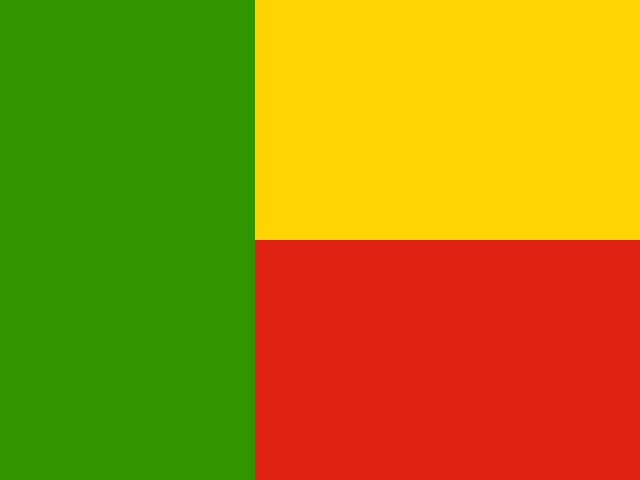
Location
Benin is in Western Africa, bordering the Bight of Benin, between Nigeria and Togo. It shares land borders with Nigeria (809 km), Togo (651 km), Burkina Faso (386 km) and Niger (277 km) and has 121 km of coastline. Its capitals are Porto-Novo (constitutional capital) and Cotonou (seat of government).
Benin population 2026: 15.17 Million — growth, rank & history →Key Statistics for 2026
Total population
Population Change
Median age of population
Population density
Life expectancy at birth
Agricultural land
Apple Import Volume
Dam capacity per capita
Female population of reproductive age
Health Care Spending per Capita
Learning-adjusted years of school
History
Benin, located in West Africa, has a rich and complex history that traces back to ancient times. The region was home to various indigenous groups and early civilizations, including the Fon and Yoruba peoples. Archaeological evidence suggests that the area was inhabited as early as 2000 BC, with the emergence of the ancient kingdom of Dahomey around the 17th century. This kingdom became a formidable power in West Africa, known for its military prowess and trade in slaves, palm oil, and other goods. The Dahomey Kingdom's social structure was sophisticated, with a monarchy that wielded significant authority, and it played a crucial role in the transatlantic slave trade, which profoundly impacted the region's demographics and economy.
During the medieval period, Benin experienced significant developments, particularly through trade and cultural exchanges. The Kingdom of Dahomey expanded its influence across the region, establishing strong trade links with European powers and neighboring states. The arrival of the Portuguese in the late 15th century marked the beginning of European involvement in the region, culminating in increased competition for control over trade routes and resources. The 18th century saw the kingdom at its height, with a well-organized military and an economy largely based on agriculture and trade, particularly in enslaved people, which led to substantial wealth and cultural prosperity.
The arrival of colonial powers in the 19th century marked a turning point in Benin's history. In the late 1800s, French colonial forces invaded and ultimately annexed Dahomey, establishing it as a French protectorate in 1892 and later as a colony in 1904. The colonial period brought profound changes, dismantling traditional power structures and imposing new administrative systems that often disregarded local customs. After World War II, the rise of nationalist movements led to increased demands for independence, culminating in Benin's independence from France on August 1, 1960.
In the years following independence, Benin experienced political instability characterized by a series of coups and changes in government. The establishment of a Marxist-Leninist regime under Mathieu Kérékou in 1972 marked a significant shift in the country's governance. However, by the late 1980s, economic difficulties and public discontent led to a transition towards democracy. The national conference of 1990 was pivotal in this process, resulting in a new constitution and the establishment of a multi-party system. Today, Benin is recognized for its strides towards democratic governance, though it still faces challenges related to political stability and economic development, reflecting its complex historical legacy.
Geography
Benin is located in West Africa, bordered by Togo to the west, Nigeria to the east, and Burkina Faso and Niger to the north. The country has a coastline along the Gulf of Guinea to the south, stretching approximately 121 kilometers. The strategic position of Benin, lying between the larger nations of Nigeria and Togo, contributes to its cultural diversity and economic interactions within the region. The country's geographical coordinates are approximately 9.3076° N latitude and 2.3158° E longitude, placing it within the tropical zone of West Africa.
The physical features of Benin are characterized by a mix of low-lying coastal plains and rolling savannahs. The terrain is predominantly flat, with some elevated areas in the north, where the Atakora Mountains rise, reaching elevations of up to 1,000 meters. The country is crisscrossed by several rivers, including the Ouémé and the Mono, which are vital for transportation, irrigation, and fishing. The diverse landscapes of Benin range from the fertile agricultural zones in the south to the semi-arid regions in the north, supporting various ecosystems and wildlife.
Benin experiences a tropical climate, marked by two distinct seasons: a wet season from April to October and a dry season from November to March. The average temperature typically ranges between 25°C and 30°C (77°F to 86°F), with humidity levels being highest during the rainy months. The southern coastal region receives significant rainfall, while the northern part of the country experiences a drier climate, influencing agricultural practices and water availability throughout the year.
Natural resources in Benin include agricultural products such as cotton, cashew nuts, and palm oil, which are vital to the country's economy. Additionally, the country has significant mineral deposits, including limestone and granite. However, environmental challenges such as deforestation, soil degradation, and the effects of climate change pose threats to its natural resources and biodiversity. Efforts to promote sustainable practices and preserve the environment are essential for the long-term viability of Benin's natural wealth.
Government
Benin operates as a presidential representative democratic republic, where the President of Benin serves as both the head of state and the head of government. The political system is characterized by a multi-party framework, allowing for a range of political parties to participate in the electoral process. The Constitution of Benin, adopted in 1990, laid the groundwork for democratic governance and has been amended several times to enhance political stability and representation.
The structure of the government is divided into three branches: the executive, legislative, and judicial. The executive branch is led by the President, who is elected for a five-year term and is eligible for re-election. Supporting the President is the Council of Ministers, which is appointed by the President and is responsible for the administration of government policies and programs. The legislative branch consists of a unicameral National Assembly, with members elected for four-year terms. The National Assembly plays a crucial role in law-making and oversight of the executive. The judiciary is independent, comprised of various courts including the Supreme Court, which is the highest court and oversees the interpretation of laws.
Key institutions in Benin's government include the Presidency, the National Assembly, and the Judicial Authority. The President of Benin, as of the latest elections, is Patrice Talon, who has been in office since April 2016. The National Assembly is made up of 83 deputies who represent the electorate, and its leadership plays a significant role in the legislative process. The judicial system, while independent, has faced challenges regarding its impartiality and effectiveness, particularly in high-profile cases involving political figures.
The electoral system in Benin allows for direct elections of the President and members of the National Assembly, with provisions for universal suffrage. Political parties must register to participate in elections, and a two-round system is applied for presidential elections if no candidate secures a majority in the first round. The political landscape in Benin is marked by a variety of parties, although recent years have seen increased tension and division among them, particularly regarding electoral reforms and the conduct of elections. The political environment is dynamic and continues to evolve as the country navigates challenges related to governance, democracy, and civil rights.
Economy
The economy of Benin is classified as a mixed economy, where agriculture plays a significant role alongside growing sectors such as trade and services. As of 2022, Benin's Gross Domestic Product (GDP) was estimated at approximately $14.7 billion, indicating a modest yet steady economic growth trajectory. The country has made strides in improving its economic environment, with a focus on enhancing infrastructure and attracting foreign investment. Despite its challenges, Benin has shown resilience and potential for increased economic development.
Major industries in Benin include agriculture, which employs a significant portion of the population and contributes to about 30% of the GDP. Key agricultural products include cotton, maize, yams, and cashew nuts, with cotton being the leading export. Additionally, the economy benefits from trade-related activities, particularly through the Port of Cotonou, which is a vital transit hub for goods entering and leaving the landlocked neighboring countries. The services sector, encompassing trade, telecommunications, and tourism, is also expanding, contributing to the overall economic landscape.
Benin's trade relationships are characterized by its connections with both regional and international partners. The country primarily exports agricultural goods, with cotton as the main export commodity, accounting for over 60% of total exports. Major trading partners include India, France, and Nigeria, with imports heavily relying on machinery, petroleum products, and foodstuffs. The country is a member of the West African Economic and Monetary Union (WAEMU), facilitating trade within the region and providing a framework for economic cooperation.
Despite its economic potential, Benin faces several challenges that could hinder its growth. Issues such as limited access to finance, inadequate infrastructure, and high unemployment rates persist. Additionally, the country is vulnerable to fluctuations in global commodity prices, particularly for cotton. However, there are opportunities for economic diversification, especially in sectors like renewable energy and technology. By addressing its challenges and leveraging its strategic location in West Africa, Benin can enhance its economic prospects and improve the standard of living for its citizens.
Culture
Benin is a culturally rich nation located in West Africa, characterized by its diverse languages, religions, and ethnic groups. The official language is French, a remnant of the colonial period; however, numerous indigenous languages are widely spoken, including Fon and Yoruba, which reflect the country's ethnic diversity. The population is composed primarily of the Fon, Yoruba, and Bariba peoples, among others. Religiously, Benin is home to a mix of beliefs, with traditional African religions playing a significant role alongside Christianity and Islam. The Vodun (or Voodoo) religion, which is deeply rooted in the country’s history, is recognized as an official religion and is celebrated annually during the Voodoo Festival.
The cultural traditions and customs of Benin are vibrant and varied, often showcased through colorful festivals and ceremonies. Traditional practices are integral to community life, with rituals and celebrations often centered around agriculture, harvests, and ancestor worship. The annual Ouidah Voodoo Festival, attracting thousands of visitors, exemplifies this cultural richness and highlights the importance of Vodun in the social fabric of Benin. Additionally, the country’s rich oral traditions are preserved through storytelling, proverbs, and oral poetry, which serve both entertainment and educational purposes.
Benin's artistic expressions are particularly notable in the realms of music, literature, and visual arts. The country boasts a rich musical heritage that includes various genres, such as traditional drumming, the popular Afrobeat, and contemporary music styles. Artists like Angélique Kidjo have gained international recognition, bringing Beninese music to global audiences. In literature, Benin has produced prominent writers such as the renowned novelist and playwright, Paulin Soumanou Vieyra, who have contributed significantly to African literature. The visual arts, including traditional pottery, weaving, and wood carving, reflect the intricate craftsmanship and aesthetic values of the Beninese people.
The cuisine of Benin is a delicious reflection of its cultural diversity, with staple foods including maize, yams, and cassava, often accompanied by spicy sauces and stews. Popular dishes such as akara (bean cakes) and pâte (a dough-like dish made from corn or cassava) are frequently enjoyed by locals. Daily life in Benin often revolves around family and community, with social gatherings playing a crucial role in maintaining relationships and cultural ties. Traditional markets are central to daily life, serving as hubs for commerce, socialization, and the exchange of cultural practices, further enriching the country's vibrant tapestry of life.
About This Data
This page displays comprehensive statistical data for Benin for the year 2026. All data points are sourced from authoritative international organizations and are regularly updated to ensure accuracy and reliability.
Click on any statistic to explore more detailed information, see how Benin compares with other countries, and view historical trends.
Primary Data Sources
CIA World Factbook
Comprehensive country profiles and demographic statistics from the Central Intelligence Agency
Learn moreUnited Nations Statistics
Global demographic data and population projections from UN agencies and research divisions
Learn moreWorld Bank Open Data
Development indicators and comprehensive population metrics from the World Bank database
Learn moreCompare Benin with other countries
Side-by-side comparisons across population, GDP, geography, and more.
Frequently Asked Questions About Benin
Which continent is Benin in?▾
Benin is in Africa, in the Western Africa subregion according to the UN geoscheme.
What is the population of Benin in 2026?▾
The population of Benin in 2026 is 15,166,195 persons.
What is the GDP of Benin?▾
The Gross Domestic Product (GDP) of Benin is 23,822,129,490.67 USD.
What is the total fertility rate in Benin?▾
The total fertility rate in Benin is 4.34 children per woman.
What is the life expectancy in Benin?▾
The life expectancy at birth in Benin is 63.24 years.
What is the under-five mortality rate in Benin?▾
The under-five mortality rate in Benin is 74.27 per 1,000 live births.
What percentage of Benin's population lives in urban areas?▾
74.46% of Benin's population lives in urban areas.