
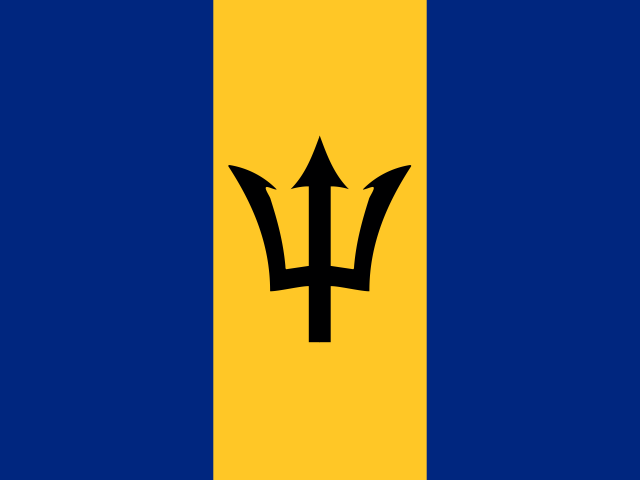
Location
Barbados is in the Caribbean, island in the North Atlantic Ocean, northeast of Venezuela. It has no land borders and has 97 km of coastline. The capital is Bridgetown.
Barbados population 2026: 282,780 — growth, rank & history →Key Statistics for 2026
History
Barbados has a rich and complex history that dates back to its earliest known inhabitants, the Arawak and Carib peoples, who arrived around 2500 BC. These indigenous groups thrived on the island's fertile soil, cultivating crops such as cassava and sweet potatoes. However, by the time of European contact, the indigenous population had diminished significantly, likely due to diseases and conflicts. The island was first sighted by the Portuguese in the early 16th century, though it remained largely uninhabited until the English established a settlement in 1627, marking the beginning of a colonial era that would shape the island's future.
The medieval period in Barbados, particularly from the 17th to the 18th century, saw the establishment of a plantation economy based on sugar cane, which became the backbone of the island’s economy. The influx of African slaves to work on these plantations significantly altered the demographic landscape, as enslaved Africans were brought in large numbers to meet the labor demands of sugar production. By the late 18th century, Barbados was one of the richest colonies in the British Empire, but this wealth was built on the exploitation and suffering of enslaved people, leading to rising tensions and calls for emancipation.
Modern history in Barbados is marked by significant events such as the abolition of slavery in 1834, which brought profound social and economic changes. The island experienced a series of political transformations throughout the 20th century, culminating in independence from the United Kingdom on November 30, 1966. This transition to self-governance allowed Barbados to forge its own identity and develop a robust tourism industry, which has since become a cornerstone of its economy. The island also became a member of several international organizations, including the United Nations and the Caribbean Community (CARICOM), further solidifying its role on the global stage.
In recent years, Barbados has gained historical significance for its efforts toward sustainable development and climate change resilience. The island has positioned itself as a leader in environmental initiatives, particularly in renewable energy. Additionally, in 2021, Barbados transitioned to a republic, removing the British monarch as head of state and electing its first president, which symbolized a new era of national sovereignty and identity. This move reflects the island's ongoing commitment to self-determination and its evolving historical narrative as it navigates the complexities of modern geopolitics and climate challenges.
Geography
Barbados is an island nation located in the eastern Caribbean Sea, lying approximately 100 miles (160 kilometers) east of Saint Vincent and the Grenadines. It is the most easterly of the Lesser Antilles and is bordered by the Atlantic Ocean to the east and the Caribbean Sea to the west. The island has a total area of about 430 square kilometers (166 square miles) and is situated between latitudes 13° and 14° N, and longitudes 59° and 60° W. Its geographical position places it outside the main hurricane belt, although it can occasionally be affected by tropical storms.
The physical landscape of Barbados is characterized by a central limestone plateau, which rises to a height of 336 meters (1,102 feet) at Mount Hillaby, the highest point on the island. The terrain is predominantly flat with rolling hills and a rugged coastline featuring cliffs and sandy beaches. The island is intersected by several small rivers and streams, with the most significant being the Scotland River and the Careenage. These waterways, while not extensive, contribute to the island's drainage and play a role in its ecosystem.
Barbados experiences a tropical climate, with a marked wet and dry season. The dry season typically lasts from December to May, characterized by lower humidity and pleasant temperatures, ranging from 24°C to 30°C (75°F to 86°F). The wet season, from June to November, brings higher humidity and more frequent rainfall, with the peak of the hurricane season occurring between August and October. Average annual rainfall is about 1,200 millimeters (47 inches), which supports the island's lush vegetation and agricultural activities.
The natural resources of Barbados are relatively limited, as the island lacks significant mineral deposits. However, it is rich in fertile soil, which supports agriculture, primarily in sugar cane production, which has historically been a cornerstone of its economy. Additionally, the island's coastal waters are abundant in marine life, making fishing a vital aspect of local livelihoods. Environmental characteristics include a diverse array of ecosystems, including coral reefs, mangroves, and tropical forests, which are crucial for biodiversity and offer protection against coastal erosion.
Government
Barbados operates as a parliamentary democracy within the framework of a constitutional monarchy. The head of state is the monarch of the United Kingdom, currently King Charles III, who is represented on the island by a Governor-General. The political system is characterized by a strong tradition of democratic governance, featuring multiple political parties and regular electoral cycles. Following its independence from the United Kingdom in 1966, Barbados has developed a stable political environment that promotes civil liberties and political pluralism.
The structure of government in Barbados consists of three branches: the executive, legislative, and judicial. The executive branch is led by the Prime Minister, who is the head of government and is appointed by the Governor-General. The Prime Minister selects members of the Cabinet, who are responsible for various government ministries. The legislative branch is bicameral, consisting of the House of Assembly and the Senate. The House of Assembly has 30 elected members, while the Senate includes 21 appointed members, providing a balance of elected and appointed representation. The judicial branch operates independently from the other branches, with the Supreme Court serving as the highest court of appeal in the country.
Key institutions in Barbados include the Parliament, which is responsible for enacting laws, and the Judiciary, which interprets and applies those laws. The Governor-General holds a ceremonial role, with most executive powers exercised by the Prime Minister and the Cabinet. Political leadership is largely dominated by two major parties: the Democratic Labour Party (DLP) and the Barbados Labour Party (BLP). These parties have alternated in power, reflecting the dynamic political landscape of the nation.
The electoral system in Barbados is based on a first-past-the-post voting mechanism, where candidates compete in single-member constituencies. General elections are held every five years, with the most recent election taking place in January 2022. Voter participation is relatively high, indicating strong public engagement in the democratic process. The political landscape is marked by active civil society participation, with numerous advocacy groups and non-governmental organizations influencing policy and governance in Barbados.
Economy
Barbados operates as a parliamentary democracy with a mixed economic system that combines both private and public sector enterprises. The country's Gross Domestic Product (GDP) was estimated at approximately $5 billion USD in 2022, with a per capita GDP of around $17,000 USD, indicating a relatively high standard of living compared to other Caribbean nations. The economy is characterized by a reliance on tourism and international business, with the services sector contributing over 80% of GDP, while agriculture and manufacturing play smaller roles in the overall economic landscape.
The major industries in Barbados are primarily driven by tourism, which accounts for a significant portion of foreign exchange earnings and employment. The island attracts millions of visitors annually, drawn by its beautiful beaches and vibrant culture. Other key sectors include financial services, information technology, and agriculture, particularly the production of sugarcane, rum, and other food products. The government has also invested in renewable energy initiatives, aiming to diversify the economy and reduce dependence on fossil fuels.
Barbados maintains strong trade relationships within the Caribbean Community (CARICOM) and with countries such as the United States, Canada, and the United Kingdom. The nation exports goods worth around $800 million USD annually, with key exports including sugar, rum, and various manufactured goods. Conversely, imports, which total approximately $1.5 billion USD, include machinery, chemicals, and food products. This trade imbalance highlights the country's reliance on imports for essential goods, underscoring the importance of enhancing local production capabilities.
Despite its stable economic environment, Barbados faces several challenges, including vulnerability to external economic shocks, natural disasters, and a high public debt-to-GDP ratio, which stands at over 100%. However, opportunities exist for economic growth through diversification, particularly in the renewable energy sector and digital economy. The government is focused on attracting foreign investment, enhancing the tourism experience, and promoting sustainable practices to ensure long-term economic resilience and stability.
Culture
Barbados is a vibrant island nation in the Caribbean, known for its rich tapestry of cultures stemming from a diverse population. The official language is English, reflecting the island's colonial history, while Bajan, a local dialect, is widely spoken among residents. The population is predominantly of African descent, with a mix of European, East Indian, and indigenous Arawak influences, contributing to a unique cultural identity. The religious landscape is predominantly Christian, with Anglican, Roman Catholic, and Methodist communities, alongside a smaller presence of Rastafarians and other faiths, showcasing the island's spiritual diversity.
The cultural traditions of Barbados are deeply rooted in its history and are celebrated through various festivals and events. One of the most notable is Crop Over, a traditional harvest festival that dates back to the 1780s. This lively celebration includes music, dance, and colorful parades, emphasizing the island's connection to its agricultural heritage. Additionally, the island's customs are reflected in its rituals and family gatherings, where storytelling and folklore play an important role in preserving Bajan history and values.
The arts scene in Barbados is vibrant, with a strong emphasis on music and literature. The island is famous for its contributions to calypso and reggae music, with renowned artists like Rihanna and The Mighty Gabby gaining international fame. The annual Barbados Music Festival showcases local talent and attracts visitors from around the world. In literature, Bajan authors such as George Lamming and Kamau Brathwaite have made significant contributions to Caribbean literature, often exploring themes of identity and colonialism through their works.
Barbadian cuisine reflects the island's multicultural influences, characterized by its use of fresh local ingredients and bold flavors. Traditional dishes such as cou-cou and flying fish are staples, often enjoyed during family meals and community gatherings. Daily life in Barbados is marked by a strong sense of community, with social interactions often centered around festivals, markets, and beach activities. The islanders, known for their warmth and hospitality, embody the island's slogan, "Pride and Industry," reflecting a commitment to heritage and progress.
About This Data
This page displays comprehensive statistical data for Barbados for the year 2026. All data points are sourced from authoritative international organizations and are regularly updated to ensure accuracy and reliability.
Click on any statistic to explore more detailed information, see how Barbados compares with other countries, and view historical trends.
Primary Data Sources
CIA World Factbook
Comprehensive country profiles and demographic statistics from the Central Intelligence Agency
Learn moreUnited Nations Statistics
Global demographic data and population projections from UN agencies and research divisions
Learn moreWorld Bank Open Data
Development indicators and comprehensive population metrics from the World Bank database
Learn moreCompare Barbados with other countries
Side-by-side comparisons across population, GDP, geography, and more.
Frequently Asked Questions About Barbados
Which continent is Barbados in?▾
Barbados is in North America, in the Caribbean subregion according to the UN geoscheme.
What is the population of Barbados in 2026?▾
The population of Barbados in 2026 is approximately 282,780 people.
What is the area of Barbados?▾
Barbados covers an area of 430 square kilometers.
What is the GDP of Barbados?▾
The Gross Domestic Product (GDP) of Barbados is 8,775,240,000 US dollars.
What is the population density of Barbados?▾
The population density of Barbados is approximately 657.46 people per square kilometer.
What is the official language of Barbados?▾
The official language of Barbados is English.
What is the capital of Barbados?▾
The capital of Barbados is Bridgetown.